Miss Helen Stephens, after winning the 100-meter race for women yesterday, was received by Chancellor Hitler and congratulated on her success. Then she went back to the women discus throwers to her turn for the United States.
Miss Stephens had been in the discus competition before the start of the 100 meters. She just dropped out for a few minutes to win the gold medal in time just 1/10 of a second behind her world record established the day before.
Sunday, August 6, 2006

Military Guard adds to Olympic pageantry
There are three companies of the military guards marching around the Berlin streets daily during the Olympics. Normally, only Field Marshal Werner von Blomberg, as War Minister, rates a guard company for his military. It stages a parade with bands daily when the guards change.
But the procession down Unter den Linden has proved such an attraction to the crowd that two more guard changes now are put on for the satisfaction of the Olympic visitors.
The second of the three companies is a guard for the headquarters of the Berlin command which is at the foor of the Unter den Linden opposite the old imperial palace. The third id Colonel-General Hermann Göring's own gray-coated company for the Air Ministry, called the Luftwaffe here.
To see not only little boys but their daddies, rotund, solid burghers, all marching alongside the soldiers is to gain a little understanding of the Third Reich.
But the procession down Unter den Linden has proved such an attraction to the crowd that two more guard changes now are put on for the satisfaction of the Olympic visitors.
The second of the three companies is a guard for the headquarters of the Berlin command which is at the foor of the Unter den Linden opposite the old imperial palace. The third id Colonel-General Hermann Göring's own gray-coated company for the Air Ministry, called the Luftwaffe here.
To see not only little boys but their daddies, rotund, solid burghers, all marching alongside the soldiers is to gain a little understanding of the Third Reich.
Berlin Weather changes for the gloomy
Luck in the matter of the weather, which has been all on the side of the Nazis since they obtained power in Germany, seems to have failed them in these Olympics. Until now it has almost assured that for any big German fete day the weather would be ideal.
Only once in the last three years did the weather fail them. That was the memorable May Day last year when the snow flurries and a biting wind spoiled for more than a million persons at Tempelhof the effect of Hitler's speech. The labor demonstration by the masses on May Day was not so much emphasized this year.
But that was an exception. All the other big Nazi shows have had blue skies in the their favor until these Olympics, upon the success of which the régime sets so much store. Ever since they begain it has rained in Berlin daily after the fashion of April transposed to August.
Yet, even after that, the weather gods seem to have tried to be as kind as possible. Today, while it was raining heavily in the city so that hundreds were discouraged from going to the games, hardly a drop fell on the stadium before the games closed. in fact, wet weather has not greatly hampered the tests themselves.
Since the games began it has begun to rain with clocklike regularity a few minutes after 6 PM when the last major event was just over. It also rains regularly during the noon recess from 12 to 3.
The attendance keeps up just the same. On the first day of the games, 86 special trains arrived in Berlin with 52,000 passengers and 95,000 more passengers came on regular trains. The second day53 special trains brought 27,000 passengers and the regular trains, 91,000. Figures for later days are unavailable at this time, but it is quite certain the influx is keeping up, if it is not necessarily increasing.
Only once in the last three years did the weather fail them. That was the memorable May Day last year when the snow flurries and a biting wind spoiled for more than a million persons at Tempelhof the effect of Hitler's speech. The labor demonstration by the masses on May Day was not so much emphasized this year.
But that was an exception. All the other big Nazi shows have had blue skies in the their favor until these Olympics, upon the success of which the régime sets so much store. Ever since they begain it has rained in Berlin daily after the fashion of April transposed to August.
Yet, even after that, the weather gods seem to have tried to be as kind as possible. Today, while it was raining heavily in the city so that hundreds were discouraged from going to the games, hardly a drop fell on the stadium before the games closed. in fact, wet weather has not greatly hampered the tests themselves.
Since the games began it has begun to rain with clocklike regularity a few minutes after 6 PM when the last major event was just over. It also rains regularly during the noon recess from 12 to 3.
The attendance keeps up just the same. On the first day of the games, 86 special trains arrived in Berlin with 52,000 passengers and 95,000 more passengers came on regular trains. The second day53 special trains brought 27,000 passengers and the regular trains, 91,000. Figures for later days are unavailable at this time, but it is quite certain the influx is keeping up, if it is not necessarily increasing.
Saturday, August 5, 2006
Television
Television halls accommodating 3,000 have been opened throughout Berlin where one may view the Olympic Games. Unfortunately, the results are very close to zero.
You cannot see Olympics by television yet. All that you can are some men dressed like athletes but only faintly distinguishable, like humans floating in a milk bath. Only the polo games show up fairly clearly when black or chestnut ponies are used. All white objects are divined, rather than seen, as vague blurs in a milky mess.
There are three television "guns" on the Olympic Field and two television vans covering events outside the stadium. Witleben station sends the pictures by the two transmitters to eighteen separate halls and rooms. The largest holds 300 spectators, but television is not yet sufficiently developed to handle successfully such a difficult project as covering the Olympics.
Athletes who stay in the Olympic Village because the y have competitions scheduled for the following day get a chance - for what it's worth - to see the games via television, for a special theatre has been set up for them in Hindenburg Assembly Hall.
Radio is till the most reliable transmitter of Olympic results. Twenty transmitting vans are put at the disposal of the foreign media along with 300 microphones. Radio broadcasts at the Olympics are given in 28 different languages.
You cannot see Olympics by television yet. All that you can are some men dressed like athletes but only faintly distinguishable, like humans floating in a milk bath. Only the polo games show up fairly clearly when black or chestnut ponies are used. All white objects are divined, rather than seen, as vague blurs in a milky mess.
There are three television "guns" on the Olympic Field and two television vans covering events outside the stadium. Witleben station sends the pictures by the two transmitters to eighteen separate halls and rooms. The largest holds 300 spectators, but television is not yet sufficiently developed to handle successfully such a difficult project as covering the Olympics.
Athletes who stay in the Olympic Village because the y have competitions scheduled for the following day get a chance - for what it's worth - to see the games via television, for a special theatre has been set up for them in Hindenburg Assembly Hall.
Radio is till the most reliable transmitter of Olympic results. Twenty transmitting vans are put at the disposal of the foreign media along with 300 microphones. Radio broadcasts at the Olympics are given in 28 different languages.
Control & language at the Games
The Olympic Organization Committee has announced that the results of the games cannot continue to be broadcast in three languages because it would take so much time that the broadcasters would be going all the time and spoil the show.
On the whole this is rather lucky. It was tried yesterday in the stadium, but the Americans found they understood German better than the variety of English used by the announcer.
The real control of the games is in the hands of the so-called International Olympic Committee. This body is composed of five noblemen and only two commoners. European aristocracy always has had a stranglehold on the Olympics as they were founded by Baron Pierre de Coubertin. The five all-powerful aristocrats here today are Count Henri de Baillet-Latour of Belgium, Baron Godefrey de Bloney of Switzerland, the Marquis de Polignac of France, Lord Aberdare of England and Count Bonaccosa of Italy.
The list of seventy-one members of the International Committee as a whole is rich with the names of titled sportsmen form all nations are preceded by Excellence or General.
On the whole this is rather lucky. It was tried yesterday in the stadium, but the Americans found they understood German better than the variety of English used by the announcer.
The real control of the games is in the hands of the so-called International Olympic Committee. This body is composed of five noblemen and only two commoners. European aristocracy always has had a stranglehold on the Olympics as they were founded by Baron Pierre de Coubertin. The five all-powerful aristocrats here today are Count Henri de Baillet-Latour of Belgium, Baron Godefrey de Bloney of Switzerland, the Marquis de Polignac of France, Lord Aberdare of England and Count Bonaccosa of Italy.
The list of seventy-one members of the International Committee as a whole is rich with the names of titled sportsmen form all nations are preceded by Excellence or General.
Owens wins Broad Jump
The Broad Jump had been one of the events of Owens' three in this eleventh Olympics that he had been most certain of winning. Lutz Long, so unheralded in German sporting circles for he is neither a soldier nor a policeman, tied Owens at 7.87 meters with his two leaps remaining. He forced Owens to catapult out near his own new world record of 26' 8 ½" in order to emerge victorious at all yesterday.
 So delighted was Chancellor Hitler by the gallant fight that Long had made that he congratulated him privately just before he himself left the stadium. In fact, his eagerness to receive the youthful German was so great that the Führer condescended to wait until his emissaries had pried Long loose from Owens, with whom he was affectionately walking along the track arm and arm in what could be called friendship. All Owens received was his gold medal which probably satisfied him just fine.
The broad jump was one of the most dramatic events of the entire day, surprising as that may sound. It started with the unusual flourish and ended the same way. In the morning the leapers had to beat 23' 5" to qualify.
Owens strolled over to the runway and, still in his pullovers, raced to the pit and tan right through, a customary warm-up gesture. But the red flag was raised greatly to the Buckeye Bullet's astonishment. That counted as one of three jumps. On his second try, which he made in earnest, Jesse hit the take-off board cleanly and sailed through the air. Again the red flag was waved for some mysterious reason.
The situation was getting to be alarming by this time. Owens had only one more jump left to stay in the competition. So, on his last attempt, he sprinted carefully, left the ground with a half foot clearance at the take-off and went past 25' safely.
In the afternoon, Owens had close call of that nature. The pressure came from Long. The German, carried along on the wings of superhuman endeavor - the hallmark of every Reich athlete in this meet - was bounding along right at Owens' heels. He was only an inch behind the American's 7.87 meters as they went for their last three jumps.
On his second in the final, Long hit the nail exactly on the head, doing the same distance as the Ohioan and tying him for the championship as the crowd went into frenzied ecstasy of applause. But the jubilation was short-lived.
Owens came thundering down the runway and drove into space a moment later. He had taken the play away at 7.94 meters and then drove beyond Long's reach with his final jump that cemented the distinction of his becoming the first 26-footer in Olympic history. Incidentally, the German in second place also surpassed the Olympic record.
 So delighted was Chancellor Hitler by the gallant fight that Long had made that he congratulated him privately just before he himself left the stadium. In fact, his eagerness to receive the youthful German was so great that the Führer condescended to wait until his emissaries had pried Long loose from Owens, with whom he was affectionately walking along the track arm and arm in what could be called friendship. All Owens received was his gold medal which probably satisfied him just fine.
The broad jump was one of the most dramatic events of the entire day, surprising as that may sound. It started with the unusual flourish and ended the same way. In the morning the leapers had to beat 23' 5" to qualify.
Owens strolled over to the runway and, still in his pullovers, raced to the pit and tan right through, a customary warm-up gesture. But the red flag was raised greatly to the Buckeye Bullet's astonishment. That counted as one of three jumps. On his second try, which he made in earnest, Jesse hit the take-off board cleanly and sailed through the air. Again the red flag was waved for some mysterious reason.
The situation was getting to be alarming by this time. Owens had only one more jump left to stay in the competition. So, on his last attempt, he sprinted carefully, left the ground with a half foot clearance at the take-off and went past 25' safely.
In the afternoon, Owens had close call of that nature. The pressure came from Long. The German, carried along on the wings of superhuman endeavor - the hallmark of every Reich athlete in this meet - was bounding along right at Owens' heels. He was only an inch behind the American's 7.87 meters as they went for their last three jumps.
On his second in the final,
 Long hit the nail exactly on the head, doing the same distance as the Ohioan and tying him for the championship as the crowd went into frenzied ecstasy of applause. But the jubilation was short-lived.
Owens came thundering down the runway and drove into space a moment later. He had taken the play away at 7.94 meters and then drove beyond Long's reach with his final jump that cemented the distinction of his becoming the first 26-footer in Olympic history. Incidentally, the German in second place also surpassed the Olympic record.
Friday, August 4, 2006
Big Medal Haul for US
The United States stole away what to date had been a distinctly German show by winning four out of five medal events today. On the third day, a crowd of 90,000 gathered for the morning preliminaries, and once again another capacity throng of 110,ooo later packed the Reich Sports Field Stadium. They came to cheer for mare German victories, but remained instead to turn their hosannas in the direction of the Americans.
The invincible Jesse Owens of Ohio won the broad jump at the Olympic record distance of 8.06 meters (26' 5 21/64"). Miss Stephens walked off with the Women's 100-meter dash final in world record time. Glenn Hardin slammed to the victory in the 400-meter hurdles, and John woodruff, a freshman from the University of Pittsburgh, gave America its first 800-meter triumph in twenty-four years.
Topping the achievement of the Star-Spangled Brigade, Owens twice broke the world 200-meter mark around the turn, as well as the Olympic standard, hitting the identical figures of 21.1 seconds in both trials.
The only championship to evade the Americans' grasp was the women's discus crown. And that went to Germany as Miss Gisela Mauermayer broke the Olympic record with a toss of 47.63 meters amid the exuberant shouts of her compatriots.
But Germany's share in the harvest was a relatively minor one. The United States closed so far ahead in the race for men's track and field championship that every one else is lapped at least a full circuit beyond.
The invincible Jesse Owens of Ohio won the broad jump at the Olympic record distance of 8.06 meters (26' 5 21/64"). Miss Stephens walked off with the Women's 100-meter dash final in world record time. Glenn Hardin slammed to the victory in the 400-meter hurdles, and John woodruff, a freshman from the University of Pittsburgh, gave America its first 800-meter triumph in twenty-four years.
Topping the achievement of the Star-Spangled Brigade, Owens twice broke the world 200-meter mark around the turn, as well as the Olympic standard, hitting the identical figures of 21.1 seconds in both trials.
The only championship to evade the Americans' grasp was the women's discus crown. And that went to Germany as Miss Gisela Mauermayer broke the Olympic record with a toss of 47.63 meters amid the exuberant shouts of her compatriots.
But Germany's share in the harvest was a relatively minor one. The United States closed so far ahead in the race for men's track and field championship that every one else is lapped at least a full circuit beyond.
Americans go 1-2 in 100-Meter dash
Jesse Owens won the 100-meter dash in what seemed a date with destiny. The Buckeye Bullet beat his nearest competitor, Ralph Metcalfe of Marquette University, by a single yard. The winning time of 10.3 seconds matched his time in the first round of heats.
The Americans finished 1-2 in front of 110,000 in the Reich Sports Field Stadium. The ovation they received was loud but only a whisper compared to the cheer that Karl Hein of Germany received.
Hardly a minute after Hitler had seated himself in his box, Erwin Blask of Germany unleashed a tremendous toss of 180' 6 ½", breaking Matt McGrath's Olympic Record. Hein, however, overhauled Blask with the best any Continental hammer-thrower ever has made: 185' 4 1/16" to give Germany its own 1-2 finish. The tumultuous applause was the loudest of the day.
The record breaking did not finsh with these two finals. Miss Helen Stephens of St. Louis Missouri, striding through the first heat of the women's 100-meter sprint turned in a dazzling 11.4 second run.
This was 4/10 of a second faster than Miss Stella Walsh's listed world record and 2/10 under the Missouri girl's own American record, which has yet to be accepted internationally.
To make it more emphatic, Miss Stephens slammed into the tape of the semi-final in 11.5 seconds. Miss Kaethe Krauss of Germany, in second place was carried along sufficiently by Miss Stephens' blinding speed to equal Miss Walsh's Olympic figure of 11.9 seconds.
It was a great day for sport as the United States took command of the men's track and field race for the first time with a total of 46 points to 31 ¼ for Germany and Finland's 30 ¼ points. But if one elects to score the women's tests with the men's than Germany, moving along the wings of a sport renaissance deeply rooted in nationalistic fervor, is at the head of the parade with 47 ¼ points.
German nationalism and the prejudice that seems to go with it revealed themselves somewhat disagreeably this afternoon. On the surface all was serene. The Führer apparently played no favorite. He did not publicly receive the winning Germans nor did he decide to greet decidedly non-Aryan Americans, Owens and Metcalfe.
But an investigation by some who had taken his departure yesterday to mean he did not want to shake hands with non-Aryan high jumpers, Cornelius Johnson and David Albritton. This investigation produced information which seemed collaborative. In the seclusion of his quarters under the stands the Reich's dictator did congratulate Hein and Blask, the hammer-throwers. Perhaps two and two makes four after all. If Hitler is going to avoid the African-Americans, he is going to have his work cut out for him.

From a general sporting standpoint, however, there could be no taking the play away from Owens. He left the stadium last night in the belief that he had broken the world record with his 10.2 time. But the usually efficient Germans have an annoying roundabout way of getting the news to the newspaper men and the athletes.
It was discovered this morning that Owen's new mark had been disallowed because of a following wind. Whether he or Miss Stephens will have the same experience tomorrow cannot be guessed. From the stands the breeze looked like a crosswind, but one can never tell about those things.
Owens won today because in truth he is the world's fastest human. No one ever ran a more perfect race. His start was perfect, his in-between running was perfect and his finish perfect.
The Buckeye Bullet ripped out of his starting holes as though slungby a giant catapult. He was ahead in his first stride and let the Osendarp and Wykoff battle behind him for what left of the race.
Metcalfe, hardly the best starter in the world, was off in atrocious fashion. He was sixth in the six man field in the getaway, but once in his stride he certainly moved. By sixty meters he had drawn up even with Hollander and begun to cut down the two yard advantage Owens had on him.
It was then a speed duel between the streamlined express and the old-fashioned steam engine that exuded sheer, rugged power. Metcalfe cut those two yards to one at the wire, but it was as close as he could get, losing by a yard a championship that had eluded him four years before by a hair.
The Americans finished 1-2 in front of 110,000 in the Reich Sports Field Stadium. The ovation they received was loud but only a whisper compared to the cheer that Karl Hein of Germany received.
Hardly a minute after Hitler had seated himself in his box, Erwin Blask of Germany unleashed a tremendous toss of 180' 6 ½", breaking Matt McGrath's Olympic Record. Hein, however, overhauled Blask with the best any Continental hammer-thrower ever has made: 185' 4 1/16" to give Germany its own 1-2 finish. The tumultuous applause was the loudest of the day.
The record breaking did not finsh with these two finals. Miss Helen Stephens of St. Louis Missouri, striding through the first heat of the women's 100-meter sprint turned in a dazzling 11.4 second run.
This was 4/10 of a second faster than Miss Stella Walsh's listed world record and 2/10 under the Missouri girl's own American record, which has yet to be accepted internationally.
To make it more emphatic, Miss Stephens slammed into the tape of the semi-final in 11.5 seconds. Miss Kaethe Krauss of Germany, in second place was carried along sufficiently by Miss Stephens' blinding speed to equal Miss Walsh's Olympic figure of 11.9 seconds.
It was a great day for sport as the United States took command of the men's track and field race for the first time with a total of 46 points to 31 ¼ for Germany and Finland's 30 ¼ points. But if one elects to score the women's tests with the men's than Germany, moving along the wings of a sport renaissance deeply rooted in nationalistic fervor, is at the head of the parade with 47 ¼ points.
German nationalism and the prejudice that seems to go with it revealed themselves somewhat disagreeably this afternoon. On the surface all was serene. The Führer apparently played no favorite. He did not publicly receive the winning Germans nor did he decide to greet decidedly non-Aryan Americans, Owens and Metcalfe.
But an investigation by some who had taken his departure yesterday to mean he did not want to shake hands with non-Aryan high jumpers, Cornelius Johnson and David Albritton. This investigation produced information which seemed collaborative. In the seclusion of his quarters under the stands the Reich's dictator did congratulate Hein and Blask, the hammer-throwers. Perhaps two and two makes four after all. If Hitler is going to avoid the African-Americans, he is going to have his work cut out for him.

From a general sporting standpoint, however, there could be no taking the play away from Owens. He left the stadium last night in the belief that he had broken the world record with his 10.2 time. But the usually efficient Germans have an annoying roundabout way of getting the news to the newspaper men and the athletes.
It was discovered this morning that Owen's new mark had been disallowed because of a following wind. Whether he or Miss Stephens will have the same experience tomorrow cannot be guessed. From the stands the breeze looked like a crosswind, but one can never tell about those things.
Owens won today because in truth he is the world's fastest human. No one ever ran a more perfect race. His start was perfect, his in-between running was perfect and his finish perfect.
The Buckeye Bullet ripped out of his starting holes as though slungby a giant catapult. He was ahead in his first stride and let the Osendarp and Wykoff battle behind him for what left of the race.
Metcalfe, hardly the best starter in the world, was off in atrocious fashion. He was sixth in the six man field in the getaway, but once in his stride he certainly moved. By sixty meters he had drawn up even with Hollander and begun to cut down the two yard advantage Owens had on him.
It was then a speed duel between the streamlined express and the old-fashioned steam engine that exuded sheer, rugged power. Metcalfe cut those two yards to one at the wire, but it was as close as he could get, losing by a yard a championship that had eluded him four years before by a hair.
Thursday, August 3, 2006
Jesse Owens breaks records
Jesse Owens of Ohio is one very good runner. Here in Berlin, he is just beginning to show how good he is to the rest of the world.
During the well-attended first round heats for the 100 meter dash, he managed to break the Olympic record with a of 10.3 seconds. Then, in the afternoon he broke his own record with a 10.2 second showing. Victory for him tomorrow in the final seems to be merely his for the asking.
In the first round, the only runner who threatened was Osendarp of the Netherlands at 10.5 seconds. Then in the quarter-finals Strandberg of Sweden outsprinted the Netherlander with Wykoff placing third.
Some of the stars who were expected to do well have been eliminated. Yoshopka of Japan, Grimbeck and Theunissen of South Africa Berger of the Netherlands and Fondevilla of Argentina have all been close to the world record mark this year but did not make the final cut.
During the well-attended first round heats for the 100 meter dash, he managed to break the Olympic record with a of 10.3 seconds. Then, in the afternoon he broke his own record with a 10.2 second showing. Victory for him tomorrow in the final seems to be merely his for the asking.
In the first round, the only runner who threatened was Osendarp of the Netherlands at 10.5 seconds. Then in the quarter-finals Strandberg of Sweden outsprinted the Netherlander with Wykoff placing third.
Some of the stars who were expected to do well have been eliminated. Yoshopka of Japan, Grimbeck and Theunissen of South Africa Berger of the Netherlands and Fondevilla of Argentina have all been close to the world record mark this year but did not make the final cut.
Hitler receives Olympians; snubs Americans
Miss Hilde (Tilly) Fleischer won the women's javelin throw and also broke the Olympic record. For once Germany's cup of joy was filled to overflowing.
The crowd was off to a good start in its applause of the Reich athletes when Miss Fleischer winged out the javelin on her first throw. And when she climbed to the victory pedestal she stood with arms outstretched in the Nazi salute to Hitler, tears in her eyes and a lump in her throat. To her went the distinction of being the first Olympic champion of 1936.
Chancellor Hitler himself witnessed the victories. With a group of State officials and National Socialist party leaders, including Julius Streicher, he spent the afternoon watching the games. He greeted the victors with a warm handclasp and a friendly pat on the back, while the welkin rang with the frenzied cheers of the spectators.
Americans also had great results for the day. Just as the setting sun dipped behind the concrete ramparts of the huge stadium America came in for her share of the glory. Cornelius Johnson, the kangaroo-legged Negro from California, won the high jump and in keeping with the general trend of things shattered the Olympic record too. This event was a slam for the United States, because Ave Albritton, Ohio State Negro, and Delos Thurber of Southern California took the other two medals.
But for politically minded persons in the crowd there was one rather disquieting incident connected with the march of these three Americans to the victory pedestal. The Führer had greeted all three medalists in other events -- the Germans and the Finns -- with a handclasp and words of congratulation. But five minutes before the United States jumpers moved in for the ceremony of the Olympic triumph Hitler left his box.
Johnson and Albritton are Negroes. None of the others were. Press box interpreters of this step chose to put two and two together. But there will be enough future Negro winners to warrant delaying passing judgment for the present.
- NYT
The crowd was off to a good start in its applause of the Reich athletes when Miss Fleischer winged out the javelin on her first throw. And when she climbed to the victory pedestal she stood with arms outstretched in the Nazi salute to Hitler, tears in her eyes and a lump in her throat. To her went the distinction of being the first Olympic champion of 1936.
Chancellor Hitler himself witnessed the victories. With a group of State officials and National Socialist party leaders, including Julius Streicher, he spent the afternoon watching the games. He greeted the victors with a warm handclasp and a friendly pat on the back, while the welkin rang with the frenzied cheers of the spectators.
Americans also had great results for the day. Just as the setting sun dipped behind the concrete ramparts of the huge stadium America came in for her share of the glory. Cornelius Johnson, the kangaroo-legged Negro from California, won the high jump and in keeping with the general trend of things shattered the Olympic record too. This event was a slam for the United States, because Ave Albritton, Ohio State Negro, and Delos Thurber of Southern California took the other two medals.
But for politically minded persons in the crowd there was one rather disquieting incident connected with the march of these three Americans to the victory pedestal. The Führer had greeted all three medalists in other events -- the Germans and the Finns -- with a handclasp and words of congratulation. But five minutes before the United States jumpers moved in for the ceremony of the Olympic triumph Hitler left his box.
Johnson and Albritton are Negroes. None of the others were. Press box interpreters of this step chose to put two and two together. But there will be enough future Negro winners to warrant delaying passing judgment for the present.
- NYT
Berlin Happy & Festive
Berliners are enjoying their 16 days of Olympic fun. The Games of the XI Olympiad go on as the citizens of this beautiful city go about their lives and join in the festivities.
The mood is gay and festive. Many Berliners are enjoying themselves. It has been said that that not since the first Sunday after Armistice have Berliners been as jubilant.
Even those not in attendance, there are loudspeakers all over Berlin announcing the results of events. Clustered around many of these loudspeakers, Berliners wait to hear how their countrymen have fared.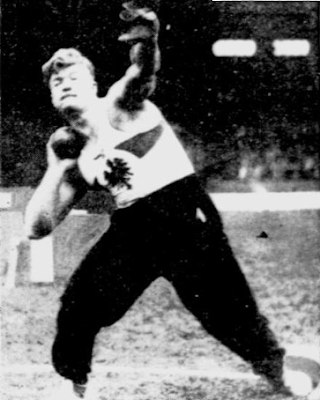
The Germans did not have long to wait for their first Olympic Champion. Miss Fleischer provided that in the Javelin contest.
Germany also had a champion when Hans Woellke won the shot-put earlier yesterday. Woellke threw the ball 53' 1 13/16" to surpass Leo Sextons Olympic record of 52' 6 3/16".
Sula Baerlund of Finland took silver and Gerhard Stoek, another German, took bronze. Sam Francis of Nebraska finished just out of the medals and Jack Torrance, Louisiana's state record holder, was fifth. Dimitri Zaitz of Boston College finished sixth.
The mood is gay and festive. Many Berliners are enjoying themselves. It has been said that that not since the first Sunday after Armistice have Berliners been as jubilant.
Even those not in attendance, there are loudspeakers all over Berlin announcing the results of events. Clustered around many of these loudspeakers, Berliners wait to hear how their countrymen have fared.

The Germans did not have long to wait for their first Olympic Champion. Miss Fleischer provided that in the Javelin contest.
Germany also had a champion when Hans Woellke won the shot-put earlier yesterday. Woellke threw the ball 53' 1 13/16" to surpass Leo Sextons Olympic record of 52' 6 3/16".
Sula Baerlund of Finland took silver and Gerhard Stoek, another German, took bronze. Sam Francis of Nebraska finished just out of the medals and Jack Torrance, Louisiana's state record holder, was fifth. Dimitri Zaitz of Boston College finished sixth.
Lindbergh leaves Berlin without meeting Hitler
Colonel Charles A. Lindbergh ended a twelve-day stay in Germany today without having met Chancellor Hitler despite having sat almost within speaking distance of each other at the Olympic Games.
The American flyer and Mrs. Lindbergh took off quietly for Copenhagen, Denmark, after the Colonel had paid tribute to the progress of Germany's aviation industry.
After his departure, it became known that Colonel Lindbergh and Chancellor Hitler had occupied seats within feet of each other at the ceremonies yesterday. Nobody apparently made any effort to introduce them.
In American diploamatic quarters it was explained "no time coud be found that was convenient to both which to arrange the meeting".
German and American officials disclaimed knowledge of plans for any future meet of the two.
"Germany leads the world in lighter-than-air craft" Colonel Lindbergh commented to friends before his departure. "That, of course, is something we all knew before I came. I was genuinely surprised to find that Germany has thoroughly developed Diesel motors for aviation purposes.
"In this, too, she leads the world. We in America have not begun to develop and exploit Diesel motors as has Germany.
"Germany was in front before and during the war as regards heavier-than-air craft, but she naturally lost the lead on account of post-war conditions. She is coming up fast, however, and sail-planing, too, is a great art in Germany."
Colonel Lindbergh added that in general he was intensely pleased by what he had observed in Germany.
The American flyer and Mrs. Lindbergh took off quietly for Copenhagen, Denmark, after the Colonel had paid tribute to the progress of Germany's aviation industry.
After his departure, it became known that Colonel Lindbergh and Chancellor Hitler had occupied seats within feet of each other at the ceremonies yesterday. Nobody apparently made any effort to introduce them.
In American diploamatic quarters it was explained "no time coud be found that was convenient to both which to arrange the meeting".
German and American officials disclaimed knowledge of plans for any future meet of the two.
"Germany leads the world in lighter-than-air craft" Colonel Lindbergh commented to friends before his departure. "That, of course, is something we all knew before I came. I was genuinely surprised to find that Germany has thoroughly developed Diesel motors for aviation purposes.
"In this, too, she leads the world. We in America have not begun to develop and exploit Diesel motors as has Germany.
"Germany was in front before and during the war as regards heavier-than-air craft, but she naturally lost the lead on account of post-war conditions. She is coming up fast, however, and sail-planing, too, is a great art in Germany."
Colonel Lindbergh added that in general he was intensely pleased by what he had observed in Germany.
Wednesday, August 2, 2006
The Opening Ceremonies of the XIth Olympiad
A gray sky that threatened rain without ever really fulfilling that threat towered today over the Opening Ceremonies of the 11th Olympic Games of modern times. It was not a misfortune, because there stood out in sharper relief all the brilliant coloring of this most picturesque of ceremonies, which comes only once ever four years.
The picture against this gray background was the huge expanse of the world's newest and biggest stadium and the great throng of 110,000 that filled the gray stone benches. In the arena below, the greenest of lawns was cut by the running track of red cinders. At each end wide granite stairways leading to the skyline were broken only by the twin stone clock towers and the unadorned flagpoles.
At one side was an orchestra, reinforced by the drums and bugles of a half-dozen military bands, and above them was a choir of a thousand, all in white. At the other side a line of gray benches was broken by a square, outstanding platform, equipped with microphones for the Caesar of this era, the German Führer, and his entourage. Below that was a little forest of chairs for the Ambassadors and special envoys of nations.
 As the ceremonies continued, a little girl in blue, her fair hair bound by a chaplet of flowers, came forward and, making a German curtsey, gave the Führer a bouquet of roses. He touched her hair and evidently spoke gently to her while Count Henri de Baillet-Latour took her by the hand and led her with the notables in frock coats and top hats to the Caesar's dais. The assembly remained standing still, vociferating in a chorus of "heils". The Germans in unison saluted their beloved Führer.
The bands broke into "Deutchland Uber Alles" then into the Nazi anthem, the "Horst-Wessel Song" as the notables took their places. Theodor Lewald, head of the German Olympic Committee gave up his chair of honor to the Italian Crown Prince.
On a flagpole, the Olympic Flag—white with five interlocking circles representing the five continents—was slowly raised. Outside the stadium, guns boomed.
First item on the program was the parade. The Olympic Bell tolled a deep note. The bell is inscribed with the words "I summon the youth of the world." As if to answer the bell's summons, into the stadium marched the athletes. Leading, because their country started the Olympic Games in 776 B. C., were the Greeks. Next, at the head of the German alphabetical list were the Egyptians. Loudest applause went to Austrians who gave the Nazi salute, to goose-stepping Bulgarians (who also rendered the Nazi salute to the delight of the German spectators), to a Swiss flag-bearer who did juggling tricks. English athletes got few cheers.
Next to last, the US team members saluted Realmleader Hitler by placing their straw hats over their hearts( as did the Philippines and China). The Americans were also the only country not lower their flag when passing the Führer. They kept their flag aloft proudly. An official statement published in all the newspapers, however, explained this as due to Army regulations and for public understanding in the matter.
For the Americans, the crowd shouted, whistled, clapped in unison. The American athletes were received somewhat coolly. The audience was notably subdued when they entered. Some European observers noted a noisy whistling that was suggestive of the "Bronx Cheer".
The noise soon died when the German team became visible at the Marathon Gate, where the teams entered. The bands ceased to play the march they had been playing and went in impassioned performances of "Deutschland Uber Ales" and the "Horst-Wessel Song" all over again. The German audience rose in silent attention. They did not wish for the American team to applauded.
As for the attire of the athletes, there was many an ensemble. The Americans looked crip[s in their white flannel trousers, their white shoes, dark blue blazers and straw hats with the national arms on the front of the blue hatband. The Egyptians wore red fezes above similar dress. Australia was in dark green and white. The Belgians were picturesque in all-gray flannels.
The Bermudans and Chinese wore white sun helmets, while the Colombians were clad in gray trousers and bright blue blazers. The Danes marched resplendent in rose and white. The British were bare headed but dressed otherwise in American fashion. So were the French. The Canadians were in red and white and gave the Olympic salute. The Italians wore black shirts over white trousers. The Germans were in all white. The officers in the parade who are to take part in the cavalry competitions all wore their national uniforms.
Germany provided the contingent of athletes. The United States with some 400 athletes, was the second largest, with France, Italy and Great Britain come next in order. Both Haiti and Costa Rica sent a single person apiece who also bore their flag for their respective nations. Honors in marching when wholly to the German, who moved like a great machine.
At last the Parade was ended and some 5,000 athletes from 52 nations came to rest on the green infield before the Führer, Dr. Lewald, made a 20-minute speech to introduce Herr Hitler, who, dressed in a brown uniform, had arrived an hour before. He addressed Hitler "respectfully and gratefully as the protector of these Olympic Games to be held in this stadium, built according to your will and purpose" invited him to declare them open.
Adolf Hitler stopped chatting with his good friend Cinemactress Leni Riefenstahl, official Olympic photographer, long enough to speak a racial comment. Said he: "In a few minutes, the torch bearer will appear to light the Olympic fire on his tripod, when it will rise, flaming to heaven, for the weeks of this festival. It creates a real and spiritual bond of fire between our German fatherland and the sacred places of Greece founded nearly 4,000 years ago by Nordic immigrants.
"Only so long as sport isn't allowed to become an end is itself but, on the contrary, a moral duty, only so long as it isn't merely an empty pleasure or the desire for thrills, but discipline and devotion to a higher ideal, dare it to be the object of such a festival."
After a pause, De Lewald announced that only the day before, the Olympic Committee decided to make the "Olympic Hymn" used at these games, the hymn for all future meets and expressed thanks to Richard Strauss for having created it.
At the end of Dr. Lewald speech, Herr Hitler stepped forward once more and fullfilled his sole duty of these game saying "I proclaim open the Olympic Games of Berlin, celebrating the XIth Olympiad of the modern era."

Then Trumpets sounded across the arena and 3,000 white pegeons flew into the air. A white clad chorus then sang the "Olympic Hymn". The Hinderburg flew over the stadium trailing the large white Olympic flag behind it.
Atop the staircase at the East gate appeared the last runner of the 3,000 who had relayed the Olympic Flame from Olympia in Greece. This last runner, Fritz Schilgen, scampered down the steps, paddled across the arena, trotted up the west stairs to a platform, dipped his torch. The Olympic Fire flared up from its bowl.
 After the ceremony of the Olympic Torch came the Olympic Oath.The 52 flag-bearers formed a semicircle in front of the reviewing stand. German Weightlifter Rudolf Ismayr mounted a tiny rostrum, recited through amplifiers so everyone could hear: "We swear that we will take part in the Olympic Games in loyal competition, respecting the regulations which govern them and desirous of participating in them in the true spirit of sportsmanship, for the honor of our country and the glory of sport." A German choir sang Handel's Hallelujah Chorus.
On the bulletin board which will proclaim the results of the competitions appeared the words of Baron de Coubertin, who revived the Olympic games in their present form:"The important thing is not to win but to take part. The essential thing is not to have conquered but to have fought to win."

Then gnarled old Spiridon Loues, Greek shepherd and marathon runner, wearing his national costume, who won the Olympic race in 1896, wobbled out of the ranks to present Herr Hitler with an olive branch. Mr. Loues said to the Chancellor "I present to you this olive branch as a symbol of love and peace. We hope that the nations will ever meet solely in such peaceful competition. Hitler receiving it with obvious emotion, thanked him heartily and shook hands with him. Handel's "Hallelujah Chorus" resounded once more and brought the ceremony to a close and the athletes marched slowly out.
As for the performance, written by Dr. Carl Diem, secretary of the Olympic Organization Committee. There had been a request from Baron de Coubertin to include Beethoven's Ninth Symphony which includes a musical setting for Friedrich von Schiller's stirring "Ode to Joy". Dr. Diem went further and wrote a pageant in five acts on the romantic theme of youth.
The first scene opened just after nightfall. No performers appeared at first. There were seen only two great choruses grouped in the shadows. From the tower above Marathon Gate were first heard the trumpets playing the "Welcome Song".
Then entered 3,000 little girls in white dresses and 900 boys in Olympic colors, from whose masses came the faint notes of glass chimes. The children danced finally forming the Olympic flag.
Then the chimes of the Potsdam Church, where Frederick the Great is buried were heard and the two choirs sang a hymn titled "Eternal Olympia" This was composed for the occasion by the German musician Werner Egk.
Following the children, came 2,000 older girls who danced as a chorus to a solo waltz by Talutta. Five hundred more girls from a noted gymnastics school then gave a demonstration of rhythmic dancing until "The Voice of the Mother" summoned them to be serious, and chorus answered in unison.
The next scene showed groups of boys from various nations engaging in games about a series of bonfires until the fires were hurried away, and the boys disappeared at the blast of a trumpet. Then the spotlights were concentrated on the ceremonial steps leading down into the stadium from Marathon Gate.
A group of 1,200 youths descended these stairs carrying silken flags of all nations. Swiss flag bearers gave a demonstration of their art of flag swinging. Then, when the flag bearers all had descended into the stadium, they raised their hands in the Olympic salute and with the chorus sang a hymn.
A sword dance followed in which both dancers died in rhythmic agony. The moral of this scene was supposedly that modern war destroys the visitor and the vanquished. After that 80 girls danced the "Dance of the Mourners".
But this led to the first bars of the 4th and final movement of Beethoven's cherished Ninth Symphony. A voice was heard reciting Schiller's famous poem. A chorus of 1,000 voices joined in. The 6,000 performers who had taken part in the previous scenes streamed into the field, joined hands and embraced. The flags of the nations taking part in the games were raised around the stadium. Lighted torches formed a ring of fire about its outer edge and the searchlights were thrown onto the 1,200 flags of nations which reappeared on the field as a signal the pageant was over.
During the day Hitler was subjected to continuous ovations. I nthe newly paved square in front of the Chancellory, in the Wilhelmstrausse, thousands stood for hours ot cheer him. Again and again he had to appear on the balcony overlooking the square to wave responses to the frenzied adulation.
Biggest and noisiest in history, the 1936 Olympics are scheduled to last for 16 days. Five thousand athletes from 50 countries will compete in 22 sports, watched by 3,500,000 spectators, recorded by 1,500 reporters. To accommodate all this, Berlin, cheated of the 1916 Olympics by the War, spent $24,000,000 on municipal improvements; a 325-acre Reichssportfeld including four stadiums, an outdoor theatre, basketball courts, pools, a polo field, a gymnasium; and an Olympic Village conveniently close to Staaken Airport which can use it for barracks when the Games are over.

The picture against this gray background was the huge expanse of the world's newest and biggest stadium and the great throng of 110,000 that filled the gray stone benches. In the arena below, the greenest of lawns was cut by the running track of red cinders. At each end wide granite stairways leading to the skyline were broken only by the twin stone clock towers and the unadorned flagpoles.
At one side was an orchestra, reinforced by the drums and bugles of a half-dozen military bands, and above them was a choir of a thousand, all in white. At the other side a line of gray benches was broken by a square, outstanding platform, equipped with microphones for the Caesar of this era, the German Führer, and his entourage. Below that was a little forest of chairs for the Ambassadors and special envoys of nations.
 As the ceremonies continued, a little girl in blue, her fair hair bound by a chaplet of flowers, came forward and, making a German curtsey, gave the Führer a bouquet of roses. He touched her hair and evidently spoke gently to her while Count Henri de Baillet-Latour took her by the hand and led her with the notables in frock coats and top hats to the Caesar's dais. The assembly remained standing still, vociferating in a chorus of "heils". The Germans in unison saluted their beloved Führer.
The bands broke into "Deutchland Uber Alles" then into the Nazi anthem, the "Horst-Wessel Song" as the notables took their places. Theodor Lewald, head of the German Olympic Committee gave up his chair of honor to the Italian Crown Prince.
On a flagpole, the Olympic Flag—white with five interlocking circles representing the five continents—was slowly raised. Outside the stadium, guns boomed.
First item on the program was the parade. The Olympic Bell tolled a deep note. The bell is inscribed with the words "I summon the youth of the world." As if to answer the bell's summons, into the stadium marched the athletes. Leading, because their country started the Olympic Games in 776 B. C., were the Greeks. Next, at the head of the German alphabetical list were the Egyptians. Loudest applause went to Austrians who gave the Nazi salute, to goose-stepping Bulgarians (who also rendered the Nazi salute to the delight of the German spectators), to a Swiss flag-bearer who did juggling tricks. English athletes got few cheers.

Next to last, the US team members saluted Realmleader Hitler by placing their straw hats over their hearts( as did the Philippines and China). The Americans were also the only country not lower their flag when passing the Führer. They kept their flag aloft proudly. An official statement published in all the newspapers, however, explained this as due to Army regulations and for public understanding in the matter.
For the Americans, the crowd shouted, whistled, clapped in unison. The American athletes were received somewhat coolly. The audience was notably subdued when they entered. Some European observers noted a noisy whistling that was suggestive of the "Bronx Cheer".
The noise soon died when the German team became visible at the Marathon Gate, where the teams entered. The bands ceased to play the march they had been playing and went in impassioned performances of "Deutschland Uber Ales" and the "Horst-Wessel Song" all over again. The German audience rose in silent attention. They did not wish for the American team to applauded.
As for the attire of the athletes, there was many an ensemble. The Americans looked crip[s in their white flannel trousers, their white shoes, dark blue blazers and straw hats with the national arms on the front of the blue hatband. The Egyptians wore red fezes above similar dress. Australia was in dark green and white. The Belgians were picturesque in all-gray flannels.
The Bermudans and Chinese wore white sun helmets, while the Colombians were clad in gray trousers and bright blue blazers. The Danes marched resplendent in rose and white. The British were bare headed but dressed otherwise in American fashion. So were the French. The Canadians were in red and white and gave the Olympic salute. The Italians wore black shirts over white trousers. The Germans were in all white. The officers in the parade who are to take part in the cavalry competitions all wore their national uniforms.
Germany provided the contingent of athletes. The United States with some 400 athletes, was the second largest, with France, Italy and Great Britain come next in order. Both Haiti and Costa Rica sent a single person apiece who also bore their flag for their respective nations. Honors in marching when wholly to the German, who moved like a great machine.
At last the Parade was ended and some 5,000 athletes from 52 nations came to rest on the green infield before the Führer, Dr. Lewald, made a 20-minute speech to introduce Herr Hitler, who, dressed in a brown uniform, had arrived an hour before. He addressed Hitler "respectfully and gratefully as the protector of these Olympic Games to be held in this stadium, built according to your will and purpose" invited him to declare them open.
Adolf Hitler stopped chatting with his good friend Cinemactress Leni Riefenstahl, official Olympic photographer, long enough to speak a racial comment. Said he: "In a few minutes, the torch bearer will appear to light the Olympic fire on his tripod, when it will rise, flaming to heaven, for the weeks of this festival. It creates a real and spiritual bond of fire between our German fatherland and the sacred places of Greece founded nearly 4,000 years ago by Nordic immigrants.
"Only so long as sport isn't allowed to become an end is itself but, on the contrary, a moral duty, only so long as it isn't merely an empty pleasure or the desire for thrills, but discipline and devotion to a higher ideal, dare it to be the object of such a festival."
After a pause, De Lewald announced that only the day before, the Olympic Committee decided to make the "Olympic Hymn" used at these games, the hymn for all future meets and expressed thanks to Richard Strauss for having created it.
At the end of Dr. Lewald speech, Herr Hitler stepped forward once more and fullfilled his sole duty of these game saying "I proclaim open the Olympic Games of Berlin, celebrating the XIth Olympiad of the modern era."

Then Trumpets sounded across the arena and 3,000 white pegeons flew into the air. A white clad chorus then sang the "Olympic Hymn". The Hinderburg flew over the stadium trailing the large white Olympic flag behind it.
Atop the staircase at the East gate appeared the last runner of the 3,000 who had relayed the Olympic Flame from Olympia in Greece. This last runner, Fritz Schilgen, scampered down the steps, paddled across the arena, trotted up the west stairs to a platform, dipped his torch. The Olympic Fire flared up from its bowl.
 After the ceremony of the Olympic Torch came the Olympic Oath.The 52 flag-bearers formed a semicircle in front of the reviewing stand. German Weightlifter Rudolf Ismayr mounted a tiny rostrum, recited through amplifiers so everyone could hear: "We swear that we will take part in the Olympic Games in loyal competition, respecting the regulations which govern them and desirous of participating in them in the true spirit of sportsmanship, for the honor of our country and the glory of sport." A German choir sang Handel's Hallelujah Chorus.
On the bulletin board which will proclaim the results of the competitions appeared the words of Baron de Coubertin, who revived the Olympic games in their present form:"The important thing is not to win but to take part. The essential thing is not to have conquered but to have fought to win."

Then gnarled old Spiridon Loues, Greek shepherd and marathon runner, wearing his national costume, who won the Olympic race in 1896, wobbled out of the ranks to present Herr Hitler with an olive branch. Mr. Loues said to the Chancellor "I present to you this olive branch as a symbol of love and peace. We hope that the nations will ever meet solely in such peaceful competition. Hitler receiving it with obvious emotion, thanked him heartily and shook hands with him. Handel's "Hallelujah Chorus" resounded once more and brought the ceremony to a close and the athletes marched slowly out.
As for the performance, written by Dr. Carl Diem, secretary of the Olympic Organization Committee. There had been a request from Baron de Coubertin to include Beethoven's Ninth Symphony which includes a musical setting for Friedrich von Schiller's stirring "Ode to Joy". Dr. Diem went further and wrote a pageant in five acts on the romantic theme of youth.
The first scene opened just after nightfall. No performers appeared at first. There were seen only two great choruses grouped in the shadows. From the tower above Marathon Gate were first heard the trumpets playing the "Welcome Song".
Then entered 3,000 little girls in white dresses and 900 boys in Olympic colors, from whose masses came the faint notes of glass chimes. The children danced finally forming the Olympic flag.
Then the chimes of the Potsdam Church, where Frederick the Great is buried were heard and the two choirs sang a hymn titled "Eternal Olympia" This was composed for the occasion by the German musician Werner Egk.

Following the children, came 2,000 older girls who danced as a chorus to a solo waltz by Talutta. Five hundred more girls from a noted gymnastics school then gave a demonstration of rhythmic dancing until "The Voice of the Mother" summoned them to be serious, and chorus answered in unison.
The next scene showed groups of boys from various nations engaging in games about a series of bonfires until the fires were hurried away, and the boys disappeared at the blast of a trumpet. Then the spotlights were concentrated on the ceremonial steps leading down into the stadium from Marathon Gate.
A group of 1,200 youths descended these stairs carrying silken flags of all nations. Swiss flag bearers gave a demonstration of their art of flag swinging. Then, when the flag bearers all had descended into the stadium, they raised their hands in the Olympic salute and with the chorus sang a hymn.
A sword dance followed in which both dancers died in rhythmic agony. The moral of this scene was supposedly that modern war destroys the visitor and the vanquished. After that 80 girls danced the "Dance of the Mourners".
But this led to the first bars of the 4th and final movement of Beethoven's cherished Ninth Symphony. A voice was heard reciting Schiller's famous poem. A chorus of 1,000 voices joined in. The 6,000 performers who had taken part in the previous scenes streamed into the field, joined hands and embraced. The flags of the nations taking part in the games were raised around the stadium. Lighted torches formed a ring of fire about its outer edge and the searchlights were thrown
 onto the 1,200 flags of nations which reappeared on the field as a signal the pageant was over.
During the day Hitler was subjected to continuous ovations. I nthe newly paved square in front of the Chancellory, in the Wilhelmstrausse, thousands stood for hours ot cheer him. Again and again he had to appear on the balcony overlooking the square to wave responses to the frenzied adulation.
Biggest and noisiest in history, the 1936 Olympics are scheduled to last for 16 days. Five thousand athletes from 50 countries will compete in 22 sports, watched by 3,500,000 spectators, recorded by 1,500 reporters. To accommodate all this, Berlin, cheated of the 1916 Olympics by the War, spent $24,000,000 on municipal improvements; a 325-acre Reichssportfeld including four stadiums, an outdoor theatre, basketball courts, pools, a polo field, a gymnasium; and an Olympic Village conveniently close to Staaken Airport which can use it for barracks when the Games are over.
The Olympics open in Berlin
Yesterday, Germany and the rest of the world celebrated the opening of the Olympics. The world took a few hours out of the tension of fascism and civil war to enjoy the opening ceremony in Berlin's Olympic Stadium, built just for this spectacle.
Questions of whether Jewish athletes would be treated fairly have been around since Adolf Hitler and the Nazi Power ascended to power in early 1933. The United States debated whether to boycott the games three years ago. President Roosevelt dismissed this and demanded that the United States participate in the games. He remarked that it was traditional that the United States was beyond external influence. He would not allow the German political differences to influence the participation of American athletes in the greatest sporting spectacle of the Globe. Many doubts and questions still linger for much of the world.
There have been reports and photos of signs informing Jews of prohibitions. These signs were not to be seen throughout Germany. The Nazi authorities may have taken them down for an International audience that does not favor the Nazi beliefs against Jews and the International Jewry itself.
Questions of whether Jewish athletes would be treated fairly have been around since Adolf Hitler and the Nazi Power ascended to power in early 1933. The United States debated whether to boycott the games three years ago. President Roosevelt dismissed this and demanded that the United States participate in the games. He remarked that it was traditional that the United States was beyond external influence. He would not allow the German political differences to influence the participation of American athletes in the greatest sporting spectacle of the Globe. Many doubts and questions still linger for much of the world.
There have been reports and photos of signs informing Jews of prohibitions. These signs were not to be seen throughout Germany. The Nazi authorities may have taken them down for an International audience that does not favor the Nazi beliefs against Jews and the International Jewry itself.
Tuesday, August 1, 2006
Tokyo to host 1940 Olympics
The Japanese public was woken today when at 6 AM, there was a radio announcement to inform them Tokyo had been selected to host the next Olympics in 1940. The result gives the Japanese enormous pleasure. The Japanese people have become one of the world's most sport-minded people in the last twenty years.
Yesterday, the International Olympic Committee voted to award the 12th Olympic Games to Tokyo. The runner up was Helskinki, Finland.
The Mayor of Tokyo will launch an elaborate program of municipal festivities to express the citizens' joy and incidentally whip up enthusiasm for the great effort to give Tokyo the latest and finest equipment.
Potential champions are already training. last night, despite temperature of 96°F and a humidity correspondingly high, a crowd of youths were practicing not just track events but javelin and discus throwing as well.
Plans for enlarging sports accommodations at a cost of ¥10,000,000 already exist as blueprints. The existing track and field stadium will be enlarged so that it will seat 120,000. A new playing field, seating 50,000 will be built, and a swimming pool accommodating 30,000 spectators is to be provided.
An entirely new Equestrian Track will be constructed in a Tokyo suburb in addition to a new indoor arena for boxing and wrestling. The yachting contests will be held off Yokohama and a new regatta course is being prepared there. A purely native addition will be a display of Japanese fencing, wrestling and archery.
An Olympic Village will be constructed in Tanagawa, thirty minutes from the city.
The Games are scheduled to run from July 20th through August 4th, 1940. The 11th Olympics open today in Berlin.
Yesterday, the International Olympic Committee voted to award the 12th Olympic Games to Tokyo. The runner up was Helskinki, Finland.
The Mayor of Tokyo will launch an elaborate program of municipal festivities to express the citizens' joy and incidentally whip up enthusiasm for the great effort to give Tokyo the latest and finest equipment.
Potential champions are already training. last night, despite temperature of 96°F and a humidity correspondingly high, a crowd of youths were practicing not just track events but javelin and discus throwing as well.
Plans for enlarging sports accommodations at a cost of ¥10,000,000 already exist as blueprints. The existing track and field stadium will be enlarged so that it will seat 120,000. A new playing field, seating 50,000 will be built, and a swimming pool accommodating 30,000 spectators is to be provided.
An entirely new Equestrian Track will be constructed in a Tokyo suburb in addition to a new indoor arena for boxing and wrestling. The yachting contests will be held off Yokohama and a new regatta course is being prepared there. A purely native addition will be a display of Japanese fencing, wrestling and archery.
An Olympic Village will be constructed in Tanagawa, thirty minutes from the city.
The Games are scheduled to run from July 20th through August 4th, 1940. The 11th Olympics open today in Berlin.
Wednesday, July 26, 2006
Italy & Germany for Franco
Italy and Germany have both voiced support for General Franco and his Fascist forces. Each will be shipping arms to the rebels to help with their struggle against the Republican government and the Monarchy.
Thursday, July 20, 2006
Another Government in Spain
 Swiftly changing governmental hands, José Giral y Pereira has also been asked to form a government by President Azaña within hours of asking Diego Martínez y Barrio to do the same. Yesterday, July 19th, Martínez y Barrio was unable to make any progress in the formation of a government. The President therefore, decided that time was not something they had on their side as rebellion continues.
One of Giral y Pereira's first orders as head of government was to issue arms to the general populace.
Seville, one of the most important cities in the south, is unsuccessfully defended by local police troops and a poorly armed workers' militia. While the heaviest weapons police possess are machine guns, the rebel General Queipo de Llano sends in artillery and heavily armed troops. Seville falls to the rebels.
Wednesday, July 19, 2006
Prime Minister Quiroga resigns
General Franco arrived in Tetuán, Spanish Morocco in Northern Africa, where he will lead the rebels in their revolt against the Spanish government.
Prime Minister Casares Quiroga resigns as chief of the Republican government. President Azaña is left scrambling. Diego Martínez y Barrio has been asked to fill the position. He will no doubt establish a government as best he can.
Prime Minister Casares Quiroga resigns as chief of the Republican government. President Azaña is left scrambling. Diego Martínez y Barrio has been asked to fill the position. He will no doubt establish a government as best he can.
Tuesday, July 18, 2006
Rebels take Southern Spain
In high good humor the Moroccan rebels launched their invasion of Spain proper. A troopship loaded with Legionnaires put in at Algeciras near Gibraltar. A rebel torpedo boat shelled the undecided garrison at La Linea, which thereupon joined the revolt. But when La Linea citizens, watching black Moorish troops march into barracks, refused to disperse, the Moors mowed them down with machine guns, blasted them with hand grenades, left La Linea's streets littered with dead. In thousands of commandeered cars, the rebels pushed north, fanning out along the railroads leading toward Madrid.
Manifestoed General Franco from Morocco: "Spain is saved! The Provinces of Andalusia, Valencia, Valladolid, Burgos, Aragon, the Canaries and the Balearic Islands, with their garrisons and civil forces, have joined enthusiastically with us. Only Madrid made an exception in sending its planes to bombard cities and towns without defense, killing women and children. . . . We will demand accounts from them as well as from those still on the fence. . . ."
Spain, however, was by no means saved for General Franco. What he needed most were Madrid and Barcelona. In both cities rebel regiments were shelled into surrender by loyal artillery and planes. The loyal Warship Cervantes sent shells whistling into Cádiz where a body of rebel troops had landed. Loyalists were further heartened by a report that General Franco had lost courage and radioed for a seaplane in which to flee.
The Government's arming of a "Red militia" of workers was what definitely took this week's revolt out of the traditional formula of Latin coups d'état and put it into the class of Russia's revolution of 1917. Last week 6,000 tough Asturian miners marched down from the North to Madrid's assistance, as the Army rebels marched up from the South. Declared the Spanish Government: "Spanish citizens! The movement in insurrection has been subjugated absolutely and it is necessary not to lose the fight."
Further Details of the Uprising in Morocco
In this sultry, tense atmosphere, some Socialists last week leaned out of their headquarters windows in the North African garrison town of Melilla in Spanish Morocco and brashly booed a regiment of the famed Spanish Foreign Legion, marching home from drill. The Legionnaires broke ranks, threw the Socialists out their own windows. At this a huge revolt, carefully planned, erupted into plain view and silence descended on Spain.
General Francisco Franco Bahamonde deserted his post on the Canary Islands, hastened to Melilla, took charge of some 20,000 rebellious Legionnaires, regulars and Moorish native troops. Within a day the rebels controlled all Spanish Morocco, a 200-mile strip of coast across from Gibraltar. When they began broadcasting from the Ceuta radio station, pretending to be the Seville station, announcing the surrender of Madrid to the rebels, sympathetic Army garrisons throughout European Spain joined the revolt. They were defeated in Barcelona and Seville but seized the southern ports of Cádiz and Málaga for a landing by the Moroccan rebels, skirmished in Burgos, Pamplona, Valladolid and Zaragoza. Government planes soared over strongholds dropping, first bombs, then leaflets urging soldiers to rebel against their rebellious officers.
Subscribe to:
Posts (Atom)