Colonel Ott, a German advisor to the Chinese, has stated that the Japanese are lucky that the Germans are still there. otherwise, it is likely they'd be replaced by Soviet ones. Their continued presence also helps to protect the German citizens who remain in the country. If the officials were to leave, it is believed that the Chinese would be rather harsh against these citizens abroad.
In China there remains citizens of several countries such as Great Britain, of course, France, the US and Japan. Many of these citizens are claiming their extraterritorial rights to protect them from the prolonged fighting.
The Japanese remain unchecked in Northern China. The Japanese commander, Lieutenant General Seishiro Itagaki, while his motorized divisions roared over a Chinese strategic highway built by famed "Model Governor" Yen Hsi-shan of Shansi, announced: "We are pursuing the disorganized Chinese troops so fast that they are unable to reform their lines in the strong positions which they had prepared earlier in anticipation of their retreat."
The Japanese while fighting the battle for Shanghai, are also having to contend with uprising in Manchukuo. The weather has been cold enough to freeze the marshes and swamps of Manchukuo allowing for easy transportation of mechanized vehicles.
Showing posts with label 上海. Show all posts
Showing posts with label 上海. Show all posts
Friday, November 16, 2007

German advisors remain
Despite a pact against Communism between Japan and Germany, Adolf Hitler has not withdrawn his advisors to the Chinese military. They continue to help the Chinese strategize against the Japanese attacks.
Conference Concludes
The conference concluded yesterday in Brussels with a chiding of the Japanese as an aggressor. The sanctions Kai-shek was hoping for are likely to only come from the United States.
Things at the Wufu line get worse. The officials who were supposed to be there to meet the exhausted Chinese troops had fled. Chinese forces have been unable to use the facilities for defense thus far.
Things at the Wufu line get worse. The officials who were supposed to be there to meet the exhausted Chinese troops had fled. Chinese forces have been unable to use the facilities for defense thus far.
Thursday, November 15, 2007
Chinese withdraw to the Wufu Line
As the conference in Brussels continues, the Chinese have now had to retreat to the Wufu Line. The Chinese have little left to use to fight against the Japanese and the frontline is near collapse.
They have recently lost the town of Kunshun. There is also a severe shortage of ammunition.
There are reports of disarray in the withdrawal.
They have recently lost the town of Kunshun. There is also a severe shortage of ammunition.
There are reports of disarray in the withdrawal.
Friday, November 9, 2007
Nine-Power Conference Continues; Chinese lose more
 The Nine-Power Conference continues in Brussels with Germany, Italy and Japan refusing to attend.
In the meantime, the Chinese have taken heavy losses. The Japanese were able to make landings at Jinshanwei in Northern China on November 5th.
On November 8th, the Chinese Central Command issued a retreat from Shanghai despite the ongoing conference. Chiang Kai-shek continues to hope that the conference will do something to contain Japan.
Sunday, November 4, 2007
Nine Powers convene in Brussels
With the Japanese closing in on the Chinese in Shanghai, western powers decided to hold a conference in Brussels to discuss possible intervention.
The nine nations are those who signed the agreement of the Open Door Policy on February 6, 1922. These nine nations include Great Britain, France, Portugal, Belgium, Italy, Japan, China, The United States and the Netherlands. The treaty has not been very effective. Six years ago with the invasion of Manchuria, the United States could do little more than impose economic sanctions on Japan.
Many of the other Chinese troops have withdrawn to the other side of the Suzhou Creek where fighting remains intense. Chiang Kai-shek continues to stay in Shanghai during the conference.
The nine nations are those who signed the agreement of the Open Door Policy on February 6, 1922. These nine nations include Great Britain, France, Portugal, Belgium, Italy, Japan, China, The United States and the Netherlands. The treaty has not been very effective. Six years ago with the invasion of Manchuria, the United States could do little more than impose economic sanctions on Japan.
Many of the other Chinese troops have withdrawn to the other side of the Suzhou Creek where fighting remains intense. Chiang Kai-shek continues to stay in Shanghai during the conference.
Monday, October 29, 2007
Hard Fighting at Suzhou Creek
The situation at Suzhou Creek looks grim. The strength of the Chinese forces is little compared to the Japanese forces. Many divisions are depleted to only one or two regiments.
Chiang Kai-shek came to the battlefield and seemed to boost morale for a short period.
Chiang Kai-shek came to the battlefield and seemed to boost morale for a short period.
Saturday, October 27, 2007
Dachang falls
Dachang has finally fallen to the Japanese. It was the last suburban town lying between the Japanese forces and the Chinese fortified within Shanghai.
The two sides engaged in many seesaw battles over the past few weeks. The frontline of the battle has only managed to move 5 Kilometers with the Japanese making the gains. The Chinese have so far, never been able to capitalize 0n Japanese vulnerabilities.
The fighting has been so intense that the rate of casualties an hour for the Chinese has reportedly been in the thousands. Some divisions have been wiped out in a matter of days.
On October 25th, however, Dachang fell to the Japanese. In the course of last night, the Chinese began to withdraw from Shanghai, particularly its downtown which they've held for the better part of three months.
The two sides engaged in many seesaw battles over the past few weeks. The frontline of the battle has only managed to move 5 Kilometers with the Japanese making the gains. The Chinese have so far, never been able to capitalize 0n Japanese vulnerabilities.
The fighting has been so intense that the rate of casualties an hour for the Chinese has reportedly been in the thousands. Some divisions have been wiped out in a matter of days.
On October 25th, however, Dachang fell to the Japanese. In the course of last night, the Chinese began to withdraw from Shanghai, particularly its downtown which they've held for the better part of three months.
Wednesday, October 3, 2007
The Chinese withdraw to keep Dachang
Since the fall of Luodian, the frontline of the battle has moved southward to the town of Dachang (大場). There the Chinese hope to maintain some sort of continued communication between themselves the the troops in downtown Shanghai.
The Japanese have increased their numbers to 200,000 given the intensity they faced from 300,000 Chinese at Luodian. Chiang Kai-shek mobilized whatever troops he could scrape up for the defense of Dachang.
After invading the town of Liuhang, the Japanese have managed to push the frontline back further to the Yunzaobin River (蘊藻濱).
The Japanese have increased their numbers to 200,000 given the intensity they faced from 300,000 Chinese at Luodian. Chiang Kai-shek mobilized whatever troops he could scrape up for the defense of Dachang.
After invading the town of Liuhang, the Japanese have managed to push the frontline back further to the Yunzaobin River (蘊藻濱).
Monday, October 1, 2007
Luodian falls

Despite numerical supremacy, the outgunned Chinese have proven to be no match for the Japanese Navy and the firepower the Japanese forces have employed thus far.
The fighting at Luodian has been intense. The Chinese seemed to refuse to change their tactics despite the technological superiority of the Japanese.
There are few Chinese left. It is estimated that over 50% of the Chinese troops sent there to hold the Japanese back have perished. The Chinese have been forced to withdraw from Luodian.
It has been reported that Luodian is now being call the grinding mill of flesh and blood.
Wednesday, September 12, 2007
The Battle moves to Luodian
The Chinese have now taken up strategic positions around Luodian (羅店) in hopes of stopping the Japanese forces. This small town is an important connection between the recently fallen Baoshan and downtown Shanghai.
The Chinese troops have actually managed to increase their numbers. They now outnumber the Japanese troops 3 to 1.
The Chinese troops have actually managed to increase their numbers. They now outnumber the Japanese troops 3 to 1.
Sunday, September 9, 2007
Continued fighting in Shanghai
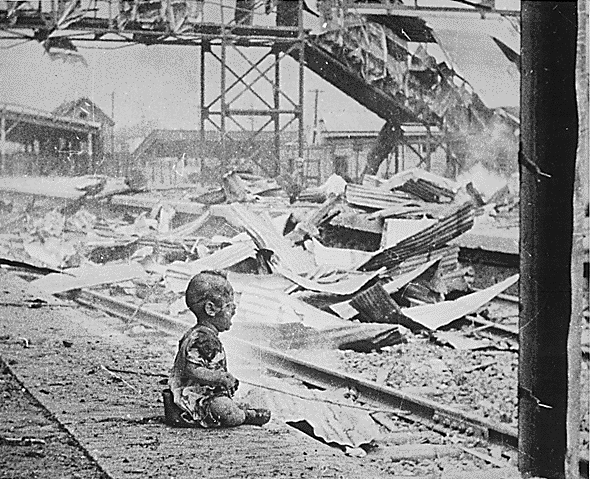 The Chinese have fought valiantly against the Japanese invasion at the port of Shanghai. They lack many of the weapons needed to beat back the amphibious assault and have mostly small arms to work with.
In many of the smaller coastal towns the Japanese have managed to gain control during the day with aid from Naval bombardments. Chinese counter attacks have then been able to regain control of many of these towns in the night.
Recently, on September 6th, the town of Baoshan. The 98th Division was ordered to protect the town. One particular battalion as reportedly suffered such losses that only one man remains alive.
Saturday, August 25, 2007
Japanese Reinforcements to Shanghai
Japan has now sent more troops to the city of Shanghai. This port city represents a great deal of importance to imperial Japan. The Japanese Expeditionary Force is led by Iwane Matsui and they landed at Liuhe, Wusong and Chuanshakou on August 23rd.
Chang Kai-shek seems to have anticipated an assault on these vulnerable coastal districts. He has reinforced them with the Chinese 18th Army. The Japanese Navy is also using its bombardment abilities to the fullest extent.
Chang Kai-shek seems to have anticipated an assault on these vulnerable coastal districts. He has reinforced them with the Chinese 18th Army. The Japanese Navy is also using its bombardment abilities to the fullest extent.
Thursday, August 23, 2007
The Battle for Shanghai
 Throwing the full weight of the imperial Japanese military, China's glorious city Shanghai has come under attack in the past fortnight.
The Chinese expected something after a Japanese Lieutenant Oyama and some Japanese Marines were discovered and shot on August 9th. The General Consul apologized for the incident. It is unclear if the Marines were acting on their own or from orders from superiors. The Japanese, nevertheless, stood firm in demanding the Chinese dismantle their protective barriers around Shanghai.
Not only did the Chinese not submit to this, Chiang Kai-shek increased the Chinese troops in Shanghai beginning August 11th.
Two days later, the Chinese Peace Preservation Corps exchanged small arms fire with Japanese troops in the Zhabei, Wusong, and Jiangwan districts of Shanghai. Following this at 3 PM, local time, the Japanese crossed the Bazi Bridge (八字橋) and began attacking. China's 88th Division returned the attack.
The Following day, Chiang Kai-shek's orders, Zhang Zhizong had the Chinese airplanes begin bombing Japanese targets with the Chinese ground forces also going on the offensive at 3 PM on that day.
On August 16, Zhang Zhizhong ordered his men to take the streets surrounding the Japanese strongholds, rather than assaulting them head-on. Every time a street was successfully cleared, the Chinese would set up sandbag blockades and set fire to allow the Japanese no escape. The tactic was successful as the Chinese were able to destroy many emplacements and outposts in a single day. However, the Japanese then deployed tanks and were able to repel Chinese attacks in the broad streets. The Chinese also ran into the same problem of the lack of heavy weapons to destroy the bunkers easily.
Thus, on August 18, the attack was called off. But in the meantime, Chen Cheng reached the frontlines to discuss the situation with Zhang Zhizhong. They decided to send the newly arrived 36th Division into the fray, by attacking the Hueishan (匯山) docks on the northern side of the Huangpu River. Meanwhile, the 87th Division broke through Japanese lines at Yangshupu, and pushed onto the Hueishan docks along with the 36th Division.
On August 22, the tanks of the 36th Division reached the docks, but were not able to hold the position for long. The Chinese troops were trained insufficiently in coordinating infantry-tank tactics, and the troops were not able to keep up to the tanks' speed. The tanks were vulnerable to Japanese anti-tank weapons and artillery in close quarters and became useless when they entered the city center. The few troops who accompanied the tanks through the city blocks were then trapped by Japanese road blockades and annihilated by flamethrowers and intense machine gun fire. While the Chinese almost succeeded in pushing the Japanese down the Huangpu River, the casualty rate was exceedingly high. In the night of August 22 alone, the 36th Division lost more than ninety officers and a thousand troops.
Most recently, on August 22, the Japanese 3rd, 8th, and 11th Divisions made an amphibious assault under cover from naval bombardments and proceeded to land in Chuanshakou (川沙口), Shizilin (獅子林), and Baoshan (寶山), towns on the northeast coast some fifty kilometers away from downtown Shanghai. Japanese landings in northeast Shanghai suburban areas meant that many Chinese troops, who were deployed in Shanghai's urban center, had to be redeployed to coastal regions to counter the landings. Thus, the frontline has been lengthened from metropolitan Shanghai along the Huangpu River to the northeast coastal districts. The Chinese offensive in the urban center has come to a halt, and the fight in downtown Shanghai essentially has become a static battle with both sides suffering heavy losses and making minimal changes in the frontline. The Chinese divisions have been able to hold onto Zhabei, Jiangwan, and other downtown positions.
Subscribe to:
Posts (Atom)