Showing posts with label US Navy. Show all posts

Thursday, December 8, 2011

Photo Essay: December 7th, 1941. Pearl Harbor

Pearl Harbor bird's eye view October 30, 1941
Taken from Residential areas.  Japanese bombers headed toward the harbor with anti-aircraft fire.
Hangar burns on Ford Island

USS Shaw explodes losing its bow

The USS West Virginia may have taken seven torpedo hits


B-17 at Hickam Field

Carnage from the air


From left to right: The West Virginia (BB-48), The Tennessee (BB-43) and the sunken Arizona (BB-39) 


The USS Arizona explodes
The Battleship USS California sinking

The Superstructure of the USS Arizona remains above the shallow waters of Pearl Harbor
Heavy Damage to the USS Casin and the USS Downes stationed at Pearl Harbor
The West Virginia and the capsized Oklahoma
USS Shaw burns whilst men on the pier throw water onto the fire.

Japanese plane dives to extinguish flames

One of the first photos to be taken.  Machine-gunned P-40

The Battleship USS California is afire and listing to port.
Oil burns.  USS Maryland in the center


Wednesday, December 7, 2011

A Summary of today's attack on Pearl Harbor

The Hawaiian island of Oahu was attacked by the Japanese Imperial Navy this morning.  The attack came from the air and began just before 8 o'clock local time.

The first attack was at Ford island, the US Navy's fortress in the sea.  Then the first planes moved to Hickam Field and did considerable damage to planes and installations there.  Wheeler field also sustained considerable damage.  Most of the planes there were destroyed.  Bellows Field on the windward side of the island also reports damage.
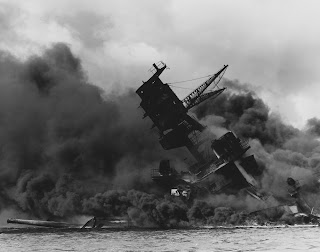
The Arizona sinking at Pearl Harbor
At Pearl Harbor, where's based the Pacific Fleet, the ships were attacked.  Many of the battleships were hit.  The USS Oklahoma was set afire.  The Arizona, next to an already torpedoed Nevada, was bombed and torpedoed early in the attack.  It sank in less than nine minutes in the shallow harbor.  An eyewitness claims it jumped 15-20 feet and broke in two.  Many other naval vessels sustained heavy damage such as the California, the West Virginia, the Tennessee and even Admiral Kimmel's own flagship, the USS Pennsylvania.  The training ship USS Utah was also sunk.

A destroyer USS Shaw was severely damaged in drydock.

Lines of communication between Army posts and Navy air drones are down.

The Navy has made no statements.  The Army has issued orders for the civilian population to remain off the streets.

Everyone here on the islands was taken by surprise by the attack.  It is difficult to believe that an air raid on the these beautiful islands has actually happened and that lives have been lost.

It is thought that planes came from the south.  One bomb dropped in front of the Governor's mansion at Washington Place and killed one man.  There was heavy bombing in the Pacific Heights residential districts killed one woman.

Casualty counts are changing every minute.  No estimate has been given.

Bulletin

President Roosevelt says the Japanese have attacked Pearl Harbor from the air.  

Bulletin

<<<<<<<<<<>>>>>>>>>>


FLASH


Washington, DC.


The White House has announced that the Japanese have attacked Pearl Harbor.


<<<<<<<<<<<END>>>>>>>>>>>

Saturday, May 17, 2008

US Congress votes for rearmament

Despite the amount of time it took for the United States to join in the Great War and its isolationist politics, the Congress has voted to begin rearmament. Navies are particularly slow to build up and the legislature gave its authorization to the Navy to begin expansion.

Monday, February 11, 2008

A Good Offence is a Good Defence

Congress continues to debate the President's requests for more military funding to rearm the forces and get America's Army and Navy up to scratch. Secretary of State Cordell Hull took it upon himself to address Congress in a letter yesterday.

He stated categorically his opinion that the proposed naval program was needed for the defense of the United States. Referring to the desire of the people and Government of the United States to keep out of war, he said that those who, with a full sense of responsibility, were advocating this program, were doing so in the belief that its adoption would contribute to achieving this desire. Secretary Hull pointed out that the Navy, even with the proposed increases, would not be able to embark upon offensive or aggressive operations overseas.

The Secretary also declared that the proposed program did not contemplate naval cooperation with any other power in the world that the policy of the United States was to avoid both extreme internationalism and extreme isolation; that, while avoiding alliances and entangling commitments, it was advisable to confer and exchange information with other governments having common objectives and, when practicable, to proceed on parallel lines. Finally, the Secretary said that if every peaceful nation insisted on remaining aloof from every other peaceful nation and on pursuing a policy of armament limitation without reference to relative armaments, the inevitable consequences would be to encourage and even to assist nations inclined to play lawless roles.

Monday, January 28, 2008

Roosevelt asks Congress to spend more on Military building

President Roosevelt recommended to Congress, in a special message today, the strengthening of our national defense. The President reported with deep regret that armaments were increasing "at an unprecedented and alarming rate". He called attention to the ominous fact that at least one fourth of the world's population was involved in "merciless devastating conflict" in spite of the fact that most people in most countries wished to live at peace.

As Commander in Chief of the Army and Navy, the President deemed it his constitutional duty to report to the Congress that the national defense of the United States was, in the light of the increasing armaments of other nations, inadequate for purposes of national security and therefore required increase.

The President said that "adequate defense" meant that for the protection not only of our coasts but also of our communities far removed from the coasts, we must keep any potential enemy many hundreds of miles away from our continental limits. We could not assume, he stated, that our defense would be limited to one ocean and one coast and that the others would certainly be safe. "

Specifically and solely because of the piling up of additional land and sea armaments in other countries" the President recommended to Congress that authorizations be granted for substantial increases in military and naval armament. Included were recommendations for increasing by 20 percent the existing naval building program and for appropriations to lay down two additional battleships and two additional cruisers during 1938.

Friday, December 14, 2007

Bombing of Panay Deliberate

Observers who witnessed the Japanese aerial attack on the USS Panay two days ago declared tonight the bombing was unmistakably deliberate, precluding a possibility of error. The observers were rescued by the Royal Navy HMS Bee.

Though the United States gunboat had American flags painting on her awnings and a carried flags in every mast, squadrons of Japanese planes bombed the Panay at 1:35 PM (this would just half past midnight in New York).

The British Royal Navy has requested the stationing of Japanese Officers on the HMS Bee and likewise on the HMS Ladybird, also posted in the Yangtze Patrol. The Japanese have yet to respond to this proposal.

Reports are coming in that Japanese Officers boarded the Panay just two scant hours before she was attacked. They asked questions about her destination and details about the offensive in Nanking. Japanese forces also came alongside her and trained their rifles on her.

The gunboat was assisting ships Meiping, Meihsia and a third ship. As they conducted their business in the Yangtze River, they hugged the North Shore. The Japanese also set these afire.

When asked about recognizing different flags, Colonel Hashimoto, a superior commanding officer in the area in charge of the Wuhu (芜湖) area, said he was out of touch with his headquarters and that his troops could not distinguish British from Chinese flags. Neutral military observers here suspect the same inability to recognize flags on the part of many Japanese pilots.

Thursday, December 13, 2007

Japanese Apologize for the Panay

Yesterday the USS Panay was strafed and bombed by Japanese forces near Nanking China where offensives were taking place. It sank in the Yangzte River.

Japanese Foreign Minister Koki Hirota expressed "profoundest apologies" today for the sinking of the gunboat.

The Foreign Minister called on US Ambassador, Joseph C. Grew, to convey the Japanese Government's regrets. Mr. Grew said he had visited the Foreign Office this morning, before he had received the news of the sinking of the Panay, and had told Mr. Hirota that shells were falling near US ships.

The Ambassador had expressly asked the Japanese vessels and aircraft use caution.

News of the Panay incident was suppressed in Japan.

Wednesday, December 12, 2007

USS Panay sunk in Yangtze River

Japanese planes strafed, bombed and sunk the USS Panay earlier today at 1:38 local time. It was anchored in the Yangtze River near Nanking in China. The Japanese are currently involved in heavy fighting with the Chinese in and around Nanking.

The riverboat and three oil steamers Mei Ping, Mei An and the Mei Hsia came under fire from nine A4N. Two bombs from a B4Y also hit the Panay.

Of the Sailors on board, three were killed and twenty seven of the remaining forty-three were injured. Five civilians were also aboard including newsmen from Movietone and Universal News.

Many of the men swam to the Ohau, an American craft nearby. The Royal Navy also had the HMS Ladybird and the HMS Bee nearby that assisted with the wounded.

The Japanese have said that they saw no flags designating the ship as American. They are calling this an accident and do not wish any hostility with the United States.

Friday, February 17, 2006

House passes Neutrality Extension

Only twenty minutes of debate on each side was allowed in the House. Questions and amendments were prohibited under the specific gag rule. The vote was 353 to 27.

In the Senate, the act has been delayed. Chairman Pittman of the Foreign Relations Committee attempted to obtain consideration of the resolution today, but finally agreed to put it off until 11 AM tomorrow. Senators McNary and Vandenberg asked for postponement due to the absence of Neautrality Act opponents Clark and Nye.

Memebers of both Houses have explained that haste is necessary because of the arms embargo provisions of the existing law expire on February 29th.

During the twenty minutes allotted, seven Representatives shared the time to debate against the resolution. Representative Maas of Minnesota called the measure a "dangerous bill".

Representative Robison of Kentucky "as a sincere advocate of peace" protested against the passage of the resolution. He said that it would delegate the war-making power to the President, and urged that it be kept in the hands of Congress "where it belongs".

After this, the House will allow ten days to consideration of the Navy and Army Appropriation Bills.