Observers who witnessed the Japanese aerial attack on the USS Panay two days ago declared tonight the bombing was unmistakably deliberate, precluding a possibility of error. The observers were rescued by the Royal Navy HMS Bee.
Though the United States gunboat had American flags painting on her awnings and a carried flags in every mast, squadrons of Japanese planes bombed the Panay at 1:35 PM (this would just half past midnight in New York).
The British Royal Navy has requested the stationing of Japanese Officers on the HMS Bee and likewise on the HMS Ladybird, also posted in the Yangtze Patrol. The Japanese have yet to respond to this proposal.
Reports are coming in that Japanese Officers boarded the Panay just two scant hours before she was attacked. They asked questions about her destination and details about the offensive in Nanking. Japanese forces also came alongside her and trained their rifles on her.
The gunboat was assisting ships Meiping, Meihsia and a third ship. As they conducted their business in the Yangtze River, they hugged the North Shore. The Japanese also set these afire.
When asked about recognizing different flags, Colonel Hashimoto, a superior commanding officer in the area in charge of the Wuhu (芜湖) area, said he was out of touch with his headquarters and that his troops could not distinguish British from Chinese flags. Neutral military observers here suspect the same inability to recognize flags on the part of many Japanese pilots.
Showing posts with label Royal Navy. Show all posts
Showing posts with label Royal Navy. Show all posts
Friday, December 14, 2007

Wednesday, December 12, 2007
USS Panay sunk in Yangtze River
Japanese planes strafed, bombed and sunk the USS Panay earlier today at 1:38 local time. It was anchored in the Yangtze River near Nanking in China. The Japanese are currently involved in heavy fighting with the Chinese in and around Nanking.
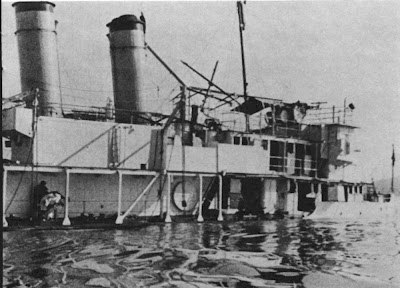
The riverboat and three oil steamers Mei Ping, Mei An and the Mei Hsia came under fire from nine A4N. Two bombs from a B4Y also hit the Panay.
Of the Sailors on board, three were killed and twenty seven of the remaining forty-three were injured. Five civilians were also aboard including newsmen from Movietone and Universal News.
Many of the men swam to the Ohau, an American craft nearby. The Royal Navy also had the HMS Ladybird and the HMS Bee nearby that assisted with the wounded.
The Japanese have said that they saw no flags designating the ship as American. They are calling this an accident and do not wish any hostility with the United States.

The riverboat and three oil steamers Mei Ping, Mei An and the Mei Hsia came under fire from nine A4N. Two bombs from a B4Y also hit the Panay.
Of the Sailors on board, three were killed and twenty seven of the remaining forty-three were injured. Five civilians were also aboard including newsmen from Movietone and Universal News.
Many of the men swam to the Ohau, an American craft nearby. The Royal Navy also had the HMS Ladybird and the HMS Bee nearby that assisted with the wounded.
The Japanese have said that they saw no flags designating the ship as American. They are calling this an accident and do not wish any hostility with the United States.
Sunday, June 19, 2005
The Anglo-German Naval Agreement
After two weeks of negotiations, Germany and Great Britain have finalized an agreement between the two nations regarding Naval building. It is now known as the Anglo-German Naval Agreement (A.G.N.A.)
The Germans will be limited to only 35% of the British Royal Navy. In addition, Germany would have to build a balanced fleet so as not to concentrate their materials into one class of ship.
The agreement as it has been agreed to:
The Germans will be limited to only 35% of the British Royal Navy. In addition, Germany would have to build a balanced fleet so as not to concentrate their materials into one class of ship.
The agreement as it has been agreed to:
"Exchange of Notes between His Majesty's Government in the United Kingdom and the German Government regrading the Limitation of Naval Armaments-London, June 18, 1935.
(1)
Sir Samuel Hoare to Herr von Ribbentrop Your Excellency, Foreign Office, June 18, 1935
During the last the last few days the representatives of the German Government and His Majesty's Government in the United Kingdom have been engaged in conversations, the primary purpose of which has been to prepare the way for the holding of a general conference on the subject of the limitation of naval armaments. I have now much pleasure in notifying your Excellency of the formal acceptance by His Majesty's Government in the United Kingdom of the proposal of the German Government discussed at those conversations that the future strength of the German navy in relation to the aggregate naval strength of the Members of the British Commonwealth of Nations should be in the proportion of 35:100. His Majesty's Government in the United Kingdom regard this proposal as a contribution of the greatest importance to the cause of future naval limitation. They further believe that the agreement which they have now reached with the German government, and which they regard as a permament and definite agreement as from to-day between the two Governments, will facilitate the conclusion of a general agreement on the subject of naval limitation between all the naval Powers of the world.
2. His Majesty's Government in the United Kingdom also agree with the explanations which were furnished by the German representatives in the course of the recent discussions in London as the method of application of this principle. These explanations may be summarised as follows:-
(a) The ratio of 35:100 is to be a permanent relationship, i.e. the total tonnage of the German fleet shall never exceed a percentage of 35 of the aggregate tonnage of the naval forces, as defined by treaty, of the Members of the British Commonwealth of Nations, or, if there should in future, be no treaty limitations of the Members of the British Commonwealth of Nations.
(b) If any future general treaty of naval limitation should not adopt the method of limitation by agreed rations between the fleets of different Powers, the German Government will not insist on the incorporation of the ratio mentioned in the preceding sub-paragraph in such future general treaty, provided that the method therein adopted fo the future limitation of naval armaments is such as to give Germany full guarantees that this ratio can be maintained.
(c) Germany will adhere to the ratio 35:100 in all circumstances, e.g. the ratio will not be affected by the construction of other Powers. If the general equilibrium of naval armaments,as normally maintained in the past, should be violently upset by any abnormal and exceptional construction by other Powers, the German Government reserve the right to invite His Majesty's Government in the United Kingdom to examine the new situation thus created.
(d)The German Government favour, the matter of limition of naval armaments, that system which divides naval vessels into categories, fixing the maximum tonnage and/or armament for vessels in each category, and allocates the tonnage to be allowed to each Power by categories of vessels. Consequently in principle, and subject to (f) below, the German Government are prepared to apply the 35 per cent. ratio to the tonnage of each category of vessel to be maintained, and to make any variation of this ratio in a particular category or categories dependent on the arrangements to this end that may be arrived at in a future general treaty on naval limitation, such arrangements being based on the principle that any increase in one category would be compensated for by a corresponding reduction in others. If no general treaty on naval limitation should be concluded, or if the future general treaty should not contain provision creating limitation by categories, the manner and degree in which the German Government will have the right to vary the 35 pe cent. ration in one or more categories wil be a matter for settlement by agreement between the German Government and His Majesty's Government in the United Kingdom, in the light of the naval situation then existing.
(e) If, and for so long as other important naval Powers retain a single category for cruisers and destroyers, Germany shall enjoy the right to have a single category for these two classes of vessels, although she would prefer to see these classes in two categories.
(f) In the matter of submarines, however, Germany, while not exceeding the ratio of 35:100 in respect of total tonnage, shall have the right to possess a submarine tonnage equal to the total submarine tonnage possessed by the Members of the British Commonwealth of Nations. The German Government, however, undertake that, except in the circumstances indicated in the immediately following sentence, Germany's submarine tonnage shall not exceed 45 per cent. of the total of that possessed by the Members of the British Commonwealth of Nations. The German Government reserve the right, in the event of a situation arising, which in their opinion, makes it necessary for Germany to avail herself of her right to a percentage of submarine tonnage exceeding the 45 per cent. above mentioned, to give notice this effect to His Majesty's Government in the United Kingdom, and agree that the matter shall be the subject of friendly discussion before the German Government exercise that right.
(g) Since it is highly improbable that the calculation of the 35 per cent. ratio should give for each category of vessels tonnage figures exactly divisible by the maximum individual tonnage permitted for ships in that category, it may be necessary that adjustments should be make in order that Germany shall not be debarred from utilising her tonnage to the full. It has consequently been agreed that the German Government and His Majesty's Government in the United Kingdom will settle by common accord what adjustments are necessary for this purpose, and it will be understood that this procedure shall not result in any substantial or permament departure from the ratio 35:100 in respect of total strengths.
3. With reference to sub-paragraph (c) of the explanations set out above, I have the honour to inform you that His Majesty's Government in the United Kingdom have taken note of the reservation and recognise in the right therein set out, on the understanding that the 35:100 ratio will be maintained in default of agreement to the contrary between the two Governments.
4. I have the honour to request your Excellency to inform me that the German Government agree that the proposal of the German Government has been correctly set out in the preceding paragraphs of this note.
I have. & c.
SAMUEL HOARE
(2)
(Translation)
Herr von Ribbentrop to Sir Samuel Hoare
Your Excellency, London, June 18, 1935
I have the honour to acknowledge the receipt of your Excellency's note of to-day's date, in which you were so good as to communicate to me on behalf of His Majesty's Government in the United Kingdom the following:-
(Here follows a German translation of paragraphs 1 to 3 of No. 1.)
I have the honour to confirm to your Excellency that the proposal of the German Government is correctly set forth in the foregoing note, and I note with pleasure that His Majesty's Government in the United Kingdom accept this proposal.
The German Government, for their part, are also of the opinion that the agreement at which they have now arrived with His Majesty's Government in the United Kingdom, and which they regard as a permanent and definite agreement with effect from to-day between the two Governments, will facilitate the conclusion of a general agreement on this question between all the naval Powers of the world.
I have, & c.
JOACHIM VON RIBBENTROP,
Ambassador Extraordinary and Plenipotentiary of Germany
Subscribe to:
Posts (Atom)