After the recent widespread pogroms throughout Germany and Austria that led to massive amounts of damage to Jews and Jewish property, the British Empire has severed diplomatic ties to the German nation.
This comes only six weeks after brokering a deal with France and Italy to bring the Sudetenland under Nazi control.
Showing posts with label Sudetenland. Show all posts
Showing posts with label Sudetenland. Show all posts
Saturday, November 15, 2008

Sunday, November 9, 2008
Goebbels speaks at Bürgerbräukeller
In the hours after Ernst vom Rath's death in Paris, Minister Joseph Goebbels gave an impassioned speech at Bürgerbräukeller. This was also to commemorate the Beer Hall Putsch of 1923. This night is accorded great significance by the Nazi Party as the Tag der Bewegung (Day of the Movement). Those present were many senior Party members who well remember the night fifteen years prior.
The night was set aside for all the Nazis to celebrate this event in the formation of the party. Chancellor Hitler was in attendance and was expected to speak as has been the tradition for numerous years. He was seen discussing a matter with associates and then abruptly left the event.
This left Propaganda Minister Joseph Goebbels to carry on with the event. Goebbels, though in charge of propaganda, lacks the fiery and passionate rhetoric and charisma of the Chancellor. He also has been seen as something of a failure due to his tepid performance during the Sudeten Crisis. Goebbels told those in attendance that "the Führer has decided that… demonstrations should not be prepared or organised by the party, but insofar as they erupt spontaneously, they are not to be hampered." Which seemed to say that if violence against Jews began in retaliation for the death of Ernst vom Rath, the Nazi Party would not interfere.
The night was set aside for all the Nazis to celebrate this event in the formation of the party. Chancellor Hitler was in attendance and was expected to speak as has been the tradition for numerous years. He was seen discussing a matter with associates and then abruptly left the event.
This left Propaganda Minister Joseph Goebbels to carry on with the event. Goebbels, though in charge of propaganda, lacks the fiery and passionate rhetoric and charisma of the Chancellor. He also has been seen as something of a failure due to his tepid performance during the Sudeten Crisis. Goebbels told those in attendance that "the Führer has decided that… demonstrations should not be prepared or organised by the party, but insofar as they erupt spontaneously, they are not to be hampered." Which seemed to say that if violence against Jews began in retaliation for the death of Ernst vom Rath, the Nazi Party would not interfere.
Saturday, October 11, 2008
Czechoslovakia complies
Preceding the Munich conference, the Czechoslovakian people would say "Even if our allies fail us, no matter if we are left to face overwhelming odds and certain defeat, nevertheless Czechoslovakia will fight rather than yield!"
Newly installed Prime Minister General Jan Syrový said in a nationwide broadcast "As soldier and as Premier ... I am passing through the saddest moment of my life, for I am fulfilling a most painful duty, a duty which for me is worse than death. . . . We were confronted with a choice between desperate and hopeless defense, which would have meant the sacrifice of our whole younger generation, their children and their wives, and acceptance of the conditions imposed on us under pressure and without war, which in their mercilessness are unexampled in history. There are smaller states than ours that lead healthy existences. . . . We shall be within narrow frontiers, but we shall be all together in one family! . . . Our army will stand guard over the nation as before. . . . Trust us!"
Newly installed Prime Minister General Jan Syrový said in a nationwide broadcast "As soldier and as Premier ... I am passing through the saddest moment of my life, for I am fulfilling a most painful duty, a duty which for me is worse than death. . . . We were confronted with a choice between desperate and hopeless defense, which would have meant the sacrifice of our whole younger generation, their children and their wives, and acceptance of the conditions imposed on us under pressure and without war, which in their mercilessness are unexampled in history. There are smaller states than ours that lead healthy existences. . . . We shall be within narrow frontiers, but we shall be all together in one family! . . . Our army will stand guard over the nation as before. . . . Trust us!"
The soldiers, as they withdrew, gave bystanders dark scowls and muttered oaths, the Czech officers avoided meeting civilian eyes, discharged their bitter duty with compressed lips. Nazi folk of the Sudeten town of Cesky Krumlov were the first Germans to dishonor themselves by opening dastardly fire upon the retreating Czech soldiers' backs. These Sudetens were also the first to smash windows and pillage shops and homes owned by Czechs, Jews and non-Nazi Sudetens such as Communists, Socialists and Social Democrats. Such outrages were not typical but exceptional, according to latest dispatches. The German army entered those parts of Czechoslovakia which it is to take over progressively by October 10 in the same peaceful fashion as it entered Austria, was cheered last week by civilians.
The German troops, ordered to swing across the frontier at three different points between Helfenberg and Finsterau at 2 PM. precisely, had set their legs in motion on German soil at 1:58 PM by the wrist watch of their commander, Colonel General Wilhelm Ritter von Leeb. They entered first that part of the Bohemian Forest in which Schiller laid his play The Robbers. Since in these rustic parts there were no accommodations deemed suitable for high officers, these, on the first night, left their German troops sleeping in tents or peasant huts, themselves returned to sleep in hotels in Germany, hurried back next morning into Sudetenland.
Fifty-eight hours after the German Army, Dictator Hitler entered Czechoslovakia under a drizzling rain this week. Every German car on this road which might possibly have contained the Führer had been wildly cheered by Sudetens for hours beforehand, and when Adolf Hitler finally reached Eger, "The Sudeten Capital," its throngs were both hoarse and hysterical. It was less than seven months since Austrians had similarly welcomed "our Deliverer," and the Führer seemed much moved as he made what was for him an exceptionally humble speech: "In this hour I want to thank the Almighty for having blessed us in the past, and to pray that He may also bless us in the future. . . . Germany is happy! . . . All are comrades ready to stake their lives for each other. . . . Over this greater German Reich is laid a German shield protecting it and a German sword defending it!"
"Vote for the Fatherland!" In Prague, although the sweeping catastrophe was obvious, editors took up the task of putting as bright an aspect on the situation as they could. The optimistic vigor of President Beneš remained dauntless. As the Chief Executive, he at once turned on every organ of propaganda and reassurance to persuade Czech refugees from areas in which plebiscites are to be held to return to the homes from which they fled under Nazi threats and "Vote for the Fatherland!"
Everywhere food was still plentiful in the land, much more so than in Germany, and there was no break in the amazing Czech morale, which endured nearly 400 years of oppression under Habsburg masters. With backhanded cheerfulness, the Narodni Listy reminded its readers: ''The history of the Czechs is almost an uninterrupted tragedy!"
Thursday, October 9, 2008
What of Germans outside Sudeten?
The Berlin Commission of Ambassadors which is implementing the Munich agreement has finished demarcating the major zones to be transferred to Germany, and has adjourned until Monday. But there’s still much to do. For example, there’s still the question of what to about Sudeten Germans outside the transfer zones. Originally their fate was to be decided by plebiscite, but it seems an exchange of populations is now preferred by the Commission. This might mean that the volunteers of the British Legion, who are to police the plebiscite areas, won’t be going after all.
Wednesday, October 8, 2008
Details of Munich Agreement hashed out
An international commission has met in Berlin to flesh out the Munich agreement. The Czechoslovakian government has protested its decision on the borders of the next area to be ceded to Germany, which includes many areas which have almost entirely Czech populations. Some 800,000 ethnic Czechs will come under German rule; but the Czech government has decided there is nothing that it can do about it, aside from protesting.
Slovakia has been given a far-reaching autonomy, but one which falls short of independence (which seemed likely earlier in the week). The Hungarian ultimatum expired yesterday, but the Czechs say they can’t respond to it due to the change in foreign ministers.
Slovakia has been given a far-reaching autonomy, but one which falls short of independence (which seemed likely earlier in the week). The Hungarian ultimatum expired yesterday, but the Czechs say they can’t respond to it due to the change in foreign ministers.
Sunday, October 5, 2008
Beneš Resigns
As a protest to the loss of the Sudeten and Teschen, President Eduard Beneš has resigned and left Czecho-Slovakia. Political problems continue for the Czecho-Slovakian government in the wake of the Munich Agreement. The Future of the nation is unclear. The Military has stood down and is not interfering with the German taking of the Sudetenland.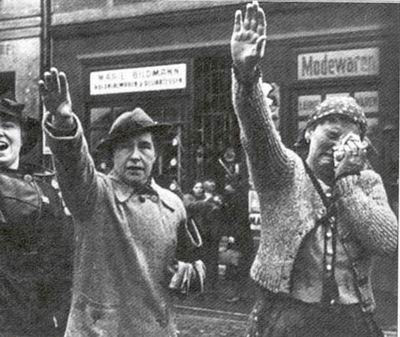
The Celebrations continue in Sudeten.

The Celebrations continue in Sudeten.
Saturday, October 4, 2008
Hitler in the Sudeten
Sudeten Germans continued their celebrations with the welcome of Hitler in Eger. People have been overcome with emotion by the arrival of the Nazis.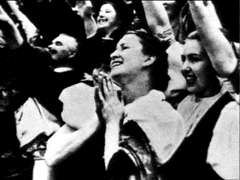 There have been anecdotal stories of Sudeten Germans needing to restrained by Nazi troops barely able to contain the celebratory mobs.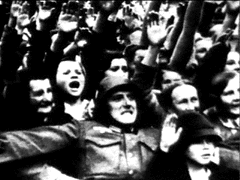
The ecstasy continues as many Sudetens claim this to be a liberation. The area had been for 400 years under Hapsburg Imperial control but was taken by Germans during the Great War. Many regions within the Sudetenland are heavily populated with German nationals.
Hitler's arrival in Eger increased the joy and happiness beyond what many would have believed possible. It is as if Christ had been walking the streets of Eger.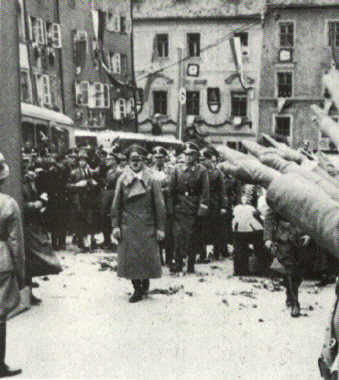 Many Sudeten Germans saluted the German Chancellor in the customary Nazi salute. He was greeted with flowers and the proverbial baby to kiss and bless.
Before arriving in the political hot spot of Eger, Chancellor Hitler also visited the border town of Asch. He and his entourage also stopped in the spa town of Franzensbad where he and Heinrich Himmler sampled some of the water from the Francis Spring thought to have curative powers.
 There have been anecdotal stories of Sudeten Germans needing to restrained by Nazi troops barely able to contain the celebratory mobs.
The ecstasy continues as many Sudetens claim this to be a liberation. The area had been for 400 years under Hapsburg Imperial control but was taken by Germans during the Great War. Many regions within the Sudetenland are heavily populated with German nationals.
Hitler's arrival in Eger increased the joy and happiness beyond what many would have believed possible. It is as if Christ had been walking the streets of Eger.
 Many Sudeten Germans saluted the German Chancellor in the customary Nazi salute. He was greeted with flowers and the proverbial baby to kiss and bless.
Before arriving in the political hot spot of Eger, Chancellor Hitler also visited the border town of Asch. He and his entourage also stopped in the spa town of Franzensbad where he and Heinrich Himmler sampled some of the water from the Francis Spring thought to have curative powers.
Sudeten Germans welcome Nazis & Wehrmacht
 After the Munich Agreement on September 30th, the already mobilized German Army began moving into the country. One of the first towns taken has been Eger, the site of much fighting in late September between Czechoslovakian troops and Nazi sympathizers.
The Czech people have much to be sad about. They lose 3.5 million citizens but also has lost 70% of its iron and steel, 70% of its electrical power and the famous Škoda Works. Even the very name of the young state has been changed: Czecho-Slovakia.
President Benes has had the the military print the march orders for his army and put the press on standby for a declaration of war. The nation is not giving in quite as easily as the major European powers would like.
Sudeten Germans have been jubilant and celebratory since the Munich Agreement was
 announced. Seemingly from nowhere Nazi flags and banners bearing the red, black and white colors and Swastika appeared in windows, on homes, businesses and on streetpoles. Children have notably been excited and have not been in schools since the announcement.
Two days ago Hitler marched unopposed into the Sudetenland. He said that it was the start of a 1000-year German Reich.
Polish troops continue to occupy Teschen as well.
Czechoslovakian Anger
Czechoslovakia has reacted largely with anger and disbelief. The President Eduard Beneš has protested the agreement which was made without Czechoslovakian input. British Prime Minister Chamberlain has told the President that if the country chose to fight Germany for the Sudetenland, they would have to do so without British support.
The people of Prague gathered to protest the sacrifice of their lands, economy and people for Appeasement.

The people of Prague gathered to protest the sacrifice of their lands, economy and people for Appeasement.
Friday, October 3, 2008
British Politics in the wake of the Munich Agreement
The British are still celebrating their escape from war, in their different ways. The King has thanked his people for their steadfastness and his prime minister for his peacemaking. The churches were packed with thanksgivers yesterday, ‘Peace Sunday’.
Chamberlain is still "The Man of the Hour". The new Westminster Hospital has been endowed with £1,000 for a bed, to be named ‘The Neville Chamberlain Bed’, ‘in perpetual remembrance of great efforts made by the Prime Minister in the cause of European peace’. Lucio, in the Manchester Guardian quotes some of the more fulsome paeans of praise from the press, for example this one from James Douglas in Saturday’s Daily Express:
The preparations for war are winding down. But there are still political activities after the Agreement. Sydney King-Farlow, in a letter to the editor of The Times, describes the disaster which has been averted:
Chamberlain is still "The Man of the Hour". The new Westminster Hospital has been endowed with £1,000 for a bed, to be named ‘The Neville Chamberlain Bed’, ‘in perpetual remembrance of great efforts made by the Prime Minister in the cause of European peace’. Lucio, in the Manchester Guardian quotes some of the more fulsome paeans of praise from the press, for example this one from James Douglas in Saturday’s Daily Express:
God has raised up in Neville Chamberlain a deliverer. Are we going to waste him? Are we as great as he is? Are we as noble? Are we as pure in heart? Beware of the old evil that is lurking within us, thirsting to destroy us.More prosaically, there is speculation that if the House of Commons is hostile to Chamberlain’s report on Munich today, then he may take the country to a general election to capitalise on his popularity among the people. (An election isn’t due until 1940.) Chamberlain has already lost one minister over Munich, Duff Cooper, the First Lord of the Admiralty. His resignation speech, if fiery enough, could spark a revolt among those backbenchers who think too high a price has been paid for peace. Certainly Labour will be critical: one prominent Labour MP, Harold Nicolson, spoke in Manchester on Saturday and said
We have betrayed a valiant little country and a great democratic idea. There are many people who feel that in so doing we have achieved peace for a generation. They are wholly mistaken. We have not achieved peace for a generation: we have achieved it only for eight months.And the ‘Peace Pact’ which Chamberlain signed with Hitler was "not worth the paper it is written on".
The preparations for war are winding down. But there are still political activities after the Agreement. Sydney King-Farlow, in a letter to the editor of The Times, describes the disaster which has been averted:
He asks if this is not an opportune moment to try to reach an international agreement to prohibit the bombing of architectural and historical treasures in the great cities?Had war come upon us, and it was hanging on a hair, it would have begun with repeated attacks by fleets of aircraft which speedily would have converted the capital cities of Europe into heaps of smoking rubble. The noblest works of man which belong not only to particular countries but to the whole world would have disappeared for ever and the destruction of human life would have been appalling.
Germany begins taking the Sudeten
 So, after all those weeks of mounting tension over the fate of the Sudetens, it’s finally being resolved: German troops have begun occupying the Sudetenland. Polish troops have also moved into Teschen, and the Czech government has agreed to let a mixed commission decide the fate of the territory claimed by Hungary. The dismemberment of Czechoslovakia has begun.
House of Commons on the Munich Agreement
The British House of Commons begins to discuss the Munich Agreement. The House will vote on the agreement in the very near future
Wednesday, October 1, 2008
Secretary Hull responds to the Munich Agreement
The Munich Agreement has been hailed in Great Britain as "Peace for out Time" and has been respected by the French and Italians. There is no doubt the Germans are over the moon about it and that Czechoslovakia despises it. As for the United States, the reaction has been one of cautious optimism and concern for a near future of warfare. Secretary Hull released this statement:
"As to immediate peace results, it is unnecessary to say that the afford a universal sense of relief. I am not undertaking to pass upon the merits of the differences to which the Four-Power Pact signed Munich on yesterday related. It is hoped that in any event the forces which stand for the principles governing peaceful and orderly international relations and their proper application should not relax, but redouble, their efforts to maintain these principles of order under law resting on a sound economic foundation."
"As to immediate peace results, it is unnecessary to say that the afford a universal sense of relief. I am not undertaking to pass upon the merits of the differences to which the Four-Power Pact signed Munich on yesterday related. It is hoped that in any event the forces which stand for the principles governing peaceful and orderly international relations and their proper application should not relax, but redouble, their efforts to maintain these principles of order under law resting on a sound economic foundation."
Reactions in Great Britain to the Munich Agreement
After the return of the Prime Minister and news of the Agreement reached in Munich, there has been an air of jubilation throughout the British Empire. Lauds are being made at the honor of Great Britain, France, Italy and even Germany. The Lord Mayor of the Welsh city of Cardiff, O. C. Purnell has ordered that the flags of Italy, France and even the Swastika be flown over the city to honor these nations.
In spite of the joy that is in the air after the momentous event, there are detractors. The First Lord of the Admiralty Alfred Duff Cooper, 1st Viscount Norwich has resigned from his position due to the Munich Agreement. He criticised the Prime Minister for employing an Appeasement policy which is just as a effective as losing a war.
The King has accepted the resignation and noted that despite his acceptance of the resignation that he had enormous respect for Lord Cooper for standing by his convictions but that he is unable to agree with them.
It might seem churlish to express any doubts about the Munich agreement, given this tremendous outpouring of gratitude and relief. But doubts there are. Of course, having accepted, under enormous pressure, the terms of an agreement dismembering their country that they were not party to, the Czechs are none too happy about it: there have been massive protests in the streets of Prague. (The authorities had to blackout the streets in order to get them to disperse).
In Britain, Sir Norman Angell calls the agreement a ‘disgraceful sacrifice of innocent third parties’ and Robert Boothby, Conservative MP, calls it a victory for force. Sinclair, leader of the Liberals, says that ‘if war has been averted, peace has not yet been established’. For Leo Amery, the respite from war might be only brief, and should be used to bring in national service at once. The leader-writer of the Manchester Guardian admits that even if a war had been fought, there was no way that Czechoslovakia’s borders could remain as they were. But it remains to be seen whether Hitler is sincere in his desire for peaceful territorial revisions. And nobody who reads the terms carefully ‘can feel other than unhappy’, so harsh are they.
The London correspondent says that ‘At first it seemed like Armistice Day. The resemblance soon passed, but it is peace, however high the price and whoever has had to pay it’. The ARP and defence measures already taken are to remain in place, but nothing further will be done for now. Boxes for gas masks are to be procured and distributed, however! And Poland still wants Teschen, and it seems Czechoslovakia is unwilling to give it up.
Mussolini has also extended an invitation to Chamberlain to visit Rome. It is believed that similar accords can be made between the British Empire and the Fascist Italian State.
In spite of the joy that is in the air after the momentous event, there are detractors. The First Lord of the Admiralty Alfred Duff Cooper, 1st Viscount Norwich has resigned from his position due to the Munich Agreement. He criticised the Prime Minister for employing an Appeasement policy which is just as a effective as losing a war.
The King has accepted the resignation and noted that despite his acceptance of the resignation that he had enormous respect for Lord Cooper for standing by his convictions but that he is unable to agree with them.
It might seem churlish to express any doubts about the Munich agreement, given this tremendous outpouring of gratitude and relief. But doubts there are. Of course, having accepted, under enormous pressure, the terms of an agreement dismembering their country that they were not party to, the Czechs are none too happy about it: there have been massive protests in the streets of Prague. (The authorities had to blackout the streets in order to get them to disperse).
In Britain, Sir Norman Angell calls the agreement a ‘disgraceful sacrifice of innocent third parties’ and Robert Boothby, Conservative MP, calls it a victory for force. Sinclair, leader of the Liberals, says that ‘if war has been averted, peace has not yet been established’. For Leo Amery, the respite from war might be only brief, and should be used to bring in national service at once. The leader-writer of the Manchester Guardian admits that even if a war had been fought, there was no way that Czechoslovakia’s borders could remain as they were. But it remains to be seen whether Hitler is sincere in his desire for peaceful territorial revisions. And nobody who reads the terms carefully ‘can feel other than unhappy’, so harsh are they.
The London correspondent says that ‘At first it seemed like Armistice Day. The resemblance soon passed, but it is peace, however high the price and whoever has had to pay it’. The ARP and defence measures already taken are to remain in place, but nothing further will be done for now. Boxes for gas masks are to be procured and distributed, however! And Poland still wants Teschen, and it seems Czechoslovakia is unwilling to give it up.
Mussolini has also extended an invitation to Chamberlain to visit Rome. It is believed that similar accords can be made between the British Empire and the Fascist Italian State.
Tuesday, September 30, 2008
"It is Peace for our Time"
Prime Minister Neville Chamberlain landed at the Heston Aerodrome earlier today to scores of citizens hoping for a word on the historic events of this morning in Munich. In addition to the agreement of the cession of the Sudetenland to Germany, he also procured an Anglo-German peace agreement between Germany and Great Britain to supplement AGNA. After disembarking, he said
Before arriving at Buckingham Palace, King George VI sent the Prime Minister a letter telling the statesman of the Empire's gratitude for the deals brokered by the Prime Minister. The King also told the British People
...the settlement of the Czechoslovakian problem, which has now been achieved is, in my view, only the prelude to a larger settlement in which all Europe may find peace. This morning I had another talk with the German Chancellor, Herr Hitler, and here is the paper which bears his name upon it as well as mine (waves paper to the crowd).Later, he also had to speak to people outside his residence at No. 10 Downing Street.Some of you, perhaps, have already heard what it contains but I would just like to read it to you. "We regard the agreement signed last night and the Anglo-German Naval Agreement, as symbolic of the desire of our two peoples never to go to war with one another again.

Many of the Prime Minister's colleagues have registered their pleasure at the resolution reached earlier today. Cabinet members whooped and hollered when the Prime Minister was accorded an honor never given to a Prime Minister in British History. He was asked to Buckingham Palace and appeared at the balcony usually occupied by the monarchy.
My good friends, this is the second time in our history that there has come back from Germany to Downing Street peace with honour. I believe it is peace for our time. We thank you from the bottom of our hearts. And now I recommend you to go home and sleep quietly in your beds.
Before arriving at Buckingham Palace, King George VI sent the Prime Minister a letter telling the statesman of the Empire's gratitude for the deals brokered by the Prime Minister. The King also told the British People
After the magnificent efforts of the Prime Minister in the cause of peace, it is my fervent hope that a new era of friendship and prosperity may be dawning among the peoples of the world.Reaction has already started to pour in throughout the country and the world and it is largely positive.
Agreement in Munich
 An agreement has been made by the leaders of the four powers who met in Munich on September 28th. Today, in the early hours, all four signed the agreement ceding the Sudetenland to the German nation. Also resolved are the territorial cessions to Poland and Hungary. Despite the loss to Czechoslovakia, War has been averted!
What follows is the agreement as signed by the four countries. It is still protested by the USSR's Joseph Stalin due Czechoslovakia's absence.
GERMANY, the United Kingdom, France and Italy, taking into consideration the agreement, which has been already reached in principle for the cession to Germany of the Sudeten German territory, have agreed on the following terms and conditions governing the said cession and the measures consequent thereon, and by this agreement they each hold themselves responsible for the steps necessary to secure its fulfilment:
(1) The evacuation will begin on 1st October.
(2) The United Kingdom, France and Italy agree that the evacuation of the territory shall be completed by the 10th October, without any existing installations having been destroyed, and that the Czechoslovak Government will be held responsible for carrying out the evacuation without damage to the said installations.
(3) The conditions governing the evacuation will be laid down in detail by an international commission composed of representatives of Germany, the United Kingdom, France, Italy and Czechoslovakia.
(4) The occupation by stages of the predominantly German territory by German troops will begin on 1st October. The four territories marked on the attached map will be occupied by German troops in the following order:
The territory marked No. I on the 1st and 2nd of October; the territory marked No. II on the 2nd and 3rd of October; the territory marked No. III on the 3rd, 4th and 5th of October; the territory marked No. IV on the 6th and 7th of October. The remaining territory of preponderantly German character will be ascertained by the aforesaid international commission forthwith and be occupied by German troops by the 10th of October.
(5) The international commission referred to in paragraph 3 will determine the territories in which a plebiscite is to be held. These territories will be occupied by international bodies until the plebiscite has been completed. The same commission will fix the conditions in which the plebiscite is to be held, taking as a basis the conditions of the Saar plebiscite. The commission will also fix a date, not later than the end of November, on which the plebiscite will be held.
(6) The final determination of the frontiers will be carried out by the international commission. The commission will also be entitled to recommend to the four Powers, Germany, the United Kingdom, France and Italy, in certain exceptional cases, minor modifications in the strictly ethnographical determination of the zones which are to be transferred without plebiscite.
(7) There will be a right of option into and out of the transferred territories, the option to be exercised within six months from the date of this agreement. A German-Czechoslovak commission shall determine the details of the option, consider ways of facilitating the transfer of population and settle questions of principle arising out of the said transfer.
(8) The Czechoslovak Government will within a period of four weeks from the date of this agreement release from their military and police forces any Sudeten Germans who may wish to be released, and the Czechoslovak Government will within the same period release Sudeten German prisoners who are serving terms of imprisonment for political offences.
Munich, September 29, 1938.
ADOLF HITLER,
NEVILLE CHAMBERLAIN,
EDOUARD DALADIER,
BENITO MUSSOLINI.
The agreement was signed at 1.30 this morning and the terms of the agreement were issued an hour later.
ADOLF HITLER,
NEVILLE CHAMBERLAIN,
EDOUARD DALADIER,
BENITO MUSSOLINI.
The agreement was signed at 1.30 this morning and the terms of the agreement were issued an hour later.
Monday, September 29, 2008
Munich Conference
The Four Powers met in Munich in an effort to keep war from occurring in Europe.
Despite the location of the problem being Czechoslovakia, it is not represented at a conference to decide it's fate. Joseph Stalin, premier of the USSR has voiced anger at this exclusion.
Despite the location of the problem being Czechoslovakia, it is not represented at a conference to decide it's fate. Joseph Stalin, premier of the USSR has voiced anger at this exclusion.
Sunday, September 28, 2008
Jews barred from Legal Practices
Starting today, Jews in all lands under Nazi power will be prohibited from practicing law. The pronouncement came out yesterday amidst the tension of the Sudetenland crisis.
It should surprise few that the Nazi Party would take this away. At this point, it would be indecent for Jews who are not accorded the same rights under the law to practicing law.
It should surprise few that the Nazi Party would take this away. At this point, it would be indecent for Jews who are not accorded the same rights under the law to practicing law.
Saturday, September 27, 2008
"A Last Effort"
Earler today, Neville Chamberlain went on the BBC Radio and proclaimed that despite France and the USSR's military preparations, the British would not be going to war over Czechoslovakian independence. Chamberlain asked for "a last effort" and another conference with Hitler.
Then Hitler made an announcement that he would meet with France, Great Britain and Italy in Munich to discuss and resolve the conflict.
Then Hitler made an announcement that he would meet with France, Great Britain and Italy in Munich to discuss and resolve the conflict.
Friday, September 26, 2008
World War?
Tonight, the World wonders if it will wake up to a World at War.
Great Britain assured France and Czechoslovakia that should Germany invade, it would stand by France in its agreements. The USSR also made similar statements to that effect. French and British Governments discussed military plans today.
Adolf Hitler also took the day to make speeches on the situation. He told the German people that once this situation is resolved, there will be no more territorial problems for the Germans. He also alluded to a severe relocation program that will likely occur in the Czech lands. Hitler even said "it is the last territorial claim which I have to make in Europe, but it is the claim from which I will not recede."
Great Britain assured France and Czechoslovakia that should Germany invade, it would stand by France in its agreements. The USSR also made similar statements to that effect. French and British Governments discussed military plans today.
Adolf Hitler also took the day to make speeches on the situation. He told the German people that once this situation is resolved, there will be no more territorial problems for the Germans. He also alluded to a severe relocation program that will likely occur in the Czech lands. Hitler even said "it is the last territorial claim which I have to make in Europe, but it is the claim from which I will not recede."
Subscribe to:
Posts (Atom)