Showing posts with label Japan. Show all posts

Thursday, December 8, 2011

Photo Essay: December 7th, 1941. Pearl Harbor

Pearl Harbor bird's eye view October 30, 1941
Taken from Residential areas.  Japanese bombers headed toward the harbor with anti-aircraft fire.
Hangar burns on Ford Island

USS Shaw explodes losing its bow

The USS West Virginia may have taken seven torpedo hits


B-17 at Hickam Field

Carnage from the air


From left to right: The West Virginia (BB-48), The Tennessee (BB-43) and the sunken Arizona (BB-39) 


The USS Arizona explodes
The Battleship USS California sinking

The Superstructure of the USS Arizona remains above the shallow waters of Pearl Harbor
Heavy Damage to the USS Casin and the USS Downes stationed at Pearl Harbor
The West Virginia and the capsized Oklahoma
USS Shaw burns whilst men on the pier throw water onto the fire.

Japanese plane dives to extinguish flames

One of the first photos to be taken.  Machine-gunned P-40

The Battleship USS California is afire and listing to port.
Oil burns.  USS Maryland in the center


Japan's Declaration of War

IMPERIAL RESCRIPT


We, by grace of heaven, Emperor of Japan, seated on the Throne of a line unbroken for ages eternal, enjoin upon ye, Our loyal and brave subjects:


We hereby declare War on the United States of America and the British Empire. The men and officers of Our Army and Navy shall do their utmost in prosecuting the war. Our public servants of various departments shall perform faithfully and diligently their respective duties; the entire nation with a united will shall mobilize their total strength so that nothing will miscarry in the attainment of Our war aims.


To insure the stability of East Asia and to contribute to world peace is the far-sighted policy which was formulated by Our Great Illustrious Imperial Grandsire and Our Great Imperial Sire succeeding Him, and which We lay constantly to heart. To cultivate friendship among nations and to enjoy prosperity in common with all nations, has always been the guiding principle of Our Empire's foreign policy. It has been truly unavoidable and far from Our wishes that Our Empire has been brought to cross swords with America and Britain. More than four years have passed since China, failing to comprehend the true intentions of Our Empire, and recklessly courting trouble, disturbed the peace of East Asia and compelled Our Empire to take up arms. Although there has been reestablished the National Government of China, with which Japan had effected neighborly intercourse and cooperation, the regime which has survived in Chungking, relying upon American and British protection, still continues its fratricidal opposition. Eager for the realization of their inordinate ambition to dominate the Orient, both America and Britain, giving support to the Chungking regime, have aggravated the disturbances in East Asia. Moreover these two Powers, inducing other countries to follow suit, increased military preparations on all sides of Our Empire to challenge Us. They have obstructed by every means Our peaceful commerce and finally resorted to a direct severance of economic relations, menacing gravely the existence of Our Empire. Patiently have We waited and long have We endured, in the hope that Our government might retrieve the situation in peace. But Our adversaries, showing not the least spirit of conciliation, have unduly delayed a settlement; and in the meantime they have intensified the economic and political pressure to compel thereby Our Empire to submission. This trend of affairs, would, if left unchecked, not only nullify Our Empire's efforts of many years for the sake of the stabilization of East Asia, but also endanger the very existence of Our nation. The situation being such as it is, Our Empire, for its existence and self-defense has no other recourse but to appeal to arms and to crush every obstacle in its path.


The hallowed spirits of Our Imperial Ancestors guarding Us from above, We rely upon the loyalty and courage of Our subjects in Our confident expectation that the task bequeathed by Our forefathers will be carried forward and that the sources of evil will be speedily eradicated and an enduring peace immutably established in East Asia, preserving thereby the glory of Our Empire.

In witness whereof, we have hereunto set our hand and caused the Grand Seal of the Empipre to be affixed at the Imperial Palace, Tokyo, this seventh day of the 12th month of the 15th year of Shōwa, corresponding to the 2,652nd year from the accession to the throne of Emporer Jimmu.


(Released by the Board of Information, December 8, 1941. Japan Times & Advertiser)

Wednesday, December 7, 2011

A Summary of today's attack on Pearl Harbor

The Hawaiian island of Oahu was attacked by the Japanese Imperial Navy this morning.  The attack came from the air and began just before 8 o'clock local time.

The first attack was at Ford island, the US Navy's fortress in the sea.  Then the first planes moved to Hickam Field and did considerable damage to planes and installations there.  Wheeler field also sustained considerable damage.  Most of the planes there were destroyed.  Bellows Field on the windward side of the island also reports damage.
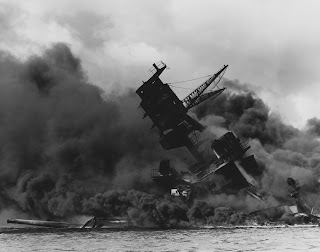
The Arizona sinking at Pearl Harbor
At Pearl Harbor, where's based the Pacific Fleet, the ships were attacked.  Many of the battleships were hit.  The USS Oklahoma was set afire.  The Arizona, next to an already torpedoed Nevada, was bombed and torpedoed early in the attack.  It sank in less than nine minutes in the shallow harbor.  An eyewitness claims it jumped 15-20 feet and broke in two.  Many other naval vessels sustained heavy damage such as the California, the West Virginia, the Tennessee and even Admiral Kimmel's own flagship, the USS Pennsylvania.  The training ship USS Utah was also sunk.

A destroyer USS Shaw was severely damaged in drydock.

Lines of communication between Army posts and Navy air drones are down.

The Navy has made no statements.  The Army has issued orders for the civilian population to remain off the streets.

Everyone here on the islands was taken by surprise by the attack.  It is difficult to believe that an air raid on the these beautiful islands has actually happened and that lives have been lost.

It is thought that planes came from the south.  One bomb dropped in front of the Governor's mansion at Washington Place and killed one man.  There was heavy bombing in the Pacific Heights residential districts killed one woman.

Casualty counts are changing every minute.  No estimate has been given.

Bulletin

President Roosevelt says the Japanese have attacked Pearl Harbor from the air.  

Bulletin

<<<<<<<<<<>>>>>>>>>>


FLASH


Washington, DC.


The White House has announced that the Japanese have attacked Pearl Harbor.


<<<<<<<<<<<END>>>>>>>>>>>

Monday, January 5, 2009

Japan has a new Prime Minister

Despite his countries successes in China, Prince Fumimaro Konoe is resigning his position as Prime Minister of Japan.

He said he was tired of being a robot for the military. His resignation became official yesterday with the instatement of the newly appointed Baron Hiranuma.

Konoe will now be chariman of the Privy Council.

Baron Kiichiro Hiranuma is notable for his Spartan lifestyle: he sleeps four hours per day, eats only two meals and participates regularly in the sports of archery and fencing. He does all this at the wise age of 73 years. The new Prime Minister is also a founder of a patriotic society.

Friday, January 2, 2009

Japan responds to US State Department

Yesterday, the US State Department made its official rejection of current policies in place in China under Japanese authority.

It was inevitable that Japan would respond as is their right. In summation, the Japanese Imperial Government replied stating it was establishing a "new order based on genuine international justice throughout East Asia". The note also went on to make it clear that there is not one nation which has the power to establish order in areas not under sovereignty particularly that of the United States. In other words, the Japanese are calling into question whether the US has any right to complain about areas that are not under its express control in China.

Thursday, January 1, 2009

Japan's New Order in China meets opposition

The United States Department of State does not believe that Japan's new order in China is beneficial. Most especially, the government feels that there are too many conflicts with US interests in China. There have been numerous economic and human rights violations during Japan's sometimes ruthless campaign on mainland Asia.

United States declared that these interferences are not only "unjust and unwarranted" but also "counter to the provisions of several binding international agreements, voluntarily entered into" to which the United States and Japan are both parties.

The Government of the United States can not assent to the establishment of a regime "which would arbitrarily deprive them of the long-established rights of equal opportunity and fair treatment".

Friday, October 10, 2008

Japanese close in on Wuhan

The Japanese have circled Wuhan, the current capital of China. Chinese forces continue to fight against Japanese aggression.

Saturday, October 4, 2008

Japanese capture Xinzhi

The Japanese Army has suffered some setbacks in its continued aggression against China. In the Jangxi province, the Chinese have managed to heavy casualties against the Japanese 106th division in the past week.

In response, the 101st division was ordered to support the beleaguered 106th. They crossed the lake on August 20th and breached the defensive lines of the Chinese 25th army. In addition, they were also able to capture Xinzhi.

Saturday, August 2, 2008

Japanese & Soviet conflict resolved

The details are not known at this time. However, sources have said that the conflict between the Japanese Empire and the Soviet Union ended on August 1st. The border between Soviet Union's Siberian wilderness and Japan's state of Manchuria, now called Manchukuo, will return to its previous situation on July 29th. This was the day the Japanese entered Siberia unprovoked.

Wednesday, July 30, 2008

Conflict at Broad Drum Peak

There has been an act of Japanese aggression at a point of disputed territory on the Manchurian and Soviet border. The Japanese attacked border guards and have been able to push some distance into Siberia.

Monday, June 23, 2008

Guerillas in the Fields

After marching from Qingdao (Tsingtao), Japanese forces finally reached the Huang (Yellow) River. Mobile Chinese forces limited Japanese control to the railway zone. Despite their military superiority, the Japanese discovered that they could capture major Chinese urban centers, but that Chinese guerillas controlled the rural areas. As a result, Chinese troops were able to conduct successful operations against the Japanese during the Spring of 1938.

Friday, June 13, 2008

Japanese land at Anqing

Today, the Japanese landed Naval forces on the Coast at Anqing. The Chinese 11th Army is nearby. More information as it happens.

Tuesday, June 10, 2008

Flooding of the Yellow River

Reports have been received that the Yellow River (Huang River) near Huayuankou. In the early morning hours of June 9th, local time, many of the local Chinese were caught unawares. The number of dead, missing and injured are unknown at this time. There has been considerable flooding in the area in the past eight years. The local populations are difficult to ascertain as records of the residents have not been effectively kept.

This flood is certainly coming at a bad time for the Japanese. This will impede their efforts at taking control of China.

Friday, May 30, 2008

Japan arrests Communists

It has been reported that 1300 alleged Communists have been arrested. Japan is appears hopes to rein in any oppositional political parties as its war with mainland Asia increases.

Wednesday, May 14, 2008

Chemical Weapons Ban

The League of Nations adopted a resolution today against the use of chemical weapons as used by Japan in its Chinese campaign. The resolution backs up Article 171 of the Treaty of Versailles and Article V of the Treaty in Relation to the Use of Submarines and Noxious Gases in Warfare. It has recently come to attention that the Japanese have used poison gas against the Chinese in Northern China.

Tuesday, April 29, 2008

City of Wuhan suffers more bombing

The Japanese have been bombing the city of Wuhan. It coincides with the Japanese Emporer's birthday today.

The Chinese though seem to be quite prepared and have been bringing Japanese planes down. The Battle continues.

Tuesday, April 8, 2008

Chinese score a vistory in Tai'erzhuang

On April 6th, the Chinese were able to beat back the Japanese after days of fighting.

Japanese troops were cut off by Chinese troops near Tai'erzhuang. On March 29th, the Japanese troops decided to tunnel under the walls to take the city. But upon emerging, they were killed by the Chinese.

On April 6th, the Japanese tried for a frontal assault. The Chinese were able to repel the Japanese attackers. Despite China's possible inability to capitalize on the retreat by the Japanese.

The Japanese has yet to acknowledge the victory.

Thursday, March 27, 2008

National Mobilization Bill

Yesterday, the Japanese government passed the National Mobilization Bill which gives the state dictatorial powers in the Japanese economy. The legislation goes into effect on May 5th.

This amounts to the Armed Forces of Japan fleecing the wealthy families of Japan.

His Imperial Majesty's Government, under its bill, proposes to run Japan under a Planning Commission with authority as complete as that of the Soviet Union State Planning Commission, but only "if in time of war it is found necessary." Much of the shouting and desk-banging in the Diet has been in efforts to find out whether His Imperial Majesty's Government considers that Japan today is at war—for Japan has not declared war on any country—and therefore whether or not the National Mobilization Bill would be operative as soon as passed.