On November 24th, Das Schwarze Korps, a Schutzstaffel periodical, claims that it would welcome the founding of a Jewish state.
"The German people are not in the least inclined to tolerate in their country hundreds of thousands of criminals, who not only secure their existence through crime, but also want to exact revenge... In such a situation we would be faced with the hard necessity of exterminating the Jewish underworld... The result would be the actual and final end of Jewry in Germany, its absolute annihilation."
Showing posts with label Germans. Show all posts
Showing posts with label Germans. Show all posts
Wednesday, November 26, 2008

Friday, November 16, 2007
Further Battling in China
Colonel Ott, a German advisor to the Chinese, has stated that the Japanese are lucky that the Germans are still there. otherwise, it is likely they'd be replaced by Soviet ones. Their continued presence also helps to protect the German citizens who remain in the country. If the officials were to leave, it is believed that the Chinese would be rather harsh against these citizens abroad.
In China there remains citizens of several countries such as Great Britain, of course, France, the US and Japan. Many of these citizens are claiming their extraterritorial rights to protect them from the prolonged fighting.
The Japanese remain unchecked in Northern China. The Japanese commander, Lieutenant General Seishiro Itagaki, while his motorized divisions roared over a Chinese strategic highway built by famed "Model Governor" Yen Hsi-shan of Shansi, announced: "We are pursuing the disorganized Chinese troops so fast that they are unable to reform their lines in the strong positions which they had prepared earlier in anticipation of their retreat."
The Japanese while fighting the battle for Shanghai, are also having to contend with uprising in Manchukuo. The weather has been cold enough to freeze the marshes and swamps of Manchukuo allowing for easy transportation of mechanized vehicles.
Wednesday, August 16, 2006
Berlin Olympics come to a Close
These Olympics have been notable not only in themselves but for the effect they have had upon all who have participated in them and watched them.
These have been the biggest athletic games ever staged, the best organized, the most largely attended, the most picturesque and most productive of new and startling records.
However, that is not only all true, but it is the picture constantly impressed on one's mind as one moves from one stirring score to another, always amid a good-humored, happy crowd, always under a forest of bright-colored flags, never lost of jostled with plenteous space around and courteous guides at hand.
That is the picture foreign visitors will take home, to the undoubted improvement of world relations and general amiability. This may be only a temporary truce in the world's quarrels, a pleasant interlude in the long procession of diplomatic disagreeableness, but even at the reaction cannot help but be good and lasting.
Take the effect on the German hosts themselves. One has noted everywhere not only pride in German athletic accomplishment - which has been really notable - and the utmost satisfaction in the great achievement of staging the show itself, but equal pride in the unstinted foreign praise given that achievement.
It is quite certain that the foreign reaction was awaited here with a ceratin measure of trepidation. There is manifest anxiety for once to win foreign praise. It has been forthcoming from every quarter and the anxious hosts are happy over the fact - happy and amiable beyond reckoning. They know now they have made an excellent impression upon upon their cosmopolitan visitors. They are back in the fold of nations who have "arrived".
Going a little deeper it is perhaps true also that this contact with many nationalities and races has made the Germans more human again after four long years of a régime which, while it strengthened, tended also to harden its votaries. It might even be said that this experience has deflated the German ego a bit. They have seen here for themselves that all races are good, some in certain respects perhaps even slightly superior to the Teutonic.
These Olympics will be remembered for the amazing feats of Jesse Owens of Ohio. His friendship with German athlete Lutz Long and competitor is a model for other athletes to emulate in the future.
The Olympics used a new technology, television to mixed results. It can be very difficult to discern images at time. It is a technology that much improvement can be made upon.
Thursday, August 10, 2006
Differences in Demeanor
Never has Berlin seen so many polyglot visitors. Every hotel is crowded beyond normal capacity and all its best known restaurants spend most of the dinner hour turning them away because there are no more seats.
Conversation in Adlon Hall at Tea Hour is reminiscent of Babel, with English running German hard as the predominant tongue and the Polish, Czech and Scandinavian Languages drowning out the customary Continental French.
English beyond doubt if the Latin of the modern world. In the press box at the Olympic Stadium and at most of the information offices more English is spoken than German. Yet in comparison with the crowds of Scandinavians, who make up the largest part of the foreign contingent, relatively few Englishmen or American are here. The Scandinavians, however, seem to get along better in English than anything else.
Scandinavians in the stands have adopted American cheering tactics and shout "Rah! Rah! Rah!" in unison.
Anybody interested in his fellowmen has been able to get a kick out of noting the difference of these foreign visitors. There is a good deal of truth in a familiar story which purports to classify national characteristics under such circumstances.
The Frenchman enters a hotel looking around with a general air indicating he would like to own it.
The German walks in looking as though some day he expects to own it.
The Englishman strolls in as though he does indeed own it.
The American goes in with the general air which seems to say he doesn't give a damn who owns it.
Wednesday, August 9, 2006
Norway beat Germany 2-0
Gloom pervaded the German morning papers today over the event in the Post Stadium yesterday where in the presence of Chancellor Hitler, Germany's Soccer team lost to Norway, 2-0.
"How could this happen?" the sports press cries bewildered. Germany's hopes actually centered on winning the gold medal in this event. With the crack Uraguayan team out the competition, they figured themselves the Olympics' best. Norway, on the other hand, was figured as a minor contender.
So sure was Germany of victory that Hitler for the first time failed to appear in the Olympic Stadium. All German victor until now have told the German press in interviews that they thing only of the Führer when competing and outdo themselves when he's there to watch.
Saturday, August 5, 2006
Owens wins Broad Jump
The Broad Jump had been one of the events of Owens' three in this eleventh Olympics that he had been most certain of winning. Lutz Long, so unheralded in German sporting circles for he is neither a soldier nor a policeman, tied Owens at 7.87 meters with his two leaps remaining. He forced Owens to catapult out near his own new world record of 26' 8 ½" in order to emerge victorious at all yesterday.
 So delighted was Chancellor Hitler by the gallant fight that Long had made that he congratulated him privately just before he himself left the stadium. In fact, his eagerness to receive the youthful German was so great that the Führer condescended to wait until his emissaries had pried Long loose from Owens, with whom he was affectionately walking along the track arm and arm in what could be called friendship. All Owens received was his gold medal which probably satisfied him just fine.
The broad jump was one of the most dramatic events of the entire day, surprising as that may sound. It started with the unusual flourish and ended the same way. In the morning the leapers had to beat 23' 5" to qualify.
Owens strolled over to the runway and, still in his pullovers, raced to the pit and tan right through, a customary warm-up gesture. But the red flag was raised greatly to the Buckeye Bullet's astonishment. That counted as one of three jumps. On his second try, which he made in earnest, Jesse hit the take-off board cleanly and sailed through the air. Again the red flag was waved for some mysterious reason.
The situation was getting to be alarming by this time. Owens had only one more jump left to stay in the competition. So, on his last attempt, he sprinted carefully, left the ground with a half foot clearance at the take-off and went past 25' safely.
In the afternoon, Owens had close call of that nature. The pressure came from Long. The German, carried along on the wings of superhuman endeavor - the hallmark of every Reich athlete in this meet - was bounding along right at Owens' heels. He was only an inch behind the American's 7.87 meters as they went for their last three jumps.
On his second in the final, Long hit the nail exactly on the head, doing the same distance as the Ohioan and tying him for the championship as the crowd went into frenzied ecstasy of applause. But the jubilation was short-lived.
Owens came thundering down the runway and drove into space a moment later. He had taken the play away at 7.94 meters and then drove beyond Long's reach with his final jump that cemented the distinction of his becoming the first 26-footer in Olympic history. Incidentally, the German in second place also surpassed the Olympic record.
 So delighted was Chancellor Hitler by the gallant fight that Long had made that he congratulated him privately just before he himself left the stadium. In fact, his eagerness to receive the youthful German was so great that the Führer condescended to wait until his emissaries had pried Long loose from Owens, with whom he was affectionately walking along the track arm and arm in what could be called friendship. All Owens received was his gold medal which probably satisfied him just fine.
The broad jump was one of the most dramatic events of the entire day, surprising as that may sound. It started with the unusual flourish and ended the same way. In the morning the leapers had to beat 23' 5" to qualify.
Owens strolled over to the runway and, still in his pullovers, raced to the pit and tan right through, a customary warm-up gesture. But the red flag was raised greatly to the Buckeye Bullet's astonishment. That counted as one of three jumps. On his second try, which he made in earnest, Jesse hit the take-off board cleanly and sailed through the air. Again the red flag was waved for some mysterious reason.
The situation was getting to be alarming by this time. Owens had only one more jump left to stay in the competition. So, on his last attempt, he sprinted carefully, left the ground with a half foot clearance at the take-off and went past 25' safely.
In the afternoon, Owens had close call of that nature. The pressure came from Long. The German, carried along on the wings of superhuman endeavor - the hallmark of every Reich athlete in this meet - was bounding along right at Owens' heels. He was only an inch behind the American's 7.87 meters as they went for their last three jumps.
On his second in the final,
 Long hit the nail exactly on the head, doing the same distance as the Ohioan and tying him for the championship as the crowd went into frenzied ecstasy of applause. But the jubilation was short-lived.
Owens came thundering down the runway and drove into space a moment later. He had taken the play away at 7.94 meters and then drove beyond Long's reach with his final jump that cemented the distinction of his becoming the first 26-footer in Olympic history. Incidentally, the German in second place also surpassed the Olympic record.
Friday, August 4, 2006
Big Medal Haul for US
The United States stole away what to date had been a distinctly German show by winning four out of five medal events today. On the third day, a crowd of 90,000 gathered for the morning preliminaries, and once again another capacity throng of 110,ooo later packed the Reich Sports Field Stadium. They came to cheer for mare German victories, but remained instead to turn their hosannas in the direction of the Americans.
The invincible Jesse Owens of Ohio won the broad jump at the Olympic record distance of 8.06 meters (26' 5 21/64"). Miss Stephens walked off with the Women's 100-meter dash final in world record time. Glenn Hardin slammed to the victory in the 400-meter hurdles, and John woodruff, a freshman from the University of Pittsburgh, gave America its first 800-meter triumph in twenty-four years.
Topping the achievement of the Star-Spangled Brigade, Owens twice broke the world 200-meter mark around the turn, as well as the Olympic standard, hitting the identical figures of 21.1 seconds in both trials.
The only championship to evade the Americans' grasp was the women's discus crown. And that went to Germany as Miss Gisela Mauermayer broke the Olympic record with a toss of 47.63 meters amid the exuberant shouts of her compatriots.
But Germany's share in the harvest was a relatively minor one. The United States closed so far ahead in the race for men's track and field championship that every one else is lapped at least a full circuit beyond.
Americans go 1-2 in 100-Meter dash
Jesse Owens won the 100-meter dash in what seemed a date with destiny. The Buckeye Bullet beat his nearest competitor, Ralph Metcalfe of Marquette University, by a single yard. The winning time of 10.3 seconds matched his time in the first round of heats.
The Americans finished 1-2 in front of 110,000 in the Reich Sports Field Stadium. The ovation they received was loud but only a whisper compared to the cheer that Karl Hein of Germany received.
Hardly a minute after Hitler had seated himself in his box, Erwin Blask of Germany unleashed a tremendous toss of 180' 6 ½", breaking Matt McGrath's Olympic Record. Hein, however, overhauled Blask with the best any Continental hammer-thrower ever has made: 185' 4 1/16" to give Germany its own 1-2 finish. The tumultuous applause was the loudest of the day.
The record breaking did not finsh with these two finals. Miss Helen Stephens of St. Louis Missouri, striding through the first heat of the women's 100-meter sprint turned in a dazzling 11.4 second run.
This was 4/10 of a second faster than Miss Stella Walsh's listed world record and 2/10 under the Missouri girl's own American record, which has yet to be accepted internationally.
To make it more emphatic, Miss Stephens slammed into the tape of the semi-final in 11.5 seconds. Miss Kaethe Krauss of Germany, in second place was carried along sufficiently by Miss Stephens' blinding speed to equal Miss Walsh's Olympic figure of 11.9 seconds.
It was a great day for sport as the United States took command of the men's track and field race for the first time with a total of 46 points to 31 ¼ for Germany and Finland's 30 ¼ points. But if one elects to score the women's tests with the men's than Germany, moving along the wings of a sport renaissance deeply rooted in nationalistic fervor, is at the head of the parade with 47 ¼ points.
German nationalism and the prejudice that seems to go with it revealed themselves somewhat disagreeably this afternoon. On the surface all was serene. The Führer apparently played no favorite. He did not publicly receive the winning Germans nor did he decide to greet decidedly non-Aryan Americans, Owens and Metcalfe.
But an investigation by some who had taken his departure yesterday to mean he did not want to shake hands with non-Aryan high jumpers, Cornelius Johnson and David Albritton. This investigation produced information which seemed collaborative. In the seclusion of his quarters under the stands the Reich's dictator did congratulate Hein and Blask, the hammer-throwers. Perhaps two and two makes four after all. If Hitler is going to avoid the African-Americans, he is going to have his work cut out for him.

From a general sporting standpoint, however, there could be no taking the play away from Owens. He left the stadium last night in the belief that he had broken the world record with his 10.2 time. But the usually efficient Germans have an annoying roundabout way of getting the news to the newspaper men and the athletes.
It was discovered this morning that Owen's new mark had been disallowed because of a following wind. Whether he or Miss Stephens will have the same experience tomorrow cannot be guessed. From the stands the breeze looked like a crosswind, but one can never tell about those things.
Owens won today because in truth he is the world's fastest human. No one ever ran a more perfect race. His start was perfect, his in-between running was perfect and his finish perfect.
The Buckeye Bullet ripped out of his starting holes as though slungby a giant catapult. He was ahead in his first stride and let the Osendarp and Wykoff battle behind him for what left of the race.
Metcalfe, hardly the best starter in the world, was off in atrocious fashion. He was sixth in the six man field in the getaway, but once in his stride he certainly moved. By sixty meters he had drawn up even with Hollander and begun to cut down the two yard advantage Owens had on him.
It was then a speed duel between the streamlined express and the old-fashioned steam engine that exuded sheer, rugged power. Metcalfe cut those two yards to one at the wire, but it was as close as he could get, losing by a yard a championship that had eluded him four years before by a hair.
Thursday, August 3, 2006
Hitler receives Olympians; snubs Americans
Miss Hilde (Tilly) Fleischer won the women's javelin throw and also broke the Olympic record. For once Germany's cup of joy was filled to overflowing.
The crowd was off to a good start in its applause of the Reich athletes when Miss Fleischer winged out the javelin on her first throw. And when she climbed to the victory pedestal she stood with arms outstretched in the Nazi salute to Hitler, tears in her eyes and a lump in her throat. To her went the distinction of being the first Olympic champion of 1936.
Chancellor Hitler himself witnessed the victories. With a group of State officials and National Socialist party leaders, including Julius Streicher, he spent the afternoon watching the games. He greeted the victors with a warm handclasp and a friendly pat on the back, while the welkin rang with the frenzied cheers of the spectators.
Americans also had great results for the day. Just as the setting sun dipped behind the concrete ramparts of the huge stadium America came in for her share of the glory. Cornelius Johnson, the kangaroo-legged Negro from California, won the high jump and in keeping with the general trend of things shattered the Olympic record too. This event was a slam for the United States, because Ave Albritton, Ohio State Negro, and Delos Thurber of Southern California took the other two medals.
But for politically minded persons in the crowd there was one rather disquieting incident connected with the march of these three Americans to the victory pedestal. The Führer had greeted all three medalists in other events -- the Germans and the Finns -- with a handclasp and words of congratulation. But five minutes before the United States jumpers moved in for the ceremony of the Olympic triumph Hitler left his box.
Johnson and Albritton are Negroes. None of the others were. Press box interpreters of this step chose to put two and two together. But there will be enough future Negro winners to warrant delaying passing judgment for the present.
- NYT
Berlin Happy & Festive
Berliners are enjoying their 16 days of Olympic fun. The Games of the XI Olympiad go on as the citizens of this beautiful city go about their lives and join in the festivities.
The mood is gay and festive. Many Berliners are enjoying themselves. It has been said that that not since the first Sunday after Armistice have Berliners been as jubilant.
Even those not in attendance, there are loudspeakers all over Berlin announcing the results of events. Clustered around many of these loudspeakers, Berliners wait to hear how their countrymen have fared.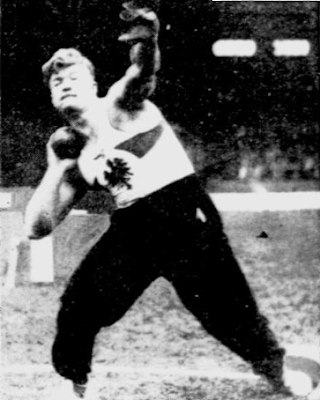
The Germans did not have long to wait for their first Olympic Champion. Miss Fleischer provided that in the Javelin contest.
Germany also had a champion when Hans Woellke won the shot-put earlier yesterday. Woellke threw the ball 53' 1 13/16" to surpass Leo Sextons Olympic record of 52' 6 3/16".
Sula Baerlund of Finland took silver and Gerhard Stoek, another German, took bronze. Sam Francis of Nebraska finished just out of the medals and Jack Torrance, Louisiana's state record holder, was fifth. Dimitri Zaitz of Boston College finished sixth.
The mood is gay and festive. Many Berliners are enjoying themselves. It has been said that that not since the first Sunday after Armistice have Berliners been as jubilant.
Even those not in attendance, there are loudspeakers all over Berlin announcing the results of events. Clustered around many of these loudspeakers, Berliners wait to hear how their countrymen have fared.

The Germans did not have long to wait for their first Olympic Champion. Miss Fleischer provided that in the Javelin contest.
Germany also had a champion when Hans Woellke won the shot-put earlier yesterday. Woellke threw the ball 53' 1 13/16" to surpass Leo Sextons Olympic record of 52' 6 3/16".
Sula Baerlund of Finland took silver and Gerhard Stoek, another German, took bronze. Sam Francis of Nebraska finished just out of the medals and Jack Torrance, Louisiana's state record holder, was fifth. Dimitri Zaitz of Boston College finished sixth.
Subscribe to:
Posts (Atom)