The Japanese Army has suffered some setbacks in its continued aggression against China. In the Jangxi province, the Chinese have managed to heavy casualties against the Japanese 106th division in the past week.
In response, the 101st division was ordered to support the beleaguered 106th. They crossed the lake on August 20th and breached the defensive lines of the Chinese 25th army. In addition, they were also able to capture Xinzhi.
Saturday, October 4, 2008

Sudeten Germans welcome Nazis & Wehrmacht
 After the Munich Agreement on September 30th, the already mobilized German Army began moving into the country. One of the first towns taken has been Eger, the site of much fighting in late September between Czechoslovakian troops and Nazi sympathizers.
The Czech people have much to be sad about. They lose 3.5 million citizens but also has lost 70% of its iron and steel, 70% of its electrical power and the famous Škoda Works. Even the very name of the young state has been changed: Czecho-Slovakia.
President Benes has had the the military print the march orders for his army and put the press on standby for a declaration of war. The nation is not giving in quite as easily as the major European powers would like.
Sudeten Germans have been jubilant and celebratory since the Munich Agreement was
 announced. Seemingly from nowhere Nazi flags and banners bearing the red, black and white colors and Swastika appeared in windows, on homes, businesses and on streetpoles. Children have notably been excited and have not been in schools since the announcement.
Two days ago Hitler marched unopposed into the Sudetenland. He said that it was the start of a 1000-year German Reich.
Polish troops continue to occupy Teschen as well.
Czechoslovakian Anger
Czechoslovakia has reacted largely with anger and disbelief. The President Eduard Beneš has protested the agreement which was made without Czechoslovakian input. British Prime Minister Chamberlain has told the President that if the country chose to fight Germany for the Sudetenland, they would have to do so without British support.
The people of Prague gathered to protest the sacrifice of their lands, economy and people for Appeasement.

The people of Prague gathered to protest the sacrifice of their lands, economy and people for Appeasement.
Friday, October 3, 2008
British Politics in the wake of the Munich Agreement
The British are still celebrating their escape from war, in their different ways. The King has thanked his people for their steadfastness and his prime minister for his peacemaking. The churches were packed with thanksgivers yesterday, ‘Peace Sunday’.
Chamberlain is still "The Man of the Hour". The new Westminster Hospital has been endowed with £1,000 for a bed, to be named ‘The Neville Chamberlain Bed’, ‘in perpetual remembrance of great efforts made by the Prime Minister in the cause of European peace’. Lucio, in the Manchester Guardian quotes some of the more fulsome paeans of praise from the press, for example this one from James Douglas in Saturday’s Daily Express:
The preparations for war are winding down. But there are still political activities after the Agreement. Sydney King-Farlow, in a letter to the editor of The Times, describes the disaster which has been averted:
Chamberlain is still "The Man of the Hour". The new Westminster Hospital has been endowed with £1,000 for a bed, to be named ‘The Neville Chamberlain Bed’, ‘in perpetual remembrance of great efforts made by the Prime Minister in the cause of European peace’. Lucio, in the Manchester Guardian quotes some of the more fulsome paeans of praise from the press, for example this one from James Douglas in Saturday’s Daily Express:
God has raised up in Neville Chamberlain a deliverer. Are we going to waste him? Are we as great as he is? Are we as noble? Are we as pure in heart? Beware of the old evil that is lurking within us, thirsting to destroy us.More prosaically, there is speculation that if the House of Commons is hostile to Chamberlain’s report on Munich today, then he may take the country to a general election to capitalise on his popularity among the people. (An election isn’t due until 1940.) Chamberlain has already lost one minister over Munich, Duff Cooper, the First Lord of the Admiralty. His resignation speech, if fiery enough, could spark a revolt among those backbenchers who think too high a price has been paid for peace. Certainly Labour will be critical: one prominent Labour MP, Harold Nicolson, spoke in Manchester on Saturday and said
We have betrayed a valiant little country and a great democratic idea. There are many people who feel that in so doing we have achieved peace for a generation. They are wholly mistaken. We have not achieved peace for a generation: we have achieved it only for eight months.And the ‘Peace Pact’ which Chamberlain signed with Hitler was "not worth the paper it is written on".
The preparations for war are winding down. But there are still political activities after the Agreement. Sydney King-Farlow, in a letter to the editor of The Times, describes the disaster which has been averted:
He asks if this is not an opportune moment to try to reach an international agreement to prohibit the bombing of architectural and historical treasures in the great cities?Had war come upon us, and it was hanging on a hair, it would have begun with repeated attacks by fleets of aircraft which speedily would have converted the capital cities of Europe into heaps of smoking rubble. The noblest works of man which belong not only to particular countries but to the whole world would have disappeared for ever and the destruction of human life would have been appalling.
Germany begins taking the Sudeten
 So, after all those weeks of mounting tension over the fate of the Sudetens, it’s finally being resolved: German troops have begun occupying the Sudetenland. Polish troops have also moved into Teschen, and the Czech government has agreed to let a mixed commission decide the fate of the territory claimed by Hungary. The dismemberment of Czechoslovakia has begun.
House of Commons on the Munich Agreement
The British House of Commons begins to discuss the Munich Agreement. The House will vote on the agreement in the very near future
Wednesday, October 1, 2008
Secretary Hull responds to the Munich Agreement
The Munich Agreement has been hailed in Great Britain as "Peace for out Time" and has been respected by the French and Italians. There is no doubt the Germans are over the moon about it and that Czechoslovakia despises it. As for the United States, the reaction has been one of cautious optimism and concern for a near future of warfare. Secretary Hull released this statement:
"As to immediate peace results, it is unnecessary to say that the afford a universal sense of relief. I am not undertaking to pass upon the merits of the differences to which the Four-Power Pact signed Munich on yesterday related. It is hoped that in any event the forces which stand for the principles governing peaceful and orderly international relations and their proper application should not relax, but redouble, their efforts to maintain these principles of order under law resting on a sound economic foundation."
"As to immediate peace results, it is unnecessary to say that the afford a universal sense of relief. I am not undertaking to pass upon the merits of the differences to which the Four-Power Pact signed Munich on yesterday related. It is hoped that in any event the forces which stand for the principles governing peaceful and orderly international relations and their proper application should not relax, but redouble, their efforts to maintain these principles of order under law resting on a sound economic foundation."
Reactions in Great Britain to the Munich Agreement
After the return of the Prime Minister and news of the Agreement reached in Munich, there has been an air of jubilation throughout the British Empire. Lauds are being made at the honor of Great Britain, France, Italy and even Germany. The Lord Mayor of the Welsh city of Cardiff, O. C. Purnell has ordered that the flags of Italy, France and even the Swastika be flown over the city to honor these nations.
In spite of the joy that is in the air after the momentous event, there are detractors. The First Lord of the Admiralty Alfred Duff Cooper, 1st Viscount Norwich has resigned from his position due to the Munich Agreement. He criticised the Prime Minister for employing an Appeasement policy which is just as a effective as losing a war.
The King has accepted the resignation and noted that despite his acceptance of the resignation that he had enormous respect for Lord Cooper for standing by his convictions but that he is unable to agree with them.
It might seem churlish to express any doubts about the Munich agreement, given this tremendous outpouring of gratitude and relief. But doubts there are. Of course, having accepted, under enormous pressure, the terms of an agreement dismembering their country that they were not party to, the Czechs are none too happy about it: there have been massive protests in the streets of Prague. (The authorities had to blackout the streets in order to get them to disperse).
In Britain, Sir Norman Angell calls the agreement a ‘disgraceful sacrifice of innocent third parties’ and Robert Boothby, Conservative MP, calls it a victory for force. Sinclair, leader of the Liberals, says that ‘if war has been averted, peace has not yet been established’. For Leo Amery, the respite from war might be only brief, and should be used to bring in national service at once. The leader-writer of the Manchester Guardian admits that even if a war had been fought, there was no way that Czechoslovakia’s borders could remain as they were. But it remains to be seen whether Hitler is sincere in his desire for peaceful territorial revisions. And nobody who reads the terms carefully ‘can feel other than unhappy’, so harsh are they.
The London correspondent says that ‘At first it seemed like Armistice Day. The resemblance soon passed, but it is peace, however high the price and whoever has had to pay it’. The ARP and defence measures already taken are to remain in place, but nothing further will be done for now. Boxes for gas masks are to be procured and distributed, however! And Poland still wants Teschen, and it seems Czechoslovakia is unwilling to give it up.
Mussolini has also extended an invitation to Chamberlain to visit Rome. It is believed that similar accords can be made between the British Empire and the Fascist Italian State.
In spite of the joy that is in the air after the momentous event, there are detractors. The First Lord of the Admiralty Alfred Duff Cooper, 1st Viscount Norwich has resigned from his position due to the Munich Agreement. He criticised the Prime Minister for employing an Appeasement policy which is just as a effective as losing a war.
The King has accepted the resignation and noted that despite his acceptance of the resignation that he had enormous respect for Lord Cooper for standing by his convictions but that he is unable to agree with them.
It might seem churlish to express any doubts about the Munich agreement, given this tremendous outpouring of gratitude and relief. But doubts there are. Of course, having accepted, under enormous pressure, the terms of an agreement dismembering their country that they were not party to, the Czechs are none too happy about it: there have been massive protests in the streets of Prague. (The authorities had to blackout the streets in order to get them to disperse).
In Britain, Sir Norman Angell calls the agreement a ‘disgraceful sacrifice of innocent third parties’ and Robert Boothby, Conservative MP, calls it a victory for force. Sinclair, leader of the Liberals, says that ‘if war has been averted, peace has not yet been established’. For Leo Amery, the respite from war might be only brief, and should be used to bring in national service at once. The leader-writer of the Manchester Guardian admits that even if a war had been fought, there was no way that Czechoslovakia’s borders could remain as they were. But it remains to be seen whether Hitler is sincere in his desire for peaceful territorial revisions. And nobody who reads the terms carefully ‘can feel other than unhappy’, so harsh are they.
The London correspondent says that ‘At first it seemed like Armistice Day. The resemblance soon passed, but it is peace, however high the price and whoever has had to pay it’. The ARP and defence measures already taken are to remain in place, but nothing further will be done for now. Boxes for gas masks are to be procured and distributed, however! And Poland still wants Teschen, and it seems Czechoslovakia is unwilling to give it up.
Mussolini has also extended an invitation to Chamberlain to visit Rome. It is believed that similar accords can be made between the British Empire and the Fascist Italian State.
Tuesday, September 30, 2008
"It is Peace for our Time"
Prime Minister Neville Chamberlain landed at the Heston Aerodrome earlier today to scores of citizens hoping for a word on the historic events of this morning in Munich. In addition to the agreement of the cession of the Sudetenland to Germany, he also procured an Anglo-German peace agreement between Germany and Great Britain to supplement AGNA. After disembarking, he said
Before arriving at Buckingham Palace, King George VI sent the Prime Minister a letter telling the statesman of the Empire's gratitude for the deals brokered by the Prime Minister. The King also told the British People
...the settlement of the Czechoslovakian problem, which has now been achieved is, in my view, only the prelude to a larger settlement in which all Europe may find peace. This morning I had another talk with the German Chancellor, Herr Hitler, and here is the paper which bears his name upon it as well as mine (waves paper to the crowd).Later, he also had to speak to people outside his residence at No. 10 Downing Street.Some of you, perhaps, have already heard what it contains but I would just like to read it to you. "We regard the agreement signed last night and the Anglo-German Naval Agreement, as symbolic of the desire of our two peoples never to go to war with one another again.

Many of the Prime Minister's colleagues have registered their pleasure at the resolution reached earlier today. Cabinet members whooped and hollered when the Prime Minister was accorded an honor never given to a Prime Minister in British History. He was asked to Buckingham Palace and appeared at the balcony usually occupied by the monarchy.
My good friends, this is the second time in our history that there has come back from Germany to Downing Street peace with honour. I believe it is peace for our time. We thank you from the bottom of our hearts. And now I recommend you to go home and sleep quietly in your beds.
Before arriving at Buckingham Palace, King George VI sent the Prime Minister a letter telling the statesman of the Empire's gratitude for the deals brokered by the Prime Minister. The King also told the British People
After the magnificent efforts of the Prime Minister in the cause of peace, it is my fervent hope that a new era of friendship and prosperity may be dawning among the peoples of the world.Reaction has already started to pour in throughout the country and the world and it is largely positive.
New Riots against Jews in Poland
Another wave of rioting against Polish Jews swept Poland today. No word on damages or casualties.
Agreement in Munich
 An agreement has been made by the leaders of the four powers who met in Munich on September 28th. Today, in the early hours, all four signed the agreement ceding the Sudetenland to the German nation. Also resolved are the territorial cessions to Poland and Hungary. Despite the loss to Czechoslovakia, War has been averted!
What follows is the agreement as signed by the four countries. It is still protested by the USSR's Joseph Stalin due Czechoslovakia's absence.
GERMANY, the United Kingdom, France and Italy, taking into consideration the agreement, which has been already reached in principle for the cession to Germany of the Sudeten German territory, have agreed on the following terms and conditions governing the said cession and the measures consequent thereon, and by this agreement they each hold themselves responsible for the steps necessary to secure its fulfilment:
(1) The evacuation will begin on 1st October.
(2) The United Kingdom, France and Italy agree that the evacuation of the territory shall be completed by the 10th October, without any existing installations having been destroyed, and that the Czechoslovak Government will be held responsible for carrying out the evacuation without damage to the said installations.
(3) The conditions governing the evacuation will be laid down in detail by an international commission composed of representatives of Germany, the United Kingdom, France, Italy and Czechoslovakia.
(4) The occupation by stages of the predominantly German territory by German troops will begin on 1st October. The four territories marked on the attached map will be occupied by German troops in the following order:
The territory marked No. I on the 1st and 2nd of October; the territory marked No. II on the 2nd and 3rd of October; the territory marked No. III on the 3rd, 4th and 5th of October; the territory marked No. IV on the 6th and 7th of October. The remaining territory of preponderantly German character will be ascertained by the aforesaid international commission forthwith and be occupied by German troops by the 10th of October.
(5) The international commission referred to in paragraph 3 will determine the territories in which a plebiscite is to be held. These territories will be occupied by international bodies until the plebiscite has been completed. The same commission will fix the conditions in which the plebiscite is to be held, taking as a basis the conditions of the Saar plebiscite. The commission will also fix a date, not later than the end of November, on which the plebiscite will be held.
(6) The final determination of the frontiers will be carried out by the international commission. The commission will also be entitled to recommend to the four Powers, Germany, the United Kingdom, France and Italy, in certain exceptional cases, minor modifications in the strictly ethnographical determination of the zones which are to be transferred without plebiscite.
(7) There will be a right of option into and out of the transferred territories, the option to be exercised within six months from the date of this agreement. A German-Czechoslovak commission shall determine the details of the option, consider ways of facilitating the transfer of population and settle questions of principle arising out of the said transfer.
(8) The Czechoslovak Government will within a period of four weeks from the date of this agreement release from their military and police forces any Sudeten Germans who may wish to be released, and the Czechoslovak Government will within the same period release Sudeten German prisoners who are serving terms of imprisonment for political offences.
Munich, September 29, 1938.
ADOLF HITLER,
NEVILLE CHAMBERLAIN,
EDOUARD DALADIER,
BENITO MUSSOLINI.
The agreement was signed at 1.30 this morning and the terms of the agreement were issued an hour later.
ADOLF HITLER,
NEVILLE CHAMBERLAIN,
EDOUARD DALADIER,
BENITO MUSSOLINI.
The agreement was signed at 1.30 this morning and the terms of the agreement were issued an hour later.
Monday, September 29, 2008
Munich Conference
The Four Powers met in Munich in an effort to keep war from occurring in Europe.
Despite the location of the problem being Czechoslovakia, it is not represented at a conference to decide it's fate. Joseph Stalin, premier of the USSR has voiced anger at this exclusion.
Despite the location of the problem being Czechoslovakia, it is not represented at a conference to decide it's fate. Joseph Stalin, premier of the USSR has voiced anger at this exclusion.
Sunday, September 28, 2008
Jews barred from Legal Practices
Starting today, Jews in all lands under Nazi power will be prohibited from practicing law. The pronouncement came out yesterday amidst the tension of the Sudetenland crisis.
It should surprise few that the Nazi Party would take this away. At this point, it would be indecent for Jews who are not accorded the same rights under the law to practicing law.
It should surprise few that the Nazi Party would take this away. At this point, it would be indecent for Jews who are not accorded the same rights under the law to practicing law.
Saturday, September 27, 2008
"A Last Effort"
Earler today, Neville Chamberlain went on the BBC Radio and proclaimed that despite France and the USSR's military preparations, the British would not be going to war over Czechoslovakian independence. Chamberlain asked for "a last effort" and another conference with Hitler.
Then Hitler made an announcement that he would meet with France, Great Britain and Italy in Munich to discuss and resolve the conflict.
Then Hitler made an announcement that he would meet with France, Great Britain and Italy in Munich to discuss and resolve the conflict.
Friday, September 26, 2008
World War?
Tonight, the World wonders if it will wake up to a World at War.
Great Britain assured France and Czechoslovakia that should Germany invade, it would stand by France in its agreements. The USSR also made similar statements to that effect. French and British Governments discussed military plans today.
Adolf Hitler also took the day to make speeches on the situation. He told the German people that once this situation is resolved, there will be no more territorial problems for the Germans. He also alluded to a severe relocation program that will likely occur in the Czech lands. Hitler even said "it is the last territorial claim which I have to make in Europe, but it is the claim from which I will not recede."
Great Britain assured France and Czechoslovakia that should Germany invade, it would stand by France in its agreements. The USSR also made similar statements to that effect. French and British Governments discussed military plans today.
Adolf Hitler also took the day to make speeches on the situation. He told the German people that once this situation is resolved, there will be no more territorial problems for the Germans. He also alluded to a severe relocation program that will likely occur in the Czech lands. Hitler even said "it is the last territorial claim which I have to make in Europe, but it is the claim from which I will not recede."
Thursday, September 25, 2008
Chamberlain leaves Bad Godesberg
Chamberlain returns to London breaking talks with Hitler. In his posession is a memorandum given to him by Hitler stating that he wants full military control of Sudetenland by October 1st.
Wednesday, September 24, 2008
Mobilization
The French have now mobilized in the Alsace region. France also claimed that it would back up its ally should it be invaded. In addition Soviet forces have mobilized in preparation to back up their ally, Czechoslovakia.  It seems the war many of Europe's powers were hoping to avoid may indeed be upon us.
In the Sudetenland itself, the land that started this whole debacle, violence broke out. On the Czechoslovakian-German border there has been fighting back and forth. The Czechoslovakian troops took Eger back from the Sudeten Germans.
German troops continue to increase in number.
Talks continue between Hitler and Chamberlain at Bad Godesberg.
 It seems the war many of Europe's powers were hoping to avoid may indeed be upon us.
In the Sudetenland itself, the land that started this whole debacle, violence broke out. On the Czechoslovakian-German border there has been fighting back and forth. The Czechoslovakian troops took Eger back from the Sudeten Germans.
German troops continue to increase in number.
Talks continue between Hitler and Chamberlain at Bad Godesberg.
Strasbourg Riots against Jews
There have been reports of anti-Jewish riots in the ancient French town of Strasbourg.
Jews have found an uneasy life in Strasbourg throughout history. In the 14th Century, many were burned alive. There were laws in 1308 that forbid beards and male circumcision. There have also been infrequent pogroms against the Jews.
Jews have found an uneasy life in Strasbourg throughout history. In the 14th Century, many were burned alive. There were laws in 1308 that forbid beards and male circumcision. There have also been infrequent pogroms against the Jews.
No Jewish Doctors in Danzig
This afternoon, the Danzig Senate annuls all work permits of Jewish Doctors who received their degrees in Germany. Reportedly, this decree affects every practicing Jewish physician in Danzig save one.
Tuesday, September 23, 2008
New Czechoslovakian Government
 In response to Hitler's demands on September 22nd, a new cabinet has been installed in the Czechoslovakian government. President Beneš installed General Jan Syrový as Prime Minister after the resignation of Milan Hodza. He has also ordered a mobilization.
Monday, September 22, 2008
Hodza Resigns
Premier Milan Hodza has stepped down and the cabinet has been dissolved. This is a reaction to the capitulation to Germany's demands for the Sudetenland.
Hitler's New Demands are Rejected
The French and British Governments have rejected Hitler's demands for Polish and Hungarian territorial transactions.
Hitler makes new Demands
Prime Minister Chamberlain met with Chancellor Hitler in Bad Godesberg yesterday. It seemed Germany had finally gotten its demands: control of the Sudetenland and union with the German peoples there. However, Hitler has said that the conditions of the capitulation are no longer acceptable. He has added to the demands. He now wants the Poles and Magyars within Czechoslovakia to be united with Poland and Hungary, their respective nations.
Czechoslovakia Capitulates
Even after the USSR made war talk at the League of Nations yesterday, Czechoslovakia has capitulated. Late last night, the government agreed to Germany's demands.
Despite this, crowds of Czechs gathered in Prague demanding Czechoslovakian troops remain in the Sudetenland. This seems all for not since the presence of German troops on the border and a promise of invasion would bring a very swift war.
Despite this, crowds of Czechs gathered in Prague demanding Czechoslovakian troops remain in the Sudetenland. This seems all for not since the presence of German troops on the border and a promise of invasion would bring a very swift war.
Sunday, September 21, 2008
The Soviet Union talks War
Today, at the League of Nations, the Soviet Foreign Minister Maxim Litvinoff accused the French and British governments of appeasement. He further accused the two nations of using Czechoslovakia to forestall war and also predicted that a larger war would result from their current actions.
Litvinoff included in his speech that the Soviet War Department was ready to discuss military plans with France. The Soviet Union it seems is ready to back up its ally Czechoslovakia.
Litvinoff included in his speech that the Soviet War Department was ready to discuss military plans with France. The Soviet Union it seems is ready to back up its ally Czechoslovakia.
Saturday, September 20, 2008
The Czechoslovakian Response
Today the Czechoslovakian government gave the governments of France and Great Britain a note at 2.45 PM Eastern Time. In this note they expressed their point of view. It became apparent to both the French and the British that what they said was unacceptable.
At the same time, Prime Minister Chamberlain travelled for his second meeting with Hitler in BadGodesburg. A joint declaration has been issued by both the French and British governments telling Czechoslovakia to capitulate to the German demands in 24 hours else face invasion.
At the same time, Prime Minister Chamberlain travelled for his second meeting with Hitler in BadGodesburg. A joint declaration has been issued by both the French and British governments telling Czechoslovakia to capitulate to the German demands in 24 hours else face invasion.
Friday, September 19, 2008
Details of the Agreement
Edward R. Morrow of CBS radio reported what many in London believe to be the consensus Hitler and Chamberlain arrived at during their meeting in Bertesgaden. He said "First, the Sudeten majority districts are to be turned over to Germany. Some newspapers mention that those areas having more than 50% Sudetens will be turned over. Second, Britain is to take part in an international guarantee of what is left of Czechoslovakia. And third, the Franco-Czech and the Russian-Czech Alliance is to be abandoned."
This would effectively end the Czechoslovakian nation as we know it.
This would effectively end the Czechoslovakian nation as we know it.
Thursday, September 18, 2008
Hodza talks tough
 Earlier today, the Premier of Czechoslovakia Milan Hodza announced on Czechoslovakian radio that if a plebiscite were agreed between Germany and Great Britain, it would be unacceptable to his government. He also said that if it did indeed come down to it, Czechoslovakia would go alone against Hitler and the Nazis.
Italy's own Benito Mussolini also chimed in that if there were to be a plebiscite there should be one for all races within Czechoslovakia.
At that time, Chamberlain had returned from Bertesgaden meeting with Hitler. Many assume there was a plebiscite agreed upon between Hitler and Chamberlain. Chamberlain is now discussing the situation with French Prime Minister Deladier in London.
Wednesday, September 17, 2008
Lord Runciman returns from Prague
Lord and Lady Runciman returned from their five-week-long trip to Prague on yesterday, September 16th. Lord Runciman's report is anticipated by the Prime Minister as soon as he is able.
The situation in the Sudetenland remains as untenable as possible.
The situation in the Sudetenland remains as untenable as possible.
Tuesday, September 16, 2008
Chamberlain visits with Hitler; Henlein's Flight
The Prime Minister of Great Britain, Neville Chamberlain met with German Chancellor Adolf Hitler in Bertesgaden, near Munich in Southern Germany on September 15th. There the two leaders will discuss ways to end this crisis before it erupts into war.
But not before all talks between Henlein and the Czechoslovakian Government completely end. Sudeten Party leader Konrad Helein had laid out an ultimatum to rescind Martial Law, recall the reserves to their barracks, withdraw the state police from the territory, and accept this by midnight or all negotiations would be called off. When his demands were not met, he fled to Germany.
With all this continuing to worsen, Nazi radio and Czechoslovakian radio transmissions have been having their own war of words. Even Hungary has joined in and reiterated Germany's narrative on events. Czechoslovakian radio continues to refute the claims made by Germany.
But not before all talks between Henlein and the Czechoslovakian Government completely end. Sudeten
 Party leader Konrad Helein had laid out an ultimatum to rescind Martial Law, recall the reserves to their barracks, withdraw the state police from the territory, and accept this by midnight or all negotiations would be called off. When his demands were not met, he fled to Germany.
 With all this continuing to worsen, Nazi radio and Czechoslovakian radio transmissions have been having their own war of words. Even Hungary has joined in and reiterated Germany's narrative on events. Czechoslovakian radio continues to refute the claims made by Germany.
Monday, September 15, 2008
Martial Law in Sudetenland
It seemed the crisis was averted until Hitler's speech on the 12th. No the Sudeten Germans are up in arms once more. President Beneš has imposed martial law in response to the increased agitation. There has also been a recall of Czechoslovak reservists in light of this change of events.
Saturday, September 13, 2008
Hitler rattles more sabres
Adolf Hitler said in his speech to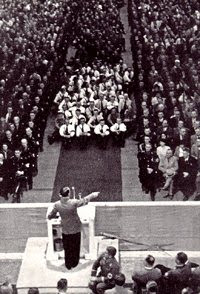 the Nazi Party at Nuremberg that the Czechoslovakian Government was using all of its means possible to annihilate the 3.5 million Sudeten Germans. He claimed that these people were being deprived of their rights, for example, they were not permitted to sing German songs or to wear white stockings. If indeed they went through with any of these crimes they were brutally struck down. Although the tone was ferociously threatening, he gave no examples of atrocities, perhaps because there are none. "The misery of the Sudeten Germans is without end," he declared. He then went on to promise that Germany would take care of her own and put an end to the continued oppression of 3.5 million Germans. "I hope that the foreign statesman will be convinced that these are not mere words," he added ominously.
Hitler has demanded the direct annexation of the Sudetenland by the Reich, hinting that if necessary, he would resort to war. He also has said that the Sudentenland is an internal matter for Germans, and supposedly Central Europeans. It is no place for international statesmen, no doubt referring to Prime Minister Chamberlain.
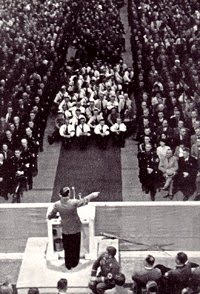 the Nazi Party at Nuremberg that the Czechoslovakian Government was using all of its means possible to annihilate the 3.5 million Sudeten Germans. He claimed that these people were being deprived of their rights, for example, they were not permitted to sing German songs or to wear white stockings. If indeed they went through with any of these crimes they were brutally struck down. Although the tone was ferociously threatening, he gave no examples of atrocities, perhaps because there are none. "The misery of the Sudeten Germans is without end," he declared. He then went on to promise that Germany would take care of her own and put an end to the continued oppression of 3.5 million Germans. "I hope that the foreign statesman will be convinced that these are not mere words," he added ominously.
Hitler has demanded the direct annexation of the Sudetenland by the Reich, hinting that if necessary, he would resort to war. He also has said that the Sudentenland is an internal matter for Germans, and supposedly Central Europeans. It is no place for international statesmen, no doubt referring to Prime Minister Chamberlain.
Thursday, September 11, 2008
Pope Pius XI speaks
Pope Pius XI has been increasingly vocal about the Anti-Semitic laws being passed in Central Europe and other countries lack of action on the matter. He has been referring to the inaction as a Conspiracy of Silence. Recently, he made a speech to Belgian Catholic pilgrims at the Vatican in which he said
The Pope has been published in Mit brennender Sorge a German Catholic encyclical last year condemning Nazi Party policies against the Roman Catholic Church and Judaism.
"Mark well that in the Catholic Mass, Abraham is our Patriarch and forefather. Anti-Semitism is incompatible with the lofty thought which that fact expresses. It is a movement with which we Christians can have nothing to do. No, no, I say to you it is impossible for a Christian to take part in anti-Semitism. It is inadmissible. Through Christ and in Christ we are the spiritual progeny of Abraham. Spiritually, we [Christians] are all Semites".
The Pope has been published in Mit brennender Sorge a German Catholic encyclical last year condemning Nazi Party policies against the Roman Catholic Church and Judaism.
Beneš appeals to the World for Peace
Czechoslovakian President Eduard Beneš made an appeal via Radio Broadcast asking for peace and calm in the face of this crisis. He also told the Czechoslovakian people that they would be "firm and have faith in our state, in its health and its strength, in the indestructible spirit and devotion of its people."
Wednesday, September 10, 2008
Changes in the German Army Command
 Among all the events of this crisis, there has been a change in the command structure of the German Army. General Ludwig Beck was Oberkommando des Heeres, otherwise known as the Chief of the General Staff of the Army. He seemingly is not any longer after August 27.
General Franz Halder has now become the new Oberkommando des Heeres. He began this post on September 1st. These events are just now being noticed due in part because of the tension in the Sudetenland.
Tuesday, September 9, 2008
Impasse!
Talks between the Czechoslovakian Government and Henlein's Sudeten Party have broken down. Of course, negotiations still continue between Great Britain and Czechoslovakia. Germany is staying somewhat quiet. In the coming days, there will be a Congress of the Nazi Party in Nuremberg.
Monday, September 8, 2008
German Sudetens protest
In response to the plan put forth by the Czechoslovakian Government, many of the Sudeten Germans who agree with Konrad Henlein, protested. However, what is Plan No. 4?
Plan No. 4 adds both financial and political concessions such as "states rights to minorities in Sudeten. President Beneš offered to lend a billion Czechoslovak koruny ($35,000,000) "on the most favorable terms" to stimulate industry in Czechoslovak districts now suffering from unemployment, with 700,000,000 koruny earmarked for Sudeten districts. Britain and France stood ready to lend this money to Czechoslovakia, it was understood in Prague, and Dr. Beneš clearly hoped many observers of the Sudeten Germans had been right in reporting recently that what they want is a return to prosperity, not Germany.
Plan No. 4 went further than Plan No. 3 in offering Sudeten Germans and other minority peoples State jobs (including "irremovable judgeships") in the same proportion as their numbers bear to the total population of Czechoslovakia. Moreover, each ministry of the Czechoslovak Cabinet would have a separate "section" corresponding to each minority, and each section would be headed by a member of that minority to guard its interests. As the most fateful concession of Plan No. 4, Dr. Beneš offered that in each minority canton the preservation of order should be "divided" between Federal gendarmerie in the countryside and town police of the Sudeten German or other minority faction.
Plan No. 4 adds both financial and political concessions such as "states rights to minorities in Sudeten. President Beneš offered to lend a billion Czechoslovak koruny ($35,000,000) "on the most favorable terms" to stimulate industry in Czechoslovak districts now suffering from unemployment, with 700,000,000 koruny earmarked for Sudeten districts. Britain and France stood ready to lend this money to Czechoslovakia, it was understood in Prague, and Dr. Beneš clearly hoped many observers of the Sudeten Germans had been right in reporting recently that what they want is a return to prosperity, not Germany.
Plan No. 4 went further than Plan No. 3 in offering Sudeten Germans and other minority peoples State jobs (including "irremovable judgeships") in the same proportion as their numbers bear to the total population of Czechoslovakia. Moreover, each ministry of the Czechoslovak Cabinet would have a separate "section" corresponding to each minority, and each section would be headed by a member of that minority to guard its interests. As the most fateful concession of Plan No. 4, Dr. Beneš offered that in each minority canton the preservation of order should be "divided" between Federal gendarmerie in the countryside and town police of the Sudeten German or other minority faction.
In Germany, every paper printed atrocity stories describing how a Sudeten German Nazi Deputy had been "horsewhipped" by a Czech mounted policeman at the industrial town of Moravská Ostrava. Mounted police had tried to disperse a Sudeten German crowd which had gathered to demand immediate release from jail of 82 persons arrested for possessing arms smuggled from Germany. The prisoners were charged with preparing to organize an attack from the rear upon troops defending the Czechoslovak frontier in case of war. One blow from a riding crop was afterward proved to have struck, without injuring, a man who turned out to be a Sudeten Deputy. Next day the Czech mounted policeman responsible and two others were withheld from duty by Police Chief Baca, who then suspended himself for good measure. But by this time, German papers were well started on a flood of stories under such scareheads as SAVAGE HORSEWHIPPING OF SUDETEN DEPUTY BY BESTIAL CZECH OFFICER.
The No. 1 Sudeten, Konrad Henlein, was at Nürnberg with Hitler, but in Prague the No. 2 Sudeten, Ernst Kundt, tersely announced that "satisfactory amends" had been made at Moravská Ostrava and he then withdrew the Sudeten Party's previous refusal to negotiate on the basis of Plan No. 4. Obviously they were tempted by the 700,000,000 koruny—for there are only 3,500,000 Sudeten Germans.
Smart Dr. Beneš, although relying on money to do some talking in a situation basically desperate, fully realized that Plan No. 4 impressed millions of Czechoslovaks, apart from the Sudeten Germans, as offering such extreme concessions that it imperiled the State. If accepted, Plan No. 4 risks turning every Cabinet ministry into a debating club of minority groups. How democratic Czech gendarmes and totalitarian Nazi police can "divide" responsibility for keeping of order in Sudeten cantons was an unanswered question. In an impossible situation, under crushing British pressure to concede without limit, President Beneš had conceded so much that he realized some of his own people were becoming scared. To reassure the nation, Dr. Beneš went on the air with a calm, firm and tactful broadcast, only a few minutes after he learned that in a speech at Nuremberg General Göring had just gone out of his way to abuse the culture and traditions of the Czechoslovak Republic.
Sunday, September 7, 2008
Plan No. 4
Czechoslovakian President Eduard Beneš submitted a fourth plan to the Czechoslovakian Government on September 2nd. Now, the government has submitted this to the British.
Roughly, the plan would accede the Sudeten to Germany due to the high amount of Germans in the region. Czechoslovakia has said that ceding this land would cripple the country economically and would put the nation effectively under German control.
Roughly, the plan would accede the Sudeten to Germany due to the high amount of Germans in the region. Czechoslovakia has said that ceding this land would cripple the country economically and would put the nation effectively under German control.
Sunday, August 31, 2008
Plan No. 3
In Washington, anxious Assistant Secretary of State George S. Messersmith repeatedly crawled out of bed around 4 AM to hear by transatlantic telephone what U. S. Ambassadors in Europe could tell him about whether Adolf Hitler was going to hurl the German Army into Czechoslovakia.
Sunday, August 17, 2008
Another Nazi Measure against Jews
The German Government is now requiring all Jewish women to add "Sara" to their given first names, and men to likewise add "Israel" to their names. This is to be on all legal documents and passports. This measure is to better identify Jews who have non-Jewish names.
The law goes into effect on January 1, 1939.
The law goes into effect on January 1, 1939.
Saturday, August 16, 2008
Lord Runciman meets Konrad Henlein
Viscount Runciman had been 15 days in Czechoslovakia without meeting Konrad Henlein, who thought his prestige would be enhanced if he made the British lord call on him. This, the Viscount had refused to do, but in last week's emergency Lord Runciman consented to motor from Prague into the Sudeten Nazi territory and meet Herr Henlein in the castle of Prince Max von Hohenlohe, whose lands extend right up to the German frontier.
Prince Max, although ardently pro-German, keeps his fingers crossed, has a passport which makes him a subject of the Principality of Liechtenstein. Last week he mobilized his villagers, his gamekeepers, his servants and his toddling infants, all of whom gave the Nazi salute as Lord Runciman arrived in formal black jacket, wing collar and black bat tie. Herr Henlein turned up in brown tweed coat, grey flannel slacks and white shoes. Present was the German agent known as "Princess Steffi," who generally operates in London. There she has been hostess to Herr Henlein and to Adolf Hitler's personal agent, Captain Wiedemann (TIME, Aug. 1). From the castle windows the conferees could see the Sudeten Mountains and the German frontier, patrolled unceasingly before their eyes by fighting planes of Czechoslovakia and the Reich. The meeting lasted from 12:30 to 5:45.
Diplomatic rumor had it that "Henlein showed himself most intransigent." But shortly thereafter Herr Henlein assembled his lieutenants in the Hotel Veimar in Marienbad. There he outlined the Sudeten demands anew, clarified along lines suggested by Lord Runciman. Meanwhile, to make the clamorous Henlein minority perhaps less intransigent, Premier Hodza soon after announced he would give choice political plums to Sudeten Germans by appointing them to seven large postmasterships, a district public works superintendency, two district governorships, more jobs in the railroad administration.
Prince Max, although ardently pro-German, keeps his fingers crossed, has a passport which makes him a subject of the Principality of Liechtenstein. Last week he mobilized his villagers, his gamekeepers, his servants and his toddling infants, all of whom gave the Nazi salute as Lord Runciman arrived in formal black jacket, wing collar and black bat tie. Herr Henlein turned up in brown tweed coat, grey flannel slacks and white shoes. Present was the German agent known as "Princess Steffi," who generally operates in London. There she has been hostess to Herr Henlein and to Adolf Hitler's personal agent, Captain Wiedemann (TIME, Aug. 1). From the castle windows the conferees could see the Sudeten Mountains and the German frontier, patrolled unceasingly before their eyes by fighting planes of Czechoslovakia and the Reich. The meeting lasted from 12:30 to 5:45.
Diplomatic rumor had it that "Henlein showed himself most intransigent." But shortly thereafter Herr Henlein assembled his lieutenants in the Hotel Veimar in Marienbad. There he outlined the Sudeten demands anew, clarified along lines suggested by Lord Runciman. Meanwhile, to make the clamorous Henlein minority perhaps less intransigent, Premier Hodza soon after announced he would give choice political plums to Sudeten Germans by appointing them to seven large postmasterships, a district public works superintendency, two district governorships, more jobs in the railroad administration.
Monday, August 11, 2008
Main Synagogue of Nuremberg Destroyed
The Main Synagogue of Nuremberg was burned and damaged beyond use yesterday. The Congregation of the synagogue were given until August 3rd to sell to the City of Nuremberg. After the congregation could not come to a consensus, Mayor Willi Liebel, expropriated the land.
August 10th, there was a gathering of many Nazis in front of the grand synagogue. The Mayor attended and took part in the rally as well as the Gauleiter Julius Streicher. The rally then turned into a demolition and the synagogue was heavily burned and damaged.
 The Synagogue has been a fixture in the Nuremberg skyline. No response has been lodged by the displaced congregation.
August 10th, there was a gathering of many Nazis in front of the grand synagogue. The Mayor attended and took part in the rally as well as the Gauleiter Julius Streicher. The rally then turned into a demolition and the synagogue was heavily burned and damaged.
 The Synagogue has been a fixture in the Nuremberg skyline. No response has been lodged by the displaced congregation.
Wednesday, August 6, 2008
Lord Runciman meets with German Sudeten Party members
Konrad Henlein, the Sudeten German Führer, sent only subordinates to confer with the Viscount. The consideration with which he treated them was considered spectacular. Lord Runciman's program included 20-minute formal calls on President Eduard Beneš and Premier Milan Hodza; two lengthy conferences with henchmen of Henlein, the second lasting until 2 am; next day lunch with Dr. & Mme Beneš; a short conference at his hotel with non-Nazi Czech Germans.
On the third day the British mediator uncorked his first proposal. He declared that before he could attempt to advise he must understand the problems of Czechoslovakia, must study them for at least a fortnight. Therefore, he proposed that the Government and the Sudetens stop negotiating while he studied. To this provisional Pax Runciman they agreed. Instead of discussing the disputed Minorities Statute, the Czechoslovak Parliament met for only 20 minutes—its first meeting since the war crisis was averted on May 21 —then meekly adjourned indefinitely.
Meanwhile, tourist travel to Prague picked up magically overnight. Tourists wolfed tasty Prager ham and downed it with Pilsner beer, convinced that they were safe so long as The Man With the Wrinkled Brow continues his studies.
When U. S. Ambassador to Germany Hugh Wilson, an ace career diplomat, suddenly flew to Prague on what he carefully described as "just a holiday visit" to his friend U. S. Minister to Czechoslovakia Wilbur J. Carr, Czechs were delighted.
They thought his coming was a friendly gesture by President Roosevelt and the State Department, a nudging reminder from Washington to London that the bulk of U. S. public opinion would not be favorable to a Runciman Report so couched as to sell Czechoslovakia down the river. Private Person Wilson was soon received by President Beneš and Premier Hodza, had a talk with Private Person Runciman, insisted he was only vacationing.
On the third day the British mediator uncorked his first proposal. He declared that before he could attempt to advise he must understand the problems of Czechoslovakia, must study them for at least a fortnight. Therefore, he proposed that the Government and the Sudetens stop negotiating while he studied.
 To this provisional Pax Runciman they agreed. Instead of discussing the disputed Minorities Statute, the Czechoslovak Parliament met for only 20 minutes—its first meeting since the war crisis was averted on May 21 —then meekly adjourned indefinitely.
Meanwhile, tourist travel to Prague picked up magically overnight. Tourists wolfed tasty Prager ham and downed it with Pilsner beer, convinced that they were safe so long as The Man With the Wrinkled Brow continues his studies.
When U. S. Ambassador to Germany Hugh Wilson, an ace career diplomat, suddenly flew to Prague on what he carefully described as "just a holiday visit" to his friend U. S. Minister to Czechoslovakia Wilbur J. Carr, Czechs were delighted.
They thought his coming was a friendly gesture by President Roosevelt and the State Department, a nudging reminder from Washington to London that the bulk of U. S. public opinion would not be favorable to a Runciman Report so couched as to sell Czechoslovakia down the river. Private Person Wilson was soon received by President Beneš and Premier Hodza, had a talk with Private Person Runciman, insisted he was only vacationing.
Tuesday, August 5, 2008
Lord Runciman remains in Prague
---From the New York Times---
While Viscount Runciman’s staff continues to work in close contact with the Henlein party leaders, the British negotiator in the Czech-Sudeten German dispute confined himself today to purely formal visits.
In the morning he received Premier Milan Hodza and Foreign Minister Kamil Krofta, who were returning the calls he paid on them yesterday. At noon he and Lady Runciman lunched with President Eduard Benes and his wife at Hradschin palace. At Lord Runciman’s wish the luncheon was entirely private.
In the afternoon Lord Runciman received a deputation of German Activists – who support the republic – consisting of Wenzel Jakach, Herr Taub and Herr Rehward. The interview lasted only half an hour, in contrast with the hour and a half the Henleinist leaders spent with Lord Runciman yesterday, followed by a late night conference with his staff.
These meetings were held at the Alcron Hotel. Tomorrow the Henleinist leaders again will have long conferences with Lord Runciman’s staff.
Last night they put forward the sensational demands advanced by Konrad Henlein in his Karlsbad speech April 24, when he proclaimed himself and his movement purely Nazi. The Henleinist delegates further explained to Lord Runciman’s staff the meaning of the party’s memorandum embodying most of the Karlsbad demands that was presented to the government June 7.
Incidentally, it is reported that the Committee of Political Ministers is drawing up an answer to the Henlein party’s memorandum.
The German Activist representatives deliberately refrained from bombarding Lord Runciman with documentary propaganda. They left it entirely to the British negotiator to say whether or not he wished further contact with them and advice from them. They told him that if he wished to hear the democratic German viewpoint they would be glad to draw up a memorandum next week and he requested that they do so.
They further offered to show him any industrial center in the Sudeten area that he wished to see, to enable him to “see for himself that the Sudeten Germans can do a good day’s hard work as well as conduct political agitation.”
Lord Runciman thanked them and said that he would consider their suggestion when he drew up his program of visits.
Lord Runciman is leaving Prague for a week-end in the Sudeten area and it is understood that he will pay a personal visit to a big German landowner. His staff refused all information tonight as to whom he would visit.
The German press and radio propaganda campaign in connection with the flight of two Czech planes over Glatz in German territory Wednesday is described as the most violent of all those launched against this country, not excepting the campaign in the days preceding May 21, when Czechoslovakia called reserves to the border.
The press reminds Germany that there have been many cases of German pilots flying as far as Pilsen without any Czech press campaign being launched against Germany. It is a fact the there are constant violations of the Czech frontier by German planes, which it is thought wiser here not to make the subject of protests nor even to allow mentioned [sic] in the press.
The extraordinary violence of the present German campaign gives rise to suspicions that there is truth in reports of large military concentrations around Glatz that have been received here in the last week.
Glatz is situated in a German “peninsula” almost entirely surrounded by Czechoslovak territory and it is quite conceivable that pilots flying over Czechoslovakia could make a mistake and cross the German line there.
The Prague radio replied to the German propaganda tonight in the form of an official communiqué giving three cases in which German pilots, giving the same excuse as the Germans refused to accept in the Galtz case – poor visibility – actually landed in Czechoslovak reserved military areas during the last two months.
While Viscount Runciman’s staff continues to work in close contact with the Henlein party leaders, the British negotiator in the Czech-Sudeten German dispute confined himself today to purely formal visits.
In the morning he received Premier Milan Hodza and Foreign Minister Kamil Krofta, who were returning the calls he paid on them yesterday. At noon he and Lady Runciman lunched with President Eduard Benes and his wife at Hradschin palace. At Lord Runciman’s wish the luncheon was entirely private.
In the afternoon Lord Runciman received a deputation of German Activists – who support the republic – consisting of Wenzel Jakach, Herr Taub and Herr Rehward. The interview lasted only half an hour, in contrast with the hour and a half the Henleinist leaders spent with Lord Runciman yesterday, followed by a late night conference with his staff.
These meetings were held at the Alcron Hotel. Tomorrow the Henleinist leaders again will have long conferences with Lord Runciman’s staff.
Last night they put forward the sensational demands advanced by Konrad Henlein in his Karlsbad speech April 24, when he proclaimed himself and his movement purely Nazi. The Henleinist delegates further explained to Lord Runciman’s staff the meaning of the party’s memorandum embodying most of the Karlsbad demands that was presented to the government June 7.
Incidentally, it is reported that the Committee of Political Ministers is drawing up an answer to the Henlein party’s memorandum.
The German Activist representatives deliberately refrained from bombarding Lord Runciman with documentary propaganda. They left it entirely to the British negotiator to say whether or not he wished further contact with them and advice from them. They told him that if he wished to hear the democratic German viewpoint they would be glad to draw up a memorandum next week and he requested that they do so.
They further offered to show him any industrial center in the Sudeten area that he wished to see, to enable him to “see for himself that the Sudeten Germans can do a good day’s hard work as well as conduct political agitation.”
Lord Runciman thanked them and said that he would consider their suggestion when he drew up his program of visits.
Lord Runciman is leaving Prague for a week-end in the Sudeten area and it is understood that he will pay a personal visit to a big German landowner. His staff refused all information tonight as to whom he would visit.
The German press and radio propaganda campaign in connection with the flight of two Czech planes over Glatz in German territory Wednesday is described as the most violent of all those launched against this country, not excepting the campaign in the days preceding May 21, when Czechoslovakia called reserves to the border.
The press reminds Germany that there have been many cases of German pilots flying as far as Pilsen without any Czech press campaign being launched against Germany. It is a fact the there are constant violations of the Czech frontier by German planes, which it is thought wiser here not to make the subject of protests nor even to allow mentioned [sic] in the press.
The extraordinary violence of the present German campaign gives rise to suspicions that there is truth in reports of large military concentrations around Glatz that have been received here in the last week.
Glatz is situated in a German “peninsula” almost entirely surrounded by Czechoslovak territory and it is quite conceivable that pilots flying over Czechoslovakia could make a mistake and cross the German line there.
The Prague radio replied to the German propaganda tonight in the form of an official communiqué giving three cases in which German pilots, giving the same excuse as the Germans refused to accept in the Galtz case – poor visibility – actually landed in Czechoslovak reserved military areas during the last two months.
Monday, August 4, 2008
England sends Lord Runciman to Prague
Walter Runciman, 1st Viscount Runciman of Doxford, arrived today in Prague in response to the continuing Sudetenland crisis between Czechoslovakia and Germany. He is hoping to find a mutually beneficial solution to the situation.
His first day has so far involved a meeting with the Czechoslovakian President. He will be meeting with German Sudetens and other involved parties before returning to England and the British Prime Minister, Neville Chamberlain.
His first day has so far involved a meeting with the Czechoslovakian President. He will be meeting with German Sudetens and other involved parties before returning to England and the British Prime Minister, Neville Chamberlain.
Saturday, August 2, 2008
Italy cracks down on Jews
Italy has passed the Racial Laws against the Jews barring them from studying or teaching in a school of higher learning and revoking the citizenship of all foreign Jews obtained after January, 1919, and decreeing their expulsion within six months.
Japanese & Soviet conflict resolved
The details are not known at this time. However, sources have said that the conflict between the Japanese Empire and the Soviet Union ended on August 1st. The border between Soviet Union's Siberian wilderness and Japan's state of Manchuria, now called Manchukuo, will return to its previous situation on July 29th. This was the day the Japanese entered Siberia unprovoked.
Wednesday, July 30, 2008
Conflict at Broad Drum Peak
There has been an act of Japanese aggression at a point of disputed territory on the Manchurian and Soviet border. The Japanese attacked border guards and have been able to push some distance into Siberia.
Monday, July 28, 2008
Street names changed in Germany
In Germany, a program has been started to change street names. Some of the streets apparently have Jewish sounding names. Considering the political problems that exist within Germany at this moment, it has become inappropriate to retain the names. So, the names will be changed to sound more German.
Tuesday, July 22, 2008
ID cards for Jews
The German Government passed a measure yesterday requiring all Jews to carry Identification cards. This comes after Jewish doctors were forbidden to practice medicine on non-Jews.
Tuesday, July 15, 2008
Évian Conference Concludes
 After nine days, the Évian Conference wraps up in southeastern France. No resolution was passed. There was a great deal of official statements of sympathy by nations for the stateless Jews.
Most of attending nations were reluctant to shoulder the burden of the Jewish refugees.
The Caribbean island nation of the Dominican Republic did offer safe harbor to the refugees. The so-called Sosua Project would have 100,000 Jews settling in the Dominican Republic with the American Jewish Joint Distribution Committee paying the nation millions of dollars. Costa Rica is also offering the same resolution.
The American delegate noted that the United States has immigration quotas and would be making the German and Austrian quotas fully available. France also claimed it had met "the extreme point of saturation as regards admission of refugees."
The British delegation did not remind the conference attendees of its Palestinian mandate where Jewish settlements have been forming for decades. This may, in fact, have been intentional since there were even Jewish observers from Palestine at the conference such as Mrs. Golda Meyerson. Mrs. Meyerson is Ukrainian-born Jew who was reared and educated in the United States before emigrating to Palestine. She remarked to the press after conference ended, "There is only one thing I hope to see before I die and that is that my people should not need expressions of sympathy anymore."
An Australian delegate even noted "as we [Australia] have no real racial problem, we are not desirous of importing one."
Yesterday, a Nazi newspaper published an article with a headline stating “JEWS FOR SALE AT A BARGAIN PRICE--WHO WANTS THEM? NO ONE.”
Saturday, July 12, 2008
France makes decrees
Whilst the Conference proceeds in Évian, the French Prime Minister has made some announcements in the past two days. First, Prime Minister Édouard Daladier was given the authority to govern by decree in the event of war. This is much like martial law and does not leave the people a representative voice in the creation or implementation of laws.
Second, Monsieur Daladier declared that France is recommitting itself to Czechoslovakian independence. This continues the line that France and Britain have maintained since demands from Hitler have come down for possession of the Sudetenland in April.
Second, Monsieur Daladier declared that France is recommitting itself to Czechoslovakian independence. This continues the line that France and Britain have maintained since demands from Hitler have come down for possession of the Sudetenland in April.
Monday, July 7, 2008
Secretary Hull meets with German Ambassador Hans-Heinrich Dieckhoff
Today, US Secretary of State Cordell Hull talked with the German Ambassador Hans-Heinrich Dieckhoff about the European situation. He told the Ambassador that this Government had been earnestly hoping that the German Government would reach a stage where it would decide to support the program of peace and orderly progress which the United States had been striving to keep alive and to advance.
The Secretary said that there was only one alternative course: the course of force, militarism, and territorial aggression with all the accompanying hurtful and destructive practices.
The Secretary said that there was only one alternative course: the course of force, militarism, and territorial aggression with all the accompanying hurtful and destructive practices.
Saturday, July 5, 2008
Conference on Jewish Refugees
US President Franklin Delano Roosevelt called for a conference to decide the fate of hundreds of thousands of stateless Jews from Central Europe. And that's what he's getting.
Representatives from thirty-two nations and twenty-four volunteer organizations are gathering today in Évian-les-Bains, France. Here on the western banks of Lake Geneva and in the picturesque Rhône-Alpes area of southeastern France, these delegates will discuss a solution to the refugees coming out of central Europe.
In the past few years, laws have been passed down in Germany that have made Jews in that country stateless. With other oppressive laws taking business and property from German Jews, many have left the nation looking elsewhere for hope and prosperity.
Representatives from thirty-two nations and twenty-four volunteer organizations are gathering today in Évian-les-Bains, France. Here on the western banks of Lake Geneva and in the picturesque Rhône-Alpes area of southeastern France, these delegates will discuss a solution to the refugees coming out of central Europe.
In the past few years, laws have been passed down in Germany that have made Jews in that country stateless. With other oppressive laws taking business and property from German Jews, many have left the nation looking elsewhere for hope and prosperity.
Wednesday, July 2, 2008
Austria takes Jews into custody
Earlier today, the Austrian officials took 40,000 or so Jews in protective custody. It is unknown what protective custody means, the ages or gender of the people arrested or where Austria intends to place the Jews.
State of United States Forces
Yesterday, Secretary of War Harry Woodring was able to report encouraging improvements in the military establishment. He declared, however, that there were still deficiencies in organization, equipment, and personnel that required correction. The Chief of Staff of the Army, General Malin Craig, pointed out at the same time that the Regular Army ranked only eighteenth among the standing armies of the world.
Monday, June 23, 2008
Guerillas in the Fields
After marching from Qingdao (Tsingtao), Japanese forces finally reached the Huang (Yellow) River. Mobile Chinese forces limited Japanese control to the railway zone. Despite their military superiority, the Japanese discovered that they could capture major Chinese urban centers, but that Chinese guerillas controlled the rural areas. As a result, Chinese troops were able to conduct successful operations against the Japanese during the Spring of 1938.
Sunday, June 15, 2008
Sinti & Roma elements in Germany & Austria
For the past three days, the German and Austrian authorities have been gathering up members of the Sinti and Roma groups. Sinti and Roma are Gypsies and are found living in almost every nation is Europe. Both groups have lived in Germany since the 15th Century.
The German Government took many rights from the Gypsies with "Protection of Blood and Honour" law passed in 1935. This law strips many non-Aryan groups in Germany and, since Anschluss earlier this year, Austria, of civic rights.
Gypsies have historically been nomadic groups all over Europe. The areas of largest populations are in Central and Eastern Europe. Some have countered that the Gypsies are also Aryan, the supposed race of German people.
Dr. Hans F. K. Günther of the University of Berlin has written on the subject in his 1927 book The Racial Elements of European History. Within its pages he discusses Gypsy Aryan origins that corruptions that have occurred dur to breeding with lower classes. All of this is of course the writings of German racialism and has not been wholly substantiated by other learned men.
Other authorities have noted the asocialism and community hygiene problems that the Gypsies present to the Nazi Government.
Many Gypsies have historically been distrusted due to their refusal to live sedentary lifestyles. Gypsies live a nomadic pattern using their skills in crafts and performance to earn money for food. Gypsies are often referred to as criminals, deceivers and thieves.
It is unclear where the Gypsies are going in this relocation.
The German Government took many rights from the Gypsies with "Protection of Blood and Honour" law passed in 1935. This law strips many non-Aryan groups in Germany and, since Anschluss earlier this year, Austria, of civic rights.
Gypsies have historically been nomadic groups all over Europe. The areas of largest populations are in Central and Eastern Europe. Some have countered that the Gypsies are also Aryan, the supposed race of German people.
Dr. Hans F. K. Günther of the University of Berlin has written on the subject in his 1927 book The Racial Elements of European History. Within its pages he discusses Gypsy Aryan origins that corruptions that have occurred dur to breeding with lower classes. All of this is of course the writings of German racialism and has not been wholly substantiated by other learned men.
Other authorities have noted the asocialism and community hygiene problems that the Gypsies present to the Nazi Government.
Many Gypsies have historically been distrusted due to their refusal to live sedentary lifestyles. Gypsies live a nomadic pattern using their skills in crafts and performance to earn money for food. Gypsies are often referred to as criminals, deceivers and thieves.
It is unclear where the Gypsies are going in this relocation.
Friday, June 13, 2008
Japanese land at Anqing
Today, the Japanese landed Naval forces on the Coast at Anqing. The Chinese 11th Army is nearby. More information as it happens.
Tuesday, June 10, 2008
Flooding of the Yellow River
Reports have been received that the Yellow River (Huang River) near Huayuankou. In the early morning hours of June 9th, local time, many of the local Chinese were caught unawares. The number of dead, missing and injured are unknown at this time. There has been considerable flooding in the area in the past eight years. The local populations are difficult to ascertain as records of the residents have not been effectively kept.
This flood is certainly coming at a bad time for the Japanese. This will impede their efforts at taking control of China.
This flood is certainly coming at a bad time for the Japanese. This will impede their efforts at taking control of China.
Sunday, June 8, 2008
Latvia and Estonia sign pact with Germany
Germany signed a pact promising non-aggression with the two Baltic states of Latvia and Estonia. The two nations would likely have presented little to no concern to Germany. This is more of a relief to the tiny poor Baltic nations. It is clear to many that a war in Europe is coming but it will not be Germany that brings it to Latvia and Estonia.
Wednesday, June 4, 2008
Famed Psychologist leaves Austria
Psychoanalyst and Neurologist Siegmund Freud arrived in Paris today via the Orient Express. He left his home in Vienna and Nazi Austria. Dr. Freud and his family including daughter Anna are likely to proceed on to London and establish their home there.
Saturday, May 31, 2008
Hungary limits Jewish economics
Hungary, a country that less than twenty years ago, was united with Austria as an Empire, has passed a new law against Jews. Yesterday, a law reduced the amount Jews could contribute to the economy is 20%. This law meets with much skepticism amongst the International Community. It isn't apparent how Hungary's government plans to implement such a measure against its Jewry.
Friday, May 30, 2008
Hitler announces that he will take Czechoslovakia
 Hitler has announced that he will "smash Czechoslovakia" before October 1st. It is unclear what the League of Nations will do in response, if anything can be done. Great Britain and France have not responded to Hitler's latest declaration.
Japan arrests Communists
It has been reported that 1300 alleged Communists have been arrested. Japan is appears hopes to rein in any oppositional political parties as its war with mainland Asia increases.
Thursday, May 29, 2008
Germany increases building
In response to the messages from Great Britain and France concerning Czechoslovakia, Hitler has ordered for increase in Naval Ship building beyond the Internationally imposed limits. It also appears that Hitler is now even more certain of the course of action he feels Germany must make to protect its Eastern flank from attack.
Sunday, May 25, 2008
Nuremberg Laws in effect in Austria
Germany's Nurembeg Laws went into effect yesterday. This means Jews will not have citizenship under Germany and marriages between Jews and non-Jews are voided.
Of particular interest in Austria, any books written by Jews are going to be removed, likely destroyed. In addition, any anti-Nazi literature is meeting the same fate.
Of particular interest in Austria, any books written by Jews are going to be removed, likely destroyed. In addition, any anti-Nazi literature is meeting the same fate.
Tuesday, May 20, 2008
Czechoslovakia stirs
Czechoslovakia continues to feel the pressure of its over 3 million Germans clamor for union with Germany. The Sudetenland has become a contentious territory in the western portion of the country. Adolf Hitler of Germany has demanded that the Sudetenland be handed over to Germany.
In reponse, Great Britain and France have rejected these demands. Germany has begun to build up its military installations along its shared border with Czechoslovakia. This apparent aggression has alarmed many with the Chezhoslovakian government. They are now mobilizing in an effort for defense should that need arise.
In reponse, Great Britain and France have rejected these demands. Germany has begun to build up its military installations along its shared border with Czechoslovakia. This apparent aggression has alarmed many with the Chezhoslovakian government. They are now mobilizing in an effort for defense should that need arise.
Saturday, May 17, 2008
US Congress votes for rearmament
Despite the amount of time it took for the United States to join in the Great War and its isolationist politics, the Congress has voted to begin rearmament. Navies are particularly slow to build up and the legislature gave its authorization to the Navy to begin expansion.
Wednesday, May 14, 2008
Chemical Weapons Ban
The League of Nations adopted a resolution today against the use of chemical weapons as used by Japan in its Chinese campaign. The resolution backs up Article 171 of the Treaty of Versailles and Article V of the Treaty in Relation to the Use of Submarines and Noxious Gases in Warfare. It has recently come to attention that the Japanese have used poison gas against the Chinese in Northern China.
Wednesday, April 30, 2008
Viennese Jews
Earlier today, the Volkischer Beobachter announced that "The Jewish element in Vienna must be eradicated by 1942. Whoever knows the sentiment of the Viennese will not be surprised that four years is much too long a time. National Socialism had to convince the people of Northern Germany that the Jews are dangerous. The opposite is true in Vienna."
99.5% of Austrian Jews live in Vienna. Many have already had to endure humiliation at the hands of the Nazis and their fellow countrymen. Jews were forced to scrub Schuschnigg's political slogans off the sidewalks in Vienna.
Both Jews and Gypsies have had their Austrian citizenships revoked since Anschluss.
99.5% of Austrian Jews live in Vienna. Many have already had to endure humiliation at the hands of the Nazis and their fellow countrymen.
 Jews were forced to scrub Schuschnigg's political slogans off the sidewalks in Vienna.
Both Jews and Gypsies have had their Austrian citizenships revoked since Anschluss.
Tuesday, April 29, 2008
London Conference Concludes
The representatives of the French and British Governments concluded their three day conference today. The two nations have historically been hostile but in the face of increasing territorial antagonism by Germany, the two nations have vowed to make tactical decisions with regard to each other.
City of Wuhan suffers more bombing
The Japanese have been bombing the city of Wuhan. It coincides with the Japanese Emporer's birthday today.
The Chinese though seem to be quite prepared and have been bringing Japanese planes down. The Battle continues.
The Chinese though seem to be quite prepared and have been bringing Japanese planes down. The Battle continues.
Friday, April 25, 2008
More changes for Jews
The Nazi Party has recently changed conditions for Jews living in Greater Germany. On April 22nd, "Front-Ownership" was banned. This prevents Aryans from owning Jewish businesses for Jews. This is one of the first decrees that affects non-Jews and prohibits them from assisting Jews.
In addition, yesterday it was decreed that Jews are now being required to register their property and wealth with the Government.
In addition, yesterday it was decreed that Jews are now being required to register their property and wealth with the Government.
Wednesday, April 23, 2008
Sudetengermans
After Anschluss in Austria last month, its not surprising that German populations in other countries would clamor for some sort of restitution there. The Sudetenland in Czechoslovakia is a contentious piece of property. There are 3,123,000 Germans living within Czechoslovakia. These Germans also are the majority in the Sudetenland.
Sudetendeutsche Partei represents many of these Sudetengermans. They have been accorded less rights than other ethnicities in the Sudetenland. Today, the party released the Karlsbader Programm which outlines an 8-point plan to bring equality to Sudetengermans.
Sudetendeutsche Partei represents many of these Sudetengermans. They have been accorded less rights than other ethnicities in the Sudetenland. Today, the party released the Karlsbader Programm which outlines an 8-point plan to bring equality to Sudetengermans.
Wednesday, April 16, 2008
British-Italian Accord
British and Italian representatives have hammered out an agreement about territory. The British Government has considerable assets in the Middle East such as Palestine and Egypt. Many of these are within a very short distance to Italy's African possession, Abyssinia, which was recently obtained.
The two nations have agreed to conflict with each other in that region, at least. In the agreement, Britain recognized Italy's conquest of Ethiopia. Also. Italy promised to withdraw her troops from Spain should that country's bloody and brutal Civil War conclude.
The two nations have agreed to conflict with each other in that region, at least. In the agreement, Britain recognized Italy's conquest of Ethiopia. Also. Italy promised to withdraw her troops from Spain should that country's bloody and brutal Civil War conclude.
Friday, April 11, 2008
Nazi Party banned in Bulgaria
The Eastern European sovereignty of Bulgaria has been rocky in the past few years. It was only three years ago that Tsar Boris was able to end the military regime in his Tsardom.
After Anschluss last month, many European nations have made note. Bulgaria has also followed in this trend. However, it took a different approach. The National Socialist Party has been banned in Bulgaria today.
After Anschluss last month, many European nations have made note. Bulgaria has also followed in this trend. However, it took a different approach. The National Socialist Party has been banned in Bulgaria today.
Plebiscite in Austria
The scheduled Plebiscite has come and gone. Legal voters approved of the Anschluss at 99.7%. 12,000 Voters voted against the Anschluss.
4% of the population are Gypsies and Jews. They were recently disenfranchised. When Austria united with Germany, many of the Nuremberg laws that were passed in 1935 have gone into affect in Austria.
4% of the population are Gypsies and Jews. They were recently disenfranchised. When Austria united with Germany, many of the Nuremberg laws that were passed in 1935 have gone into affect in Austria.
Tuesday, April 8, 2008
Chinese score a vistory in Tai'erzhuang
 On April 6th, the Chinese were able to beat back the Japanese after days of fighting.
Japanese troops were cut off by Chinese troops near Tai'erzhuang. On March 29th, the Japanese troops decided to tunnel under the walls to take the city. But upon emerging, they were killed by the Chinese.
On April 6th, the Japanese tried for a frontal assault. The Chinese were able to repel the Japanese attackers. Despite China's possible inability to capitalize on the retreat by the Japanese.
The Japanese has yet to acknowledge the victory.
Monday, April 7, 2008
Prince Franz abdicates
The prince of Liechtenstein has abdicated the throne. After Anschluss in March, the Prince does not want to be on the throne should Germany take control of the small principality situated between Switzerland and Austria. He has named his third cousin Franz Josef as his successor.
Prince Franz is married to a Viennese woman named Elisabeth. His wife being a Jew has roused some anti-semitic remarks among Nazi sympathetic Liechtensteiners.
Prince Franz is married to a Viennese woman named Elisabeth. His wife being a Jew has roused some anti-semitic remarks among Nazi sympathetic Liechtensteiners.
Thursday, April 3, 2008
Hitler in Vienna
Der Führer Hitler arrived in Vienna yesterday to a cheering crowd of 200,000. At the Heldenplatz, Hitler proclaimed the Anschluss to the Austrian people and the German Reich. He also commented on the criticism that some nations have directed at Germany by stating "Certain foreign newspapers have said that we fell on Austria with brutal methods. I can only say: even in death they cannot stop lying. I have in the course of my political struggle won much love from my people, but when I crossed the former frontier (into Austria) there met me such a stream of love as I have never experienced. Not as tyrants have we come, but as liberators.
A Plebiscite has been set for April 10th. At that time, Austrians will officially vote on the Anschluss. This has already passed as a legislative act in the German Reich on March 13. in essence, the Austrian people will need to ratify it on April 10th.
Political leaders such as Socialist Leader Karl Renner have urged Austria to approve the plebiscite.
Voting in the Referendum that was initiated on March 11th was still counted even during the German Blumenkreig. There were pockets if the country that were only able to count the votes three days later.
A Plebiscite has been set for April 10th. At that time, Austrians will officially vote on the Anschluss. This has already passed as a legislative act in the German Reich on March 13. in essence, the Austrian people will need to ratify it on April 10th.
Political leaders such as Socialist Leader Karl Renner have urged Austria to approve the plebiscite.
Voting in the Referendum that was initiated on March 11th was still counted even during the German Blumenkreig. There were pockets if the country that were only able to count the votes three days later.
Thursday, March 27, 2008
National Mobilization Bill
Yesterday, the Japanese government passed the National Mobilization Bill which gives the state dictatorial powers in the Japanese economy. The legislation goes into effect on May 5th.
This amounts to the Armed Forces of Japan fleecing the wealthy families of Japan.
His Imperial Majesty's Government, under its bill, proposes to run Japan under a Planning Commission with authority as complete as that of the Soviet Union State Planning Commission, but only "if in time of war it is found necessary." Much of the shouting and desk-banging in the Diet has been in efforts to find out whether His Imperial Majesty's Government considers that Japan today is at war—for Japan has not declared war on any country—and therefore whether or not the National Mobilization Bill would be operative as soon as passed.
This amounts to the Armed Forces of Japan fleecing the wealthy families of Japan.
His Imperial Majesty's Government, under its bill, proposes to run Japan under a Planning Commission with authority as complete as that of the Soviet Union State Planning Commission, but only "if in time of war it is found necessary." Much of the shouting and desk-banging in the Diet has been in efforts to find out whether His Imperial Majesty's Government considers that Japan today is at war—for Japan has not declared war on any country—and therefore whether or not the National Mobilization Bill would be operative as soon as passed.
Tuesday, March 25, 2008
Chamberlain declares England may not aid France
UK Prime Minster stated in parliament yesterday that in the event that France and Germany go to war, the United Kingdom would not be bound to come to France's defense. Chamberlain also said the same thing in case of Czechoslovakia. That nation is nervous since it has a population of 3 million Germans living in the Sudetenland.
Thursday, March 20, 2008
Poland makes ultimatum to Lithuania
Poland has given out an ultimatum to its eastern neighbor Lithuania to cease hostilities. In addition to this is a request to establish diplomatic relations between the two nations. Historically, Lithuania and Poland have been ruled many times as one country.
Poland has possession of Vilnius, a city of great importance to Lithuania. Lithuania since closed its border with Poland. Relations have now normalized.
Poland has possession of Vilnius, a city of great importance to Lithuania. Lithuania since closed its border with Poland. Relations have now normalized.
Tuesday, March 18, 2008
Arrests
In the days following the recent Anschluss of Austria by Germany, 70,000 Austrians have been arrested. This includes recently resigned Chancellor Kurt Schuschnigg.
Monday, March 17, 2008
Secretary Hull speaks of Foreign Policy
The Secretary of State in an address at Washington, March 17, 1938, declared that the momentous question was whether the doctrine of force would once more become enthroned or whether the United States and other peaceful nations would work unceasingly to preserve law, order, morality, and justice as the bases of civilized international relations.
The Secretary said that the United States might, if it chose, turn its back on the whole problem and decline the responsibility of contributing to its solution. But he warned of what such a choice would involve. It would mean a voluntary abandonment of some of the most important things that had made us great; an abject retreat before the forces which we had consistently opposed throughout our whole national history. Our security would be menaced as other nations came to believe that through fear or unwillingness we did not propose to protect our legitimate interests abroad, but intended to abandon them at the first sign of danger. The sphere of all of our international relations would shrink until we stood practically alone among the nations, "a self-constituted hermit state". We would find it necessary to reorganize our entire social and economic structure, which would mean lower living standards, regimentation, and wide-spread economic distress.
All this, the Secretary said, would be done in order to avoid war. But, he asked, would this policy give any such assurance? He believed that reason and experience definitely pointed to the contrary. We might seek to withdraw from participation in world affairs, "but we cannot thereby withdraw from the world itself". Isolation, he declared, "is not a means to security; it is a fruitful source of insecurity".
Secretary Hull emphasized that for the sake of our own best interests we must maintain our influence in world affairs and our participation in efforts toward world progress and peace. Only by making our reasonable contribution to a firm establishment of a world order based on law "can we keep the problem of our own security in true perspective, and thus discharge our responsibility to ourselves".
Saturday, March 15, 2008
Chamberlain speaks
The Prime Minister of the United Kingdom, Neville Chamberlain, finally spoke on recent events in Austria. His remarks were voiced in the House of Commons. He said:
Later he concluded:
Arthur Seyss-Inquart passed legislature yesterday that reduced Austria to the Ostmark, or Eastern Mark. As of the 14th, he is no longer the Chancellor of Austria. He now has a new title that of Reichsstatthalter.
His Majesty's Government have throughout been in the closest touch with the situation. The Foreign Secretary saw the German Foreign Minister on the 10th of March and addressed to him a grave warning on the Austrian situation and upon what appeared to be the policy of the German Government in regard to it.... Late on the 11th of March our Ambassador in Berlin registered a protest in strong terms with the German Government against such use of coercion, backed by force, against an independent State in order to create a situation incompatible with its national independence.
Later he concluded:
I imagine that according to the temperament of the individual the events which are in our minds to-day will be the cause of regret, of sorrow, perhaps of indignation. They cannot be regarded by His Majesty's Government with indifference or equanimity. They are bound to have effects which cannot yet be measured. The immediate result must be to intensify the sense of uncertainty and insecurity in Europe. Unfortunately, while the policy of appeasement would lead to a relaxation of the economic pressure under which many countries are suffering to-day, what has just occurred must inevitably retard economic recovery and, indeed, increased care will be required to ensure that marked deterioration does not set in. This is not a moment for hasty decisions or for careless words. We must consider the new situation quickly, but with cool judgement... As regards our defence programmes, we have always made it clear that they were flexible and that they would have to be reviewed from time to time in the light of any development in the international situation. It would be idle to pretend that recent events do not constitute a change of the kind that we had in mind. Accordingly we have decided to make a fresh review, and in due course we shall announce what further steps we may think it necessary to take.One may think that the Prime Minister is reading the Treaty of Versailles very liberally. Chamberlain has made reassurances toward the Czechs that Britain would not let Germany make the same steps there. Czechoslovakia has been nervous since Anshluss.
Arthur Seyss-Inquart passed legislature yesterday that reduced Austria to the Ostmark, or Eastern Mark. As of the 14th, he is no longer the Chancellor of Austria. He now has a new title that of Reichsstatthalter.
Friday, March 14, 2008
Hitler enters Austria
 Hitler entered Austria at Branau Yesterday afternoon. He proceeded to arrive at the town of Linz on his way to Vienna. He was greeted by cheers at the city hall in Linz.
In response to the recent Anschluss, Robert Kauer, current President of the minority Lutheran Church in Austria, thanked Hitler. He called Hitler the "saviour of the 350,000 German Protestants in Austria and liberator from a five-year hardship".
The Vatican Newspaper blasted the Austrian bishops and declared "The solemn declaration of the Austrian bishops ... was clearly not intended to be an approval of something that was not and is not compatible with God's law". The Vatican is maintaining a position that the bishops acted without any instruction from the Holy See.
Thursday, March 13, 2008
Blumenkrieg
The Austrian Legislature has voted to give the measure full affect today.
Reports that Germany's 8th Army of the Wehrmacht had no need to fire a single bullet have been confirmed. Austrians have generally celebrated the arrival of the German Army. It is being hailed as the Blumenkreig, or, the War of Flowers.
The representatives of the Holy See in Austria have had a more difficult time with this upheaval. Yesterday, March 12th, Cardinal Innitzer said "The Viennese Catholics should thank the Lord for the bloodless way this great political change has occurred, and they should pray for a great future for Austria. Needless to say, everyone should obey the orders of the new institutions." Many other Austrian bishops followed suit.
Vatican Radio was quick to respond with Cardinal Pacelli, the Vatican Secretary of State, commanded Innitzer report to Rome immediately. Reports have it that he may have to sign a statement retracting his previous statement. If so, the other bishops will have to no doubt, do the same.
So far, response from France and Great Britain has been moderate. Both France and Great Britain have filed protests against Germany's actions. These are little more than formalities. France has ignored many of Hitler's violations of the Treaty of Versailles. He has thus far exceeded the quota of 100 planes established in the treaty. A zone extending 50 km east of the Rhine River was specified in the Treaty to be demilitarized. There are to be no installations on this side of the river. On the western side of the same river, Allied troops were to remain in a zone for 15 years. Hitler has moved 3 battalions into this Demilitarized Zone in 1936.
In the United States, an article in the New York Times likened this event to Scotland and England joining centuries before.
Reports that Germany's 8th Army of the Wehrmacht had no need to fire a single bullet have been confirmed. Austrians have generally celebrated the arrival of the German Army. It is being hailed as the Blumenkreig, or, the War of Flowers.
The representatives of the Holy See in Austria have had a more difficult time with this upheaval. Yesterday, March 12th, Cardinal Innitzer said "The Viennese Catholics should thank the Lord for the bloodless way this great political change has occurred, and they should pray for a great future for Austria. Needless to say, everyone should obey the orders of the new institutions." Many other Austrian bishops followed suit.
Vatican Radio was quick to respond with Cardinal Pacelli, the Vatican Secretary of State, commanded Innitzer report to Rome immediately. Reports have it that he may have to sign a statement retracting his previous statement. If so, the other bishops will have to no doubt, do the same.
So far, response from France and Great Britain has been moderate. Both France and Great Britain have filed protests against Germany's actions. These are little more than formalities. France has ignored many of Hitler's violations of the Treaty of Versailles. He has thus far exceeded the quota of 100 planes established in the treaty. A zone extending 50 km east of the Rhine River was specified in the Treaty to be demilitarized. There are to be no installations on this side of the river. On the western side of the same river, Allied troops were to remain in a zone for 15 years. Hitler has moved 3 battalions into this Demilitarized Zone in 1936.
In the United States, an article in the New York Times likened this event to Scotland and England joining centuries before.
Wednesday, March 12, 2008
Incident at Trasninkai, Lithuania
In the early morning hours of Friday March 11 on the demarcation line in the village of Trasninkai near Merkinė, Lithuanian border police officer Justas Lukoševičius was on a routine patrol when he heard two, then three shots. He informed his superior officer, Vaitkus, who in turn instructed Lukoševičius to investigate the matter. Upon returning to the scene, he spotted a Polish soldier running in the bushes, apparently in the direction of Polish territory. Lukoševičius called for him to halt. Instead, the Pole fired one round in his direction from the bushes. Lukoševičius returned the fire with four rounds. Six rounds were subsequently fired at Lithuanian police officers who had gathered at the scene.
A search uncovered Stanislaw Serafin, a recent recruit to the Korpus Ochrony Pogranicza (KOP - Border Defense Corps), who was lying in the bushes mortally wounded. He was brought to Trasninkai where he died later that morning.
Anschluss
Today, Austria united with Germany. Adolf Hitler desired having all German speaking peoples united in one Germany. The last time this was fact was in 1806 under the Holy Roman Empire.
The turn of events started as far back as February. On the 12th of that month, German Chancellor Hitler met with Kurt Schuschnigg, the Chancellor of Austria, in Berchtesgaden. That's Bavaria to you and me. At this meeting, the German Chancellor demanded that Austria allow full freedom for political parties and release all political prisoners, notably the Nazi ones.
Mr. Schuschnigg complied with these demands and even appointed Arthur Seyss-Inquart as Interior Minister and Edmund Glaise-Horstenau as Minister without portfolio. Both men are Nazis.
After the release of political prisoners who've not known freedom for four long years after Austria's own civil war, the Communists sided with the Austrian government. The Socialists demanded more concessions from the government before offering any support.
Schuschnigg decided to put the vote on Austrian independence to a vote. On March 9th, he set the minimum voting age at 24. The youth of the Alpine nation have been inflamed with Nazi ideology. For this referendum to pass, Schuschnigg could not have Nazi sympathizers participating.
Germany didn't take this lying down. The Ministry of Propaganda issued reports that riots were occurring in Austria and the Austrians were pleading for Germany to come in and restore order. These were false.
Hitler demanded that control of the country be handed over to the National Socialist Party by noon on the 11th. He extended the demand two hours. It mattered little. Nazis were quick to take over Vienna.
The Chancellor resigned in the evening hours of the 11th at around 7:30 PM. He told his people and the world by radio that he had to this to avoid bloodshed.
The President of Austria, Wilhelm Miklas, though, refuses to recognize Seyss-Inquart as the new Chancellor. As long as he did this, Seyss-Inquart was unable to send a telegram under the government for German troops to enter Austria.
After much frustration, Hitler and Hermann Göring, who was waiting with his troops at the border, decided to forge a telegram, at about 10 PM, allowing them to invade Austria. At midnight, after many of the government officials had been arrested and many places in Vienna were in Nazi control, Miklas conceded and decided to appoint Seyss-Inquart as Chancellor.
The German army has slipped across the border without any resistance. There have been reports that the German soldiers have been welcomed with salutes and flowers.
The turn of events started as far back as February. On the 12th of that month, German Chancellor Hitler met with Kurt Schuschnigg, the Chancellor of Austria, in Berchtesgaden. That's Bavaria to you and me. At this meeting, the German Chancellor demanded that Austria allow full freedom for political parties and release all political prisoners, notably the Nazi ones.
Mr. Schuschnigg complied with these demands and even appointed Arthur Seyss-Inquart as Interior Minister and Edmund Glaise-Horstenau as Minister without portfolio. Both men are Nazis.
After the release of political prisoners who've not known freedom for four long years after Austria's own civil war, the Communists sided with the Austrian government. The Socialists demanded more concessions from the government before offering any support.
Schuschnigg decided to put the vote on Austrian independence to a vote. On March 9th, he set the minimum voting age at 24. The youth of the Alpine nation have been inflamed with Nazi ideology. For this referendum to pass, Schuschnigg could not have Nazi sympathizers participating.
Germany didn't take this lying down. The Ministry of Propaganda issued reports that riots were occurring in Austria and the Austrians were pleading for Germany to come in and restore order. These were false.
Hitler demanded that control of the country be handed over to the National Socialist Party by noon on the 11th. He extended the demand two hours. It mattered little. Nazis were quick to take over Vienna.
The Chancellor resigned in the evening hours of the 11th at around 7:30 PM. He told his people and the world by radio that he had to this to avoid bloodshed.
The President of Austria, Wilhelm Miklas, though, refuses to recognize Seyss-Inquart as the new Chancellor. As long as he did this, Seyss-Inquart was unable to send a telegram under the government for German troops to enter Austria.
After much frustration, Hitler and Hermann Göring, who was waiting with his troops at the border, decided to forge a telegram, at about 10 PM, allowing them to invade Austria. At midnight, after many of the government officials had been arrested and many places in Vienna were in Nazi control, Miklas conceded and decided to appoint Seyss-Inquart as Chancellor.
The German army has slipped across the border without any resistance. There have been reports that the German soldiers have been welcomed with salutes and flowers.
Friday, March 7, 2008
Japanese Yellow River Campaign
After marching from Qingdao (Tsingtao, 青島), Japanese forces finally reached the Huang (Yellow) River. Mobile Chinese forces limited Japanese control to the railway zone.
The Japanese forces have had to contend with Chinese guerillas. These guerillas have so far been underestimated.
The Japanese forces have had to contend with Chinese guerillas. These guerillas have so far been underestimated.
Wednesday, February 13, 2008
King Carol II dissolves Parliament
Two months after a mixed election, Romania's King Carol II dissolved the parliament there. He also ended the Cuza-Goga government. Both men were highly Anti-Semitic.
Those close to the King believe that the Anti-Semitic rhetoric and newly instilled laws against Romanian Jews upset the King. He is considered a true philo-semite and has not hid his displeasure at the increasing public dislike of Jews.
Those close to the King believe that the Anti-Semitic rhetoric and newly instilled laws against Romanian Jews upset the King. He is considered a true philo-semite and has not hid his displeasure at the increasing public dislike of Jews.
Monday, February 11, 2008
A Good Offence is a Good Defence
Congress continues to debate the President's requests for more military funding to rearm the forces and get America's Army and Navy up to scratch. Secretary of State Cordell Hull took it upon himself to address Congress in a letter yesterday.
He stated categorically his opinion that the proposed naval program was needed for the defense of the United States. Referring to the desire of the people and Government of the United States to keep out of war, he said that those who, with a full sense of responsibility, were advocating this program, were doing so in the belief that its adoption would contribute to achieving this desire. Secretary Hull pointed out that the Navy, even with the proposed increases, would not be able to embark upon offensive or aggressive operations overseas.
He stated categorically his opinion that the proposed naval program was needed for the defense of the United States. Referring to the desire of the people and Government of the United States to keep out of war, he said that those who, with a full sense of responsibility, were advocating this program, were doing so in the belief that its adoption would contribute to achieving this desire. Secretary Hull pointed out that the Navy, even with the proposed increases, would not be able to embark upon offensive or aggressive operations overseas.
The Secretary also declared that the proposed program did not contemplate naval cooperation with any other power in the world that the policy of the United States was to avoid both extreme internationalism and extreme isolation; that, while avoiding alliances and entangling commitments, it was advisable to confer and exchange information with other governments having common objectives and, when practicable, to proceed on parallel lines. Finally, the Secretary said that if every peaceful nation insisted on remaining aloof from every other peaceful nation and on pursuing a policy of armament limitation without reference to relative armaments, the inevitable consequences would be to encourage and even to assist nations inclined to play lawless roles.
Tuesday, February 5, 2008
Atrocities in Nanking
Since Japan took possesion of Naking late last year there has been word of many grizzly events in the city. Up until today, there had been nothing official.
The International Committee is a group of American, British, and German businessmen, missionaries, physicians and academics living in Nanking and led by German businessman, John Rabe. Despite the dangers involved, these men and their families have remained behind in Nanking. They are responsible for the Safety Zone. It was established in the city on November 22nd of last year. The Safety Zone, which is about the size of New York City's Central Park, was not shelled during combat.
Today, the committee forwarded 450 cases of disorder to the Japanese embassy. Among these cases are reports of bayoneted civilians and rape.
«Case 5- On the night of December 14th, there were many cases of Japanese soldiers entering houses and raping women or taking them away. This created panic in the area and hundreds of women moved into the Gingling College campus yesterday.»
«Case 10- On the night of December 15th, a number of Japanese soldiers entered the University of Nanking buildings at Tao Yuen and raped 30 women on the spot, some by six men.»
«Case 13 - December 18, 4 p.m., at No. 18 I Ho Lu, Japanese soldiers wanted a man's cigarette case and when he hesitated, one of the soldier crashed in the side of his head with a bayonet. The man is now at the University Hospital and is not expected to live.»
«Case 14 - On December 16th, seven girls (ages ranged from 16 to 21) were taken away from the Military College. Five returned. Each girl was raped six or seven times daily- reported December 18th.»
«Case 15 - There are about 540 refugess crowded in # 83 and 85 on Canton Road. (...) More than 30 women and girls have been raped. The women and children are crying all nights. Conditions inside the compound are worse than we can describe. Please give us help.»
«Case 16- A Chinese girl named Loh, who, with her mother and brother, was living in one of the Refugee Centers in the Refugee Zone, was shot through the head and killed by a Japanese soldier. The girl was 14 years old. The incident occurred near the Kuling Ssu, a noted temple on the border of the Refugee zone (...)»
«Case 19 - January 30th, about 5 p.m. Mr. Sone (of the Nanking Theological Seminary) was greeted by several hundred women pleading with him that they would not have to go home on February 4th. They said it was no use going home they might just as well be killed for staying at the camp as to be raped, robbed or killed at home. (...) One old woman 62 years old went home near Hansimen and Japanese soldiers came at night and wanted to rape her. She said she was too old. So the soldiers rammed a stick up her. But she survived to come back.»
The International Committee is a group of American, British, and German businessmen, missionaries, physicians and academics living in Nanking and led by German businessman, John Rabe. Despite the dangers involved, these men and their families have remained behind in Nanking. They are responsible for the Safety Zone. It was established in the city on November 22nd of last year. The Safety Zone, which is about the size of New York City's Central Park, was not shelled during combat.
Today, the committee forwarded 450 cases of disorder to the Japanese embassy. Among these cases are reports of bayoneted civilians and rape.
«Case 5- On the night of December 14th, there were many cases of Japanese soldiers entering houses and raping women or taking them away. This created panic in the area and hundreds of women moved into the Gingling College campus yesterday.»
«Case 10- On the night of December 15th, a number of Japanese soldiers entered the University of Nanking buildings at Tao Yuen and raped 30 women on the spot, some by six men.»
«Case 13 - December 18, 4 p.m., at No. 18 I Ho Lu, Japanese soldiers wanted a man's cigarette case and when he hesitated, one of the soldier crashed in the side of his head with a bayonet. The man is now at the University Hospital and is not expected to live.»
«Case 14 - On December 16th, seven girls (ages ranged from 16 to 21) were taken away from the Military College. Five returned. Each girl was raped six or seven times daily- reported December 18th.»
«Case 15 - There are about 540 refugess crowded in # 83 and 85 on Canton Road. (...) More than 30 women and girls have been raped. The women and children are crying all nights. Conditions inside the compound are worse than we can describe. Please give us help.»
«Case 16- A Chinese girl named Loh, who, with her mother and brother, was living in one of the Refugee Centers in the Refugee Zone, was shot through the head and killed by a Japanese soldier. The girl was 14 years old. The incident occurred near the Kuling Ssu, a noted temple on the border of the Refugee zone (...)»
«Case 19 - January 30th, about 5 p.m. Mr. Sone (of the Nanking Theological Seminary) was greeted by several hundred women pleading with him that they would not have to go home on February 4th. They said it was no use going home they might just as well be killed for staying at the camp as to be raped, robbed or killed at home. (...) One old woman 62 years old went home near Hansimen and Japanese soldiers came at night and wanted to rape her. She said she was too old. So the soldiers rammed a stick up her. But she survived to come back.»
The German Government Restructures
The German government reorganized the military and diplomatic command in Germany yesterday.
Werner von Blomberg, Minister of War, and Werner von Fritsch, Commander-in-Chief of the Wehrmacht, stepped down from office.
Chancellor Hitler announces he is personally taking over command of the German armed forces and assumed the Ministry of War portfolio . In the meantime, General Wilhelm Keitel became his representative at the Supreme Command (Oberkommando der Wehrmacht: OKW).
General Heinrich Brauschitsch became the new Wehrmacht commander-in-chief . In the Foreign Office, Joachim von Ribbentrop replaced Constantin von Neurath as the Minister of Foreign Affairs.
As a result of these personnel changes, both the army and diplomatic corps, formerly led by moderates, come under the direct control of the National Socialist Party - the Nazi Party.
Werner von Blomberg, Minister of War, and Werner von Fritsch, Commander-in-Chief of the Wehrmacht, stepped down from office.
Chancellor Hitler announces he is personally taking over command of the German armed forces and assumed the Ministry of War portfolio . In the meantime, General Wilhelm Keitel became his representative at the Supreme Command (Oberkommando der Wehrmacht: OKW).
General Heinrich Brauschitsch became the new Wehrmacht commander-in-chief . In the Foreign Office, Joachim von Ribbentrop replaced Constantin von Neurath as the Minister of Foreign Affairs.
As a result of these personnel changes, both the army and diplomatic corps, formerly led by moderates, come under the direct control of the National Socialist Party - the Nazi Party.
Monday, January 28, 2008
Roosevelt asks Congress to spend more on Military building
President Roosevelt recommended to Congress, in a special message today, the strengthening of our national defense. The President reported with deep regret that armaments were increasing "at an unprecedented and alarming rate". He called attention to the ominous fact that at least one fourth of the world's population was involved in "merciless devastating conflict" in spite of the fact that most people in most countries wished to live at peace.
As Commander in Chief of the Army and Navy, the President deemed it his constitutional duty to report to the Congress that the national defense of the United States was, in the light of the increasing armaments of other nations, inadequate for purposes of national security and therefore required increase.
The President said that "adequate defense" meant that for the protection not only of our coasts but also of our communities far removed from the coasts, we must keep any potential enemy many hundreds of miles away from our continental limits. We could not assume, he stated, that our defense would be limited to one ocean and one coast and that the others would certainly be safe. "
Specifically and solely because of the piling up of additional land and sea armaments in other countries" the President recommended to Congress that authorizations be granted for substantial increases in military and naval armament. Included were recommendations for increasing by 20 percent the existing naval building program and for appropriations to lay down two additional battleships and two additional cruisers during 1938.
As Commander in Chief of the Army and Navy, the President deemed it his constitutional duty to report to the Congress that the national defense of the United States was, in the light of the increasing armaments of other nations, inadequate for purposes of national security and therefore required increase.
The President said that "adequate defense" meant that for the protection not only of our coasts but also of our communities far removed from the coasts, we must keep any potential enemy many hundreds of miles away from our continental limits. We could not assume, he stated, that our defense would be limited to one ocean and one coast and that the others would certainly be safe. "
Specifically and solely because of the piling up of additional land and sea armaments in other countries" the President recommended to Congress that authorizations be granted for substantial increases in military and naval armament. Included were recommendations for increasing by 20 percent the existing naval building program and for appropriations to lay down two additional battleships and two additional cruisers during 1938.
Subscribe to:
Posts (Atom)