Monday, September 15, 2008
Martial Law in Sudetenland

Saturday, September 13, 2008
Hitler rattles more sabres
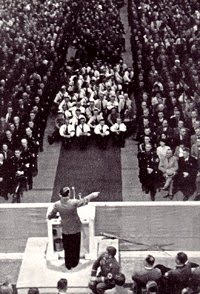 the Nazi Party at Nuremberg that the Czechoslovakian Government was using all of its means possible to annihilate the 3.5 million Sudeten Germans. He claimed that these people were being deprived of their rights, for example, they were not permitted to sing German songs or to wear white stockings. If indeed they went through with any of these crimes they were brutally struck down. Although the tone was ferociously threatening, he gave no examples of atrocities, perhaps because there are none. "The misery of the Sudeten Germans is without end," he declared. He then went on to promise that Germany would take care of her own and put an end to the continued oppression of 3.5 million Germans. "I hope that the foreign statesman will be convinced that these are not mere words," he added ominously.
Hitler has demanded the direct annexation of the Sudetenland by the Reich, hinting that if necessary, he would resort to war. He also has said that the Sudentenland is an internal matter for Germans, and supposedly Central Europeans. It is no place for international statesmen, no doubt referring to Prime Minister Chamberlain.
Thursday, September 11, 2008
Pope Pius XI speaks
"Mark well that in the Catholic Mass, Abraham is our Patriarch and forefather. Anti-Semitism is incompatible with the lofty thought which that fact expresses. It is a movement with which we Christians can have nothing to do. No, no, I say to you it is impossible for a Christian to take part in anti-Semitism. It is inadmissible. Through Christ and in Christ we are the spiritual progeny of Abraham. Spiritually, we [Christians] are all Semites".
The Pope has been published in Mit brennender Sorge a German Catholic encyclical last year condemning Nazi Party policies against the Roman Catholic Church and Judaism.
Beneš appeals to the World for Peace
Wednesday, September 10, 2008
Changes in the German Army Command
 Among all the events of this crisis, there has been a change in the command structure of the German Army. General Ludwig Beck was Oberkommando des Heeres, otherwise known as the Chief of the General Staff of the Army. He seemingly is not any longer after August 27.
General Franz Halder has now become the new Oberkommando des Heeres. He began this post on September 1st. These events are just now being noticed due in part because of the tension in the Sudetenland.
Tuesday, September 9, 2008
Impasse!
Monday, September 8, 2008
German Sudetens protest
Plan No. 4 adds both financial and political concessions such as "states rights to minorities in Sudeten. President Beneš offered to lend a billion Czechoslovak koruny ($35,000,000) "on the most favorable terms" to stimulate industry in Czechoslovak districts now suffering from unemployment, with 700,000,000 koruny earmarked for Sudeten districts. Britain and France stood ready to lend this money to Czechoslovakia, it was understood in Prague, and Dr. Beneš clearly hoped many observers of the Sudeten Germans had been right in reporting recently that what they want is a return to prosperity, not Germany.
Plan No. 4 went further than Plan No. 3 in offering Sudeten Germans and other minority peoples State jobs (including "irremovable judgeships") in the same proportion as their numbers bear to the total population of Czechoslovakia. Moreover, each ministry of the Czechoslovak Cabinet would have a separate "section" corresponding to each minority, and each section would be headed by a member of that minority to guard its interests. As the most fateful concession of Plan No. 4, Dr. Beneš offered that in each minority canton the preservation of order should be "divided" between Federal gendarmerie in the countryside and town police of the Sudeten German or other minority faction.
In Germany, every paper printed atrocity stories describing how a Sudeten German Nazi Deputy had been "horsewhipped" by a Czech mounted policeman at the industrial town of Moravská Ostrava. Mounted police had tried to disperse a Sudeten German crowd which had gathered to demand immediate release from jail of 82 persons arrested for possessing arms smuggled from Germany. The prisoners were charged with preparing to organize an attack from the rear upon troops defending the Czechoslovak frontier in case of war. One blow from a riding crop was afterward proved to have struck, without injuring, a man who turned out to be a Sudeten Deputy. Next day the Czech mounted policeman responsible and two others were withheld from duty by Police Chief Baca, who then suspended himself for good measure. But by this time, German papers were well started on a flood of stories under such scareheads as SAVAGE HORSEWHIPPING OF SUDETEN DEPUTY BY BESTIAL CZECH OFFICER.
The No. 1 Sudeten, Konrad Henlein, was at Nürnberg with Hitler, but in Prague the No. 2 Sudeten, Ernst Kundt, tersely announced that "satisfactory amends" had been made at Moravská Ostrava and he then withdrew the Sudeten Party's previous refusal to negotiate on the basis of Plan No. 4. Obviously they were tempted by the 700,000,000 koruny—for there are only 3,500,000 Sudeten Germans.
Smart Dr. Beneš, although relying on money to do some talking in a situation basically desperate, fully realized that Plan No. 4 impressed millions of Czechoslovaks, apart from the Sudeten Germans, as offering such extreme concessions that it imperiled the State. If accepted, Plan No. 4 risks turning every Cabinet ministry into a debating club of minority groups. How democratic Czech gendarmes and totalitarian Nazi police can "divide" responsibility for keeping of order in Sudeten cantons was an unanswered question. In an impossible situation, under crushing British pressure to concede without limit, President Beneš had conceded so much that he realized some of his own people were becoming scared. To reassure the nation, Dr. Beneš went on the air with a calm, firm and tactful broadcast, only a few minutes after he learned that in a speech at Nuremberg General Göring had just gone out of his way to abuse the culture and traditions of the Czechoslovak Republic.
Sunday, September 7, 2008
Plan No. 4
Roughly, the plan would accede the Sudeten to Germany due to the high amount of Germans in the region. Czechoslovakia has said that ceding this land would cripple the country economically and would put the nation effectively under German control.
Sunday, August 31, 2008
Plan No. 3
Sunday, August 17, 2008
Another Nazi Measure against Jews
The law goes into effect on January 1, 1939.
Saturday, August 16, 2008
Lord Runciman meets Konrad Henlein
Prince Max, although ardently pro-German, keeps his fingers crossed, has a passport which makes him a subject of the Principality of Liechtenstein. Last week he mobilized his villagers, his gamekeepers, his servants and his toddling infants, all of whom gave the Nazi salute as Lord Runciman arrived in formal black jacket, wing collar and black bat tie. Herr Henlein turned up in brown tweed coat, grey flannel slacks and white shoes. Present was the German agent known as "Princess Steffi," who generally operates in London. There she has been hostess to Herr Henlein and to Adolf Hitler's personal agent, Captain Wiedemann (TIME, Aug. 1). From the castle windows the conferees could see the Sudeten Mountains and the German frontier, patrolled unceasingly before their eyes by fighting planes of Czechoslovakia and the Reich. The meeting lasted from 12:30 to 5:45.
Diplomatic rumor had it that "Henlein showed himself most intransigent." But shortly thereafter Herr Henlein assembled his lieutenants in the Hotel Veimar in Marienbad. There he outlined the Sudeten demands anew, clarified along lines suggested by Lord Runciman. Meanwhile, to make the clamorous Henlein minority perhaps less intransigent, Premier Hodza soon after announced he would give choice political plums to Sudeten Germans by appointing them to seven large postmasterships, a district public works superintendency, two district governorships, more jobs in the railroad administration.
Monday, August 11, 2008
Main Synagogue of Nuremberg Destroyed
August 10th, there was a gathering of many Nazis in front of the grand synagogue. The Mayor attended and took part in the rally as well as the Gauleiter Julius Streicher. The rally then turned into a demolition and the synagogue was heavily burned and damaged.
 The Synagogue has been a fixture in the Nuremberg skyline. No response has been lodged by the displaced congregation.
Wednesday, August 6, 2008
Lord Runciman meets with German Sudeten Party members
On the third day the British mediator uncorked his first proposal. He declared that before he could attempt to advise he must understand the problems of Czechoslovakia, must study them for at least a fortnight. Therefore, he proposed that the Government and the Sudetens stop negotiating while he studied.
 To this provisional Pax Runciman they agreed. Instead of discussing the disputed Minorities Statute, the Czechoslovak Parliament met for only 20 minutes—its first meeting since the war crisis was averted on May 21 —then meekly adjourned indefinitely.
Meanwhile, tourist travel to Prague picked up magically overnight. Tourists wolfed tasty Prager ham and downed it with Pilsner beer, convinced that they were safe so long as The Man With the Wrinkled Brow continues his studies.
When U. S. Ambassador to Germany Hugh Wilson, an ace career diplomat, suddenly flew to Prague on what he carefully described as "just a holiday visit" to his friend U. S. Minister to Czechoslovakia Wilbur J. Carr, Czechs were delighted.
They thought his coming was a friendly gesture by President Roosevelt and the State Department, a nudging reminder from Washington to London that the bulk of U. S. public opinion would not be favorable to a Runciman Report so couched as to sell Czechoslovakia down the river. Private Person Wilson was soon received by President Beneš and Premier Hodza, had a talk with Private Person Runciman, insisted he was only vacationing.
Tuesday, August 5, 2008
Lord Runciman remains in Prague
While Viscount Runciman’s staff continues to work in close contact with the Henlein party leaders, the British negotiator in the Czech-Sudeten German dispute confined himself today to purely formal visits.
In the morning he received Premier Milan Hodza and Foreign Minister Kamil Krofta, who were returning the calls he paid on them yesterday. At noon he and Lady Runciman lunched with President Eduard Benes and his wife at Hradschin palace. At Lord Runciman’s wish the luncheon was entirely private.
In the afternoon Lord Runciman received a deputation of German Activists – who support the republic – consisting of Wenzel Jakach, Herr Taub and Herr Rehward. The interview lasted only half an hour, in contrast with the hour and a half the Henleinist leaders spent with Lord Runciman yesterday, followed by a late night conference with his staff.
These meetings were held at the Alcron Hotel. Tomorrow the Henleinist leaders again will have long conferences with Lord Runciman’s staff.
Last night they put forward the sensational demands advanced by Konrad Henlein in his Karlsbad speech April 24, when he proclaimed himself and his movement purely Nazi. The Henleinist delegates further explained to Lord Runciman’s staff the meaning of the party’s memorandum embodying most of the Karlsbad demands that was presented to the government June 7.
Incidentally, it is reported that the Committee of Political Ministers is drawing up an answer to the Henlein party’s memorandum.
The German Activist representatives deliberately refrained from bombarding Lord Runciman with documentary propaganda. They left it entirely to the British negotiator to say whether or not he wished further contact with them and advice from them. They told him that if he wished to hear the democratic German viewpoint they would be glad to draw up a memorandum next week and he requested that they do so.
They further offered to show him any industrial center in the Sudeten area that he wished to see, to enable him to “see for himself that the Sudeten Germans can do a good day’s hard work as well as conduct political agitation.”
Lord Runciman thanked them and said that he would consider their suggestion when he drew up his program of visits.
Lord Runciman is leaving Prague for a week-end in the Sudeten area and it is understood that he will pay a personal visit to a big German landowner. His staff refused all information tonight as to whom he would visit.
The German press and radio propaganda campaign in connection with the flight of two Czech planes over Glatz in German territory Wednesday is described as the most violent of all those launched against this country, not excepting the campaign in the days preceding May 21, when Czechoslovakia called reserves to the border.
The press reminds Germany that there have been many cases of German pilots flying as far as Pilsen without any Czech press campaign being launched against Germany. It is a fact the there are constant violations of the Czech frontier by German planes, which it is thought wiser here not to make the subject of protests nor even to allow mentioned [sic] in the press.
The extraordinary violence of the present German campaign gives rise to suspicions that there is truth in reports of large military concentrations around Glatz that have been received here in the last week.
Glatz is situated in a German “peninsula” almost entirely surrounded by Czechoslovak territory and it is quite conceivable that pilots flying over Czechoslovakia could make a mistake and cross the German line there.
The Prague radio replied to the German propaganda tonight in the form of an official communiqué giving three cases in which German pilots, giving the same excuse as the Germans refused to accept in the Galtz case – poor visibility – actually landed in Czechoslovak reserved military areas during the last two months.
Monday, August 4, 2008
England sends Lord Runciman to Prague
His first day has so far involved a meeting with the Czechoslovakian President. He will be meeting with German Sudetens and other involved parties before returning to England and the British Prime Minister, Neville Chamberlain.