Monday, September 22, 2008
Hodza Resigns

Hitler's New Demands are Rejected
Hitler makes new Demands
Czechoslovakia Capitulates
Despite this, crowds of Czechs gathered in Prague demanding Czechoslovakian troops remain in the Sudetenland. This seems all for not since the presence of German troops on the border and a promise of invasion would bring a very swift war.
Sunday, September 21, 2008
The Soviet Union talks War
Litvinoff included in his speech that the Soviet War Department was ready to discuss military plans with France. The Soviet Union it seems is ready to back up its ally Czechoslovakia.
Saturday, September 20, 2008
The Czechoslovakian Response
At the same time, Prime Minister Chamberlain travelled for his second meeting with Hitler in BadGodesburg. A joint declaration has been issued by both the French and British governments telling Czechoslovakia to capitulate to the German demands in 24 hours else face invasion.
Friday, September 19, 2008
Details of the Agreement
This would effectively end the Czechoslovakian nation as we know it.
Thursday, September 18, 2008
Hodza talks tough
 Earlier today, the Premier of Czechoslovakia Milan Hodza announced on Czechoslovakian radio that if a plebiscite were agreed between Germany and Great Britain, it would be unacceptable to his government. He also said that if it did indeed come down to it, Czechoslovakia would go alone against Hitler and the Nazis.
Italy's own Benito Mussolini also chimed in that if there were to be a plebiscite there should be one for all races within Czechoslovakia.
At that time, Chamberlain had returned from Bertesgaden meeting with Hitler. Many assume there was a plebiscite agreed upon between Hitler and Chamberlain. Chamberlain is now discussing the situation with French Prime Minister Deladier in London.
Wednesday, September 17, 2008
Lord Runciman returns from Prague
The situation in the Sudetenland remains as untenable as possible.
Tuesday, September 16, 2008
Chamberlain visits with Hitler; Henlein's Flight
But not before all talks between Henlein and the Czechoslovakian Government completely end. Sudeten
 Party leader Konrad Helein had laid out an ultimatum to rescind Martial Law, recall the reserves to their barracks, withdraw the state police from the territory, and accept this by midnight or all negotiations would be called off. When his demands were not met, he fled to Germany.
 With all this continuing to worsen, Nazi radio and Czechoslovakian radio transmissions have been having their own war of words. Even Hungary has joined in and reiterated Germany's narrative on events. Czechoslovakian radio continues to refute the claims made by Germany.
Monday, September 15, 2008
Martial Law in Sudetenland
Saturday, September 13, 2008
Hitler rattles more sabres
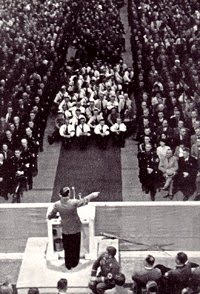 the Nazi Party at Nuremberg that the Czechoslovakian Government was using all of its means possible to annihilate the 3.5 million Sudeten Germans. He claimed that these people were being deprived of their rights, for example, they were not permitted to sing German songs or to wear white stockings. If indeed they went through with any of these crimes they were brutally struck down. Although the tone was ferociously threatening, he gave no examples of atrocities, perhaps because there are none. "The misery of the Sudeten Germans is without end," he declared. He then went on to promise that Germany would take care of her own and put an end to the continued oppression of 3.5 million Germans. "I hope that the foreign statesman will be convinced that these are not mere words," he added ominously.
Hitler has demanded the direct annexation of the Sudetenland by the Reich, hinting that if necessary, he would resort to war. He also has said that the Sudentenland is an internal matter for Germans, and supposedly Central Europeans. It is no place for international statesmen, no doubt referring to Prime Minister Chamberlain.
Thursday, September 11, 2008
Pope Pius XI speaks
"Mark well that in the Catholic Mass, Abraham is our Patriarch and forefather. Anti-Semitism is incompatible with the lofty thought which that fact expresses. It is a movement with which we Christians can have nothing to do. No, no, I say to you it is impossible for a Christian to take part in anti-Semitism. It is inadmissible. Through Christ and in Christ we are the spiritual progeny of Abraham. Spiritually, we [Christians] are all Semites".
The Pope has been published in Mit brennender Sorge a German Catholic encyclical last year condemning Nazi Party policies against the Roman Catholic Church and Judaism.
Beneš appeals to the World for Peace
Wednesday, September 10, 2008
Changes in the German Army Command
 Among all the events of this crisis, there has been a change in the command structure of the German Army. General Ludwig Beck was Oberkommando des Heeres, otherwise known as the Chief of the General Staff of the Army. He seemingly is not any longer after August 27.
General Franz Halder has now become the new Oberkommando des Heeres. He began this post on September 1st. These events are just now being noticed due in part because of the tension in the Sudetenland.
Tuesday, September 9, 2008
Impasse!
Monday, September 8, 2008
German Sudetens protest
Plan No. 4 adds both financial and political concessions such as "states rights to minorities in Sudeten. President Beneš offered to lend a billion Czechoslovak koruny ($35,000,000) "on the most favorable terms" to stimulate industry in Czechoslovak districts now suffering from unemployment, with 700,000,000 koruny earmarked for Sudeten districts. Britain and France stood ready to lend this money to Czechoslovakia, it was understood in Prague, and Dr. Beneš clearly hoped many observers of the Sudeten Germans had been right in reporting recently that what they want is a return to prosperity, not Germany.
Plan No. 4 went further than Plan No. 3 in offering Sudeten Germans and other minority peoples State jobs (including "irremovable judgeships") in the same proportion as their numbers bear to the total population of Czechoslovakia. Moreover, each ministry of the Czechoslovak Cabinet would have a separate "section" corresponding to each minority, and each section would be headed by a member of that minority to guard its interests. As the most fateful concession of Plan No. 4, Dr. Beneš offered that in each minority canton the preservation of order should be "divided" between Federal gendarmerie in the countryside and town police of the Sudeten German or other minority faction.
In Germany, every paper printed atrocity stories describing how a Sudeten German Nazi Deputy had been "horsewhipped" by a Czech mounted policeman at the industrial town of Moravská Ostrava. Mounted police had tried to disperse a Sudeten German crowd which had gathered to demand immediate release from jail of 82 persons arrested for possessing arms smuggled from Germany. The prisoners were charged with preparing to organize an attack from the rear upon troops defending the Czechoslovak frontier in case of war. One blow from a riding crop was afterward proved to have struck, without injuring, a man who turned out to be a Sudeten Deputy. Next day the Czech mounted policeman responsible and two others were withheld from duty by Police Chief Baca, who then suspended himself for good measure. But by this time, German papers were well started on a flood of stories under such scareheads as SAVAGE HORSEWHIPPING OF SUDETEN DEPUTY BY BESTIAL CZECH OFFICER.
The No. 1 Sudeten, Konrad Henlein, was at Nürnberg with Hitler, but in Prague the No. 2 Sudeten, Ernst Kundt, tersely announced that "satisfactory amends" had been made at Moravská Ostrava and he then withdrew the Sudeten Party's previous refusal to negotiate on the basis of Plan No. 4. Obviously they were tempted by the 700,000,000 koruny—for there are only 3,500,000 Sudeten Germans.
Smart Dr. Beneš, although relying on money to do some talking in a situation basically desperate, fully realized that Plan No. 4 impressed millions of Czechoslovaks, apart from the Sudeten Germans, as offering such extreme concessions that it imperiled the State. If accepted, Plan No. 4 risks turning every Cabinet ministry into a debating club of minority groups. How democratic Czech gendarmes and totalitarian Nazi police can "divide" responsibility for keeping of order in Sudeten cantons was an unanswered question. In an impossible situation, under crushing British pressure to concede without limit, President Beneš had conceded so much that he realized some of his own people were becoming scared. To reassure the nation, Dr. Beneš went on the air with a calm, firm and tactful broadcast, only a few minutes after he learned that in a speech at Nuremberg General Göring had just gone out of his way to abuse the culture and traditions of the Czechoslovak Republic.
Sunday, September 7, 2008
Plan No. 4
Roughly, the plan would accede the Sudeten to Germany due to the high amount of Germans in the region. Czechoslovakia has said that ceding this land would cripple the country economically and would put the nation effectively under German control.
Sunday, August 31, 2008
Plan No. 3
Sunday, August 17, 2008
Another Nazi Measure against Jews
The law goes into effect on January 1, 1939.